组成图示
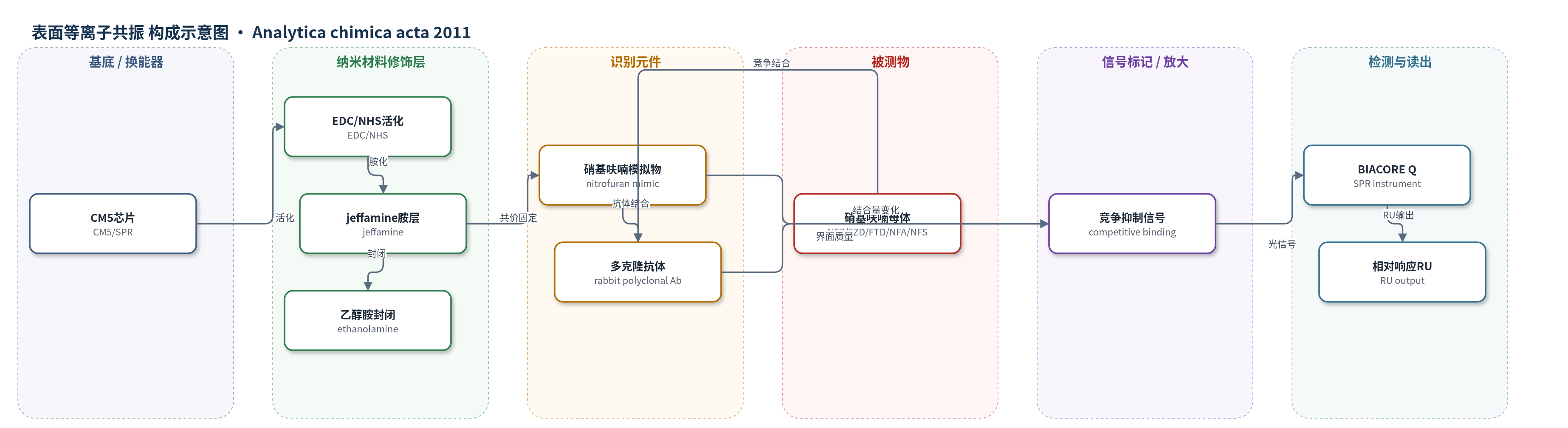
点击图片查看大图 · 依据论文自动绘制
传感器类型
表面等离子共振(SPR)生物传感器
检测对象
硝基呋喃母体化合物(nitrofurans:nitrofurazone NFZ、furazolidone FZD、furaltadone FTD、nitrofurantoin NFA、nifursol NFS);样品基质:禽类全眼(avian eyes,含视网膜、玻璃体、房水等)
检测原理
CM5芯片表面经EDC/NHS活化并用jeffamine形成胺层,再共价固定硝基呋喃模拟物,形成竞争型免疫SPR传感界面。兔多克隆抗体可识别硝基呋喃母体化合物;样品中硝基呋喃与芯片上固定的模拟物竞争结合抗体,使抗体-模拟物结合量下降。BIACORE Q通过表面等离子共振实时监测界面质量变化,输出相对响应RU。被测物浓度越高,竞争越强,RU越低,因此信号与硝基呋喃浓度呈反向关系。方法无需酶标或化学放大,依靠抗体交叉反应实现多种硝基呋喃母体化合物的快速筛查。
检测灵敏度
CCα: <1 ng eye−1 (NFZ);FZD/FTD/NFA: <1.0 ng eye−1;NFS: <5.0 ng eye−1
效应效果
方法按欧盟验证要求对21份加标禽眼样品进行验证,NFZ的CCα低于1 ng/眼,并可检测FZD、FTD、NFA(<1.0 ng/眼)和NFS(<5.0 ng/眼)。交叉反应谱显示抗体对5种主要硝基呋喃母体有显著交叉反应,对nitrovin无交叉反应。批内变异在1和2 ng/眼NFZ时分别为12.9%和10.1%,批间变异为10.8%和4.7%。芯片表面稳定,12 h内可处理24份样品。实际样品中,5只饲喂NFZ鸡的眼部筛查均高于1 ng/眼,对应肝脏LC-MS/MS确认半胱胺代谢物>5 ng/g;未用药鸡两种方法均合规。该方法为快速、通用筛查工具,但不能区分具体硝基呋喃种类。
传感器的构成
- 基底/换能器:CM5传感器芯片(羧甲基葡聚糖表面,BIACORE Q SPR换能)
- 活化层:EDC/NHS(活化羧甲基葡聚糖羧基,形成活性酯)
- 胺修饰层:jeffamine(形成稳定胺表面,用于共价固定模拟物)
- 封闭层:乙醇胺(封闭未反应位点,降低非特异结合)
- 捕获/识别元件:硝基呋喃模拟物3-(5-nitro-2-furyl) acrylic acid(固定于芯片,作为竞争结合位点)
- 识别元件:兔多克隆抗体(抗硝基呋喃模拟物-卵白素免疫原,识别硝基呋喃母体)
- 分析缓冲液:HEPES/NaCl/EDTA/Tween 20(维持抗体结合与SPR信号稳定)
中文摘要
本研究开发了一种用于禽类眼睛中多种硝基呋喃化合物多残留筛查的免疫生物传感器方法。以硝基呋喃模拟物-蛋白偶联物免疫兔,获得可结合至少5种主要硝基呋喃母体化合物的多克隆抗体。样品匀浆用0.1 mol/L盐酸提取,经固相萃取和微离心净化后进行生物传感器分析。对21份加标样品的验证表明,该方法对呋喃西林(NFZ)的检测能力(CCα)低于1 ng/眼。交叉反应数据和少量加标样品分析表明,该方法还可检测呋喃唑酮(FZD)、呋喃它酮(FTD)、呋喃妥因(NFA)和尼曲索(NFS)等主要硝基呋喃母体化合物。批内变异(n=10)在1和2 ng/眼NFZ时分别为12.9%和10.1%;批间变异(n=3)分别为10.8%和4.7%。文中还报道了交叉反应谱、验证数据以及少量实际样品分析结果。
英文摘要
An immunobiosensor assay was developed for the multi-residue screening of a range of nitrofuran compounds in avian eyes. A polyclonal antibody which binds at least 5 of the major parent nitrofurans was raised in a rabbit after inoculation with a nitrofuran mimic-protein conjugate. Sample homogenates were extracted into 0.1M hydrochloric acid and subjected to clean-up by solid phase extraction and micro-centrifugation prior to biosensor analysis. Validation data obtained from the analysis of 21 fortified samples has shown that the method has a detection capability (CCβ) of less than 1 ng eye(-1) for nitrofurazone (NFZ). In addition, cross-reactivity data and the analysis of a smaller number of fortified samples have shown that the method will also detect a range of other major parent nitrofurans including furazolidone (FZD), furaltadone (FTD), nitrofurantoin (NFA) and nifursol (NFS). Intra-assay variation (n=10) was calculated at 12.9% and 10.1% at concentrations of 1 ng eye(-1) and 2 ng eye(-1) NFZ respectively. Inter-assay variation (n=3) was determined to be 10.8% and 4.7% at the same NFZ concentrations respectively. The cross-reactivity profile and validation data for the detection of these nitrofurans are presented together with the results obtained following the analysis of a small number of incurred samples using the developed method.