组成图示
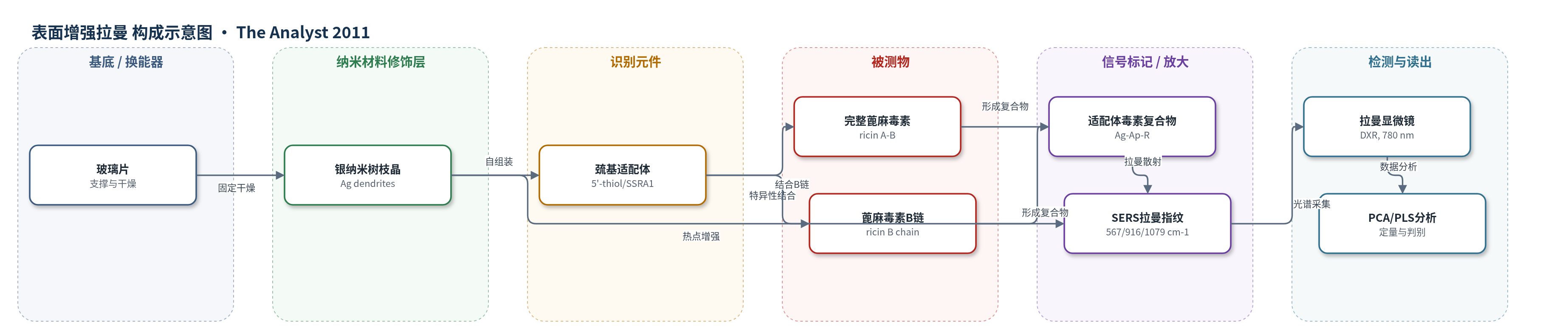
点击图片查看大图 · 依据论文自动绘制
传感器类型
表面增强拉曼(SERS)生物传感器
检测对象
蓖麻毒素B链(ricin B chain)、完整蓖麻毒素A–B复合物(intact ricin / ricin A–B complex);样品基质:PBS、苹果汁、橙汁、柠檬水、2%牛奶等液态食品基质
检测原理
SSRA1的5'端引入巯基后,通过硫醇–银相互作用自组装到银纳米树枝晶表面,形成Ag–Ap SERS基底。完整蓖麻毒素的B链与适配体特异性结合,形成Ag–Ap–R复合物,使纳米界面附近的分子组成、构象和局部电磁场环境发生变化。在780 nm激光激发下,蓖麻毒素及适配体–银复合物的拉曼散射被纳米粗糙银表面显著增强,产生可区分的分子指纹峰,如567、916和1079 cm−1。随着蓖麻毒素浓度升高,特征峰强度变化,0–50 ng/mL范围内可用PLS模型定量;高于50 ng/mL时可能因适配体结合饱和出现钩状效应。该策略无需酶或荧光标记,依靠SERS纳米热点放大和化学计量识别实现检测。
检测灵敏度
LOD: 25 ng mL−1;线性范围: 0–50 ng mL−1;ELISA检测范围: 31.2–500 ng mL−1(blocking buffer,SSRA1);苹果汁: 62.5–500 ng mL−1;柠檬水: 7.8–500 ng mL−1
效应效果
SSRA1在4–63 °C保持单一稳定折叠(ΔG = −5.05),在pH 2–7液态食品中仍能结合蓖麻毒素B链。磁珠法可从PBS、苹果汁、橙汁、柠檬水和2%牛奶中浓缩至少100 ng/mL B链(部分低至30 ng/mL),金电纺纤维法可浓缩250 ng/mL。ELISA中SSRA1在PBS的Kd为5 nM,优于C5的70 nM;blocking buffer检测范围31.2–500 ng/mL,与商品ELISA相当,但在苹果汁和柠檬水中分别达62.5–500和7.8–500 ng/mL,商品试剂盒无法检测。SERS法可检测25 ng/mL完整蓖麻毒素,PCA可区分Ag–Ap、Ag–R和Ag–Ap–R;两步法可区分天然与失活蓖麻毒素。未报告RSD和回收率百分比。
传感器的构成
- 支撑基底:玻璃片(glass slide),用于固定并干燥银纳米树枝晶–适配体复合物,供拉曼成像
- SERS增强基底:银纳米树枝晶(Ag dendrites),由锌置换硝酸银(AgNO3)制备,提供纳米粗糙贵金属表面与拉曼增强热点
- 识别元件:5'-巯基修饰SSRA1适配体(5'-thiol/SSRA1),通过硫醇自组装结合到Ag表面,特异性识别蓖麻毒素B链/完整蓖麻毒素
- 信号标记物:无外源标记,SERS直接读取蓖麻毒素/适配体–银复合物的拉曼指纹(如567、916、1079 cm−1)
- 洗涤介质:双蒸水(double distilled water),用于洗涤Ag–SSRA1复合物并降低非特异残留
- 读出系统:DXR拉曼显微镜(DXR Raman microscope,780 nm激发)与TQ Analyst/PCA/PLS分析,输出光谱变化与定量模型
中文摘要
利用微生物或毒素作为生物恐怖武器的威胁日益隐蔽,食品供应链是重要传播途径。蓖麻毒素来自蓖麻籽,热稳定性强,在酸性和碱性条件下仍保持活性,被美国疾控中心列为B类生物威胁试剂。现有蓖麻毒素检测方法依赖酶活性、免疫反应或蓖麻DNA,常受复杂食品基质干扰,动态范围有限且特异性不足。适配体是具有高亲和力和低交叉反应性的短RNA或单链DNA序列,正被开发用于食品生物传感器。本文通过SELEX筛选并表征了针对蓖麻毒素B链的单一主导DNA适配体SSRA1。SSRA1具有一个在4–63 °C范围内稳定的折叠构象(ΔG = −5.05),能从多种液态食品基质中浓缩至少30 ng/mL的蓖麻毒素B链,并在检测性能上优于现有ELISA试剂盒和已报道的蓖麻毒素适配体。此外,SSRA1与表面增强拉曼散射技术联用可检测25 ng/mL的完整蓖麻毒素A–B复合物。因此,SSRA1可作为液态食品中蓖麻毒素的前处理富集工具,也可作为直接检测传感器。
英文摘要
The use of microorganisms or toxins as weapons of death and fear is not a novel concept; however, the modes by which these agents of bioterrorism are deployed are increasingly clever and insidious. One mechanism by which biothreats are readily disseminated is through a nation's food supply. Ricin, a toxin derived from the castor bean plant, displays a strong thermostability and remains active at acidic and alkaline pHs. Therefore, the CDC has assigned ricin as a category B reagent since it may be easily amendable as a deliberate food biocontaminate. Current tools for ricin detection utilize enzymatic activity, immunointeractions and presence of castor bean DNA. Many of these tools are confounded by complex food matrices, display a limited dynamic range of detection and/or lack specificity. Aptamers, short RNA and single stranded DNA sequences, have increased affinity to their selected receptors, experience little cross-reactivity to other homologous compounds and are currently being sought after as biosensors for bacterial contaminants in food. This paper describes the selection and characterization of a single, dominant aptamer, designated as SSRA1, against the B-chain of ricin. SSRA1 displays one folding conformation that is stable across 4-63 °C (ΔG = -5.05). SSRA1 is able to concentrate at least 30 ng mL(-1) of ricin B chain from several liquid food matrices and outcompetes a currently available ELISA kit and ricin aptamer. Furthermore, we show detection of 25 ng mL(-1) of intact ricin A-B complex using SSRA1 combined with surface enhanced Raman scattering technique. Thus, SSRA1 would serve well as pre-analytical tool for processing of ricin from liquid foods to aid current diagnostics as well as a sensor for direct ricin detection.