组成图示
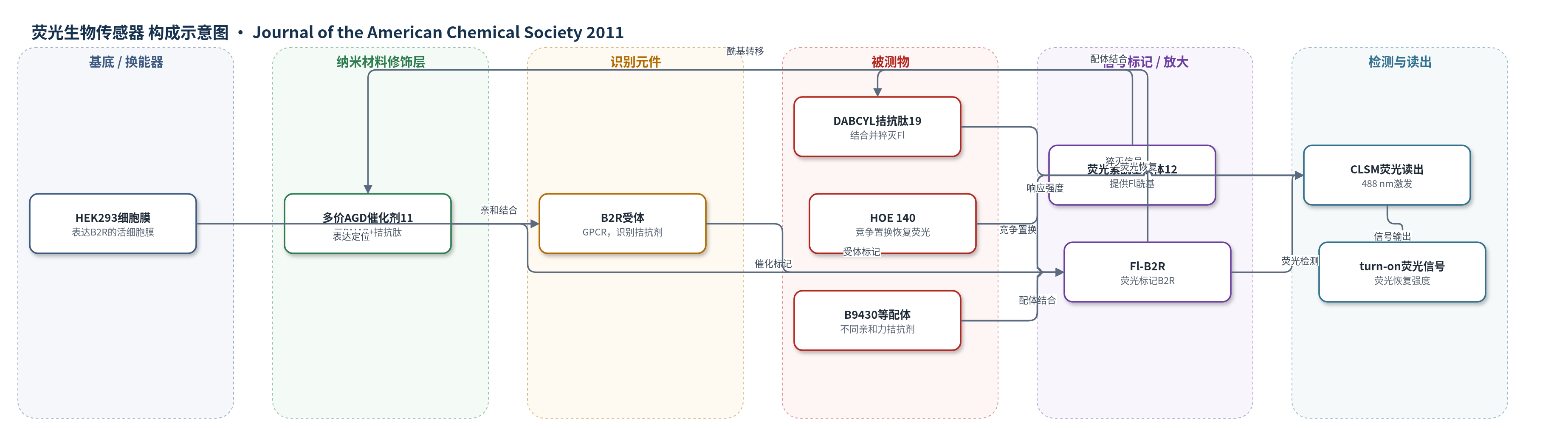
点击图片查看大图 · 依据论文自动绘制
传感器类型
荧光生物传感器
检测对象
B2R拮抗剂配体(HOE 140、B9430、DArg0[Hyp3, DPhe7, Leu8]BK、des-Arg9-BK、Lys-des-Arg9-BK),样品基质:HEK293细胞培养液/细胞表面
检测原理
多价AGD催化剂11通过B2R拮抗肽结合到活细胞表面B2R,三个DMAP基团提高局部催化效率。DMAP活化荧光素型酰基供体12,形成N-酰基吡啶鎓中间体,将荧光素共价酰化到B2R配体结合口袋附近的亲核氨基酸(如Lys/Tyr),生成Fl-B2R。随后加入DABCYL标记拮抗肽19,其非共价结合B2R使DABCYL靠近Fl,发生双分子荧光猝灭(BFQR),荧光下降。待测拮抗剂(如HOE 140)竞争置换19,使DABCYL远离Fl,荧光恢复,形成turn-on响应。荧光恢复幅度与配体亲和力和浓度相关,可用于GPCR配体筛选。
检测灵敏度
原文未报告LOD、线性范围、灵敏度斜率或R^2。
效应效果
多价DMAP使体外酰化效率提高:congerin II 3.6/4.6倍,SH2域6.7/17.2倍,FKBP12 4.7/11.5倍,三价FKBP12 15 min约90%标记。活细胞B2R 30 min达平台,约85%表面B2R被标记,单价60 min几乎无标记。过量HOE 140或无催化剂无荧光,Western blot仅见单一生物素化B2R带,Ca2+信号基本不变,细胞形态无显著变化。BFQR中DABCYL配体猝灭Fl-B2R,HOE 140恢复荧光,saralasin几乎无响应,B9430强恢复,低亲和配体无响应,亲和顺序与文献一致,可用于GPCR配体筛选。
传感器的构成
- 基底/换能平台:HEK293细胞膜(表达人源B2R,GPCR),作为活细胞表面受体定位与荧光信号载体
- 识别元件:B2R(bradykinin B2 receptor),识别并区分不同B2R拮抗剂配体
- 亲和引导催化层:多价AGD催化剂11(含三个DMAP基团和B2R拮抗肽DArg0[Hyp3, DPhe7, Leu8]BK),结合B2R并介导酰基转移
- 酰基供体/标记前体:荧光素型酰基供体12(fluorescein-type acyl donor),提供荧光素酰基
- 信号标记物:荧光素(fluorescein, Fl),共价连接至B2R配体结合口袋附近,形成Fl-B2R
- 猝灭配体:DABCYL标记B2R拮抗肽19(DABCYL-appended antagonist),结合Fl-B2R引起荧光猝灭
- 竞争/检测配体:HOE 140、B9430等B2R拮抗剂,置换DABCYL配体并恢复荧光
- 读出装置:共聚焦激光扫描显微镜(CLSM),检测488 nm激发下的荧光强度变化
中文摘要
催化剂有望作为化学蛋白质修饰工具,但催化剂或催化反应在蛋白质中的应用近期才开始,主要限于体外。通过显著改进我们此前报道的亲和引导DMAP(4-二甲基氨基吡啶,AGD)催化剂,本文发展了一种基于有机催化剂的新方法,可在活细胞表面受体蛋白上实现特异性化学酰化。催化剂由一组多价DMAP基团(酰基转移催化剂)与靶蛋白特异性配体融合而成。体外实验清楚表明,催化剂多价性可显著提高三种不同蛋白(congerin II、Src同源2(SH2)结构域和FKBP12)标记中的蛋白酰化效率。利用多价AGD催化剂和含选定探针的优化酰基供体,成功在活细胞表面选择性化学标记缓激肽B2受体(B2R,一种G蛋白偶联受体)。此外,该工具可构建基于膜蛋白(B2R)的荧光生物传感器,其荧光在拮抗剂配体结合时增强(开启)。该生物传感器可用于细胞环境中强效药物候选物的快速定量筛选与检测。亲和引导多价催化剂的设计概念将促进多种基于催化剂的蛋白质修饰工具开发,为有机化学在生物研究中的应用提供新机遇。
英文摘要
Catalysts hold promise as tools for chemical protein modification. However, the application of catalysts or catalyst-mediated reactions to proteins has only recently begun to be addressed, mainly in in vitro systems. By radically improving the affinity-guided DMAP (4-dimethylaminopyridine) (AGD) catalysts that we previously reported (Koshi, Y.; Nakata, E.; Miyagawa, M.; Tsukiji, S.; Ogawa, T.; Hamachi, I. J. Am. Chem. Soc. 2008, 130, 245.), here we have developed a new organocatalyst-based approach that allows specific chemical acylation of a receptor protein on the surface of live cells. The catalysts consist of a set of 'multivalent' DMAP groups (the acyl transfer catalyst) fused to a ligand specific to the target protein. It was clearly demonstrated by in vitro experiments that the catalyst multivalency enables remarkable enhancement of protein acylation efficiency in the labeling of three different proteins: congerin II, a Src homology 2 (SH2) domain, and FKBP12. Using a multivalent AGD catalyst and optimized acyl donors containing a chosen probe, we successfully achieved selective chemical labeling of bradykinin B(2) receptor (B(2)R), a G-protein coupled receptor, on the live cell-surface. Furthermore, the present tool allowed us to construct a membrane protein (B(2)R)-based fluorescent biosensor, the fluorescence of which is enhanced (tuned on) in response to the antagonist ligand binding. The biosensor should be applicable to rapid and quantitative screening and assay of potent drug candidates in the cellular context. The design concept of the affinity-guided, multivalent catalysts should facilitate further development of diverse catalyst-based protein modification tools, providing new opportunities for organic chemistry in biological research.