组成图示
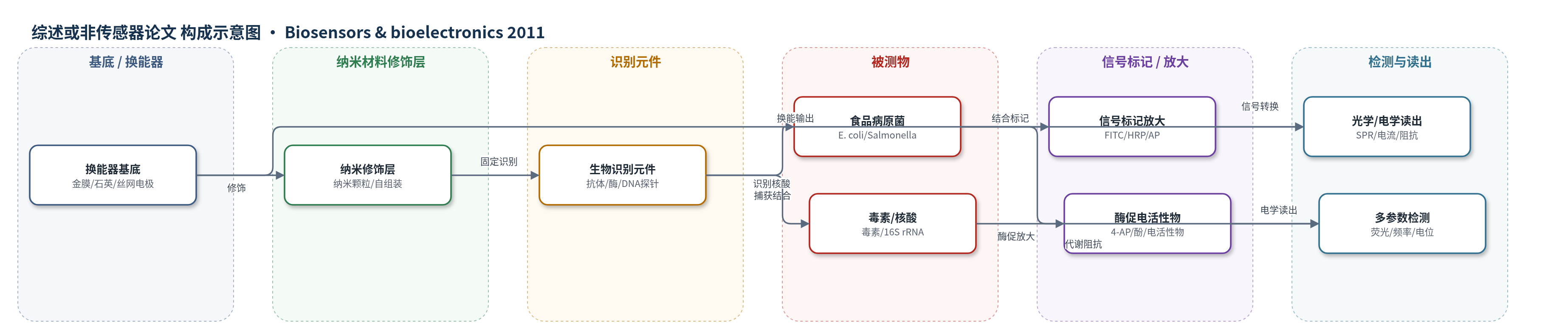
点击图片查看大图 · 依据论文自动绘制
传感器类型
综述或非传感器论文
检测对象
大肠杆菌O157:H7 (E. coli O157:H7)、沙门氏菌 (Salmonella spp.)、单核细胞增生李斯特菌 (Listeria monocytogenes)、金黄色葡萄球菌 (Staphylococcus aureus)、弯曲杆菌 (Campylobacter jejuni)、肉毒毒素 (botulinum toxin)、葡萄球菌肠毒素 (staphylococcal enterotoxin);样品基质:食品、水样、土壤、粪便/临床样本
检测原理
本文综述的食品病原生物传感器通常由换能器、生物识别元件和信号放大模块组成。识别事件包括抗体-抗原结合、核酸探针杂交、酶-底物反应或全细胞代谢;结合后引起界面质量、电荷、阻抗、折射率或光学性质变化。SPR通过病原结合导致共振波长红移,QCM通过质量增加使振荡频率下降,电化学传感器通过酶标产物或代谢物在电极上氧化还原产生电流/电位/阻抗变化,光学传感器通过荧光或光散射强度变化输出信号。信号放大常采用HRP/AP催化底物生成电活性或荧光产物、生物素-链霉亲和素多级结合、磁性纳米颗粒富集以及纳米材料增强,使信号随病原或毒素浓度增加而增强。
检测灵敏度
综述未报道统一LOD;代表性LOD: 10 CFU E. coli O157:H7;0.5 ng μL−1 (16 fmol) E. coli RNA;0.75 nM;6 CFU/mL (milk);26 CFU/mL (apple juice);10 cells/mL;10^1–10^2 CFU mL−1
效应效果
综述指出,生物传感器相比传统培养、PCR和免疫分析具有快速、实时、便携、可现场使用和可多路检测的优势。部分阻抗免疫传感器响应时间小于1 min,RNA/DNA微阵列可在25–27 min内完成自动化检测,SPE-AP DNA传感器总分析时间小于1 h,LAPS系统可在1.5 h内检测10 cells/mL,DCT传感器6 min内检测B. cereus且可从混合芽孢杆菌中区分目标菌。检测限可覆盖CFU/mL、fM、fg级,适用于食品、水样、土壤和临床样本。原文未系统报道稳定性、重现性和回收率;作者认为多阵列生物传感器最有前景,但现有方法仍受灵敏度、成本和样品前处理限制。
传感器的构成
- 综述范围:光学、SPR、压电、全细胞、电化学、阻抗等换能器,用于食品病原检测
- 换能器层:金膜、石英晶体、丝网印刷Au/Pt/C电极、ISFET/LAPS硅芯片,用于光电/压电/电学信号转换
- 识别元件层:抗体、酶、DNA/RNA探针、适配体、全细胞,用于特异性捕获病原或毒素
- 信号标记层:FITC、HRP、AP、生物素-链霉亲和素、磁性纳米颗粒,用于荧光/酶促/磁分离信号放大
- 应用基质:食品、水样、土壤、粪便/临床样本,用于实际病原检测
中文摘要
食品安全是健康生活的根本前提,免受微生物和化学交叉污染的食品具有更高的卫生与营养价值。通过食品传播的感染性疾病已成为全球数百万人面临的致命问题,食品或食品产品是超过250种已知疾病的重要传播媒介。仅在美国,每年即有7600万例食源性疾病、32500例住院和5000例死亡,专家估计食源性疾病年经济损失约50–60亿美元。因此,迫切需要开发快速、可靠、准确的方法,用于食品源病原体的直接检测与鉴定。本文综述了基于微生物的生物传感方法,包括光学、表面等离子共振(SPR)、安培、电位、全细胞、电化学、阻抗和压电等传感技术,用于食品源病原体的快速检测。文章重点讨论了从分析物识别到潜在生物传感器构型设计的主要概念、应用与实例,并展望了生物传感器研究在保障新鲜健康食品方面的未来趋势。
英文摘要
The wholesomeness of food is the real proviso for healthy life. Food freed from microbial and chemical cross-contaminations adds on to its hygienic and nutritive value. Infectious diseases spreading every day through food have become a life-threatening problem for millions of people around the world. Food or food products are the potent transmitting agent of more than 250 known diseases. So far only in the United States, 76 million cases of food-borne illness, 32,500 cases of hospitalization and 5000 cases per annum of mortality are recognized. Health expert's estimate that the yearly cost of all the food borne diseases is approximately $5-6 billion. There is therefore, is an urgent need for the development of rapid, competent, and reliable methods for direct detection and identification of foodborne brown pathogens. In this overview, we have concentrated specifically on microbe-based biosensing methods such as optical, surface plasmon resonance (SPR), amperometric, potentiometric, whole-cell, electrochemical, impedimetric, piezoelectric for the rapid detection of food borne pathogens. Furthermore, we have focused our attention on the discussion of principal concepts, applications, and examples from analyte to the configuration of potential biosensors that have been achieved up until now to detect potential foodborne pathogens. The article presents foreseeable future trends in biosensor research activities for paving the way for fresh and healthy food proposal.