组成图示
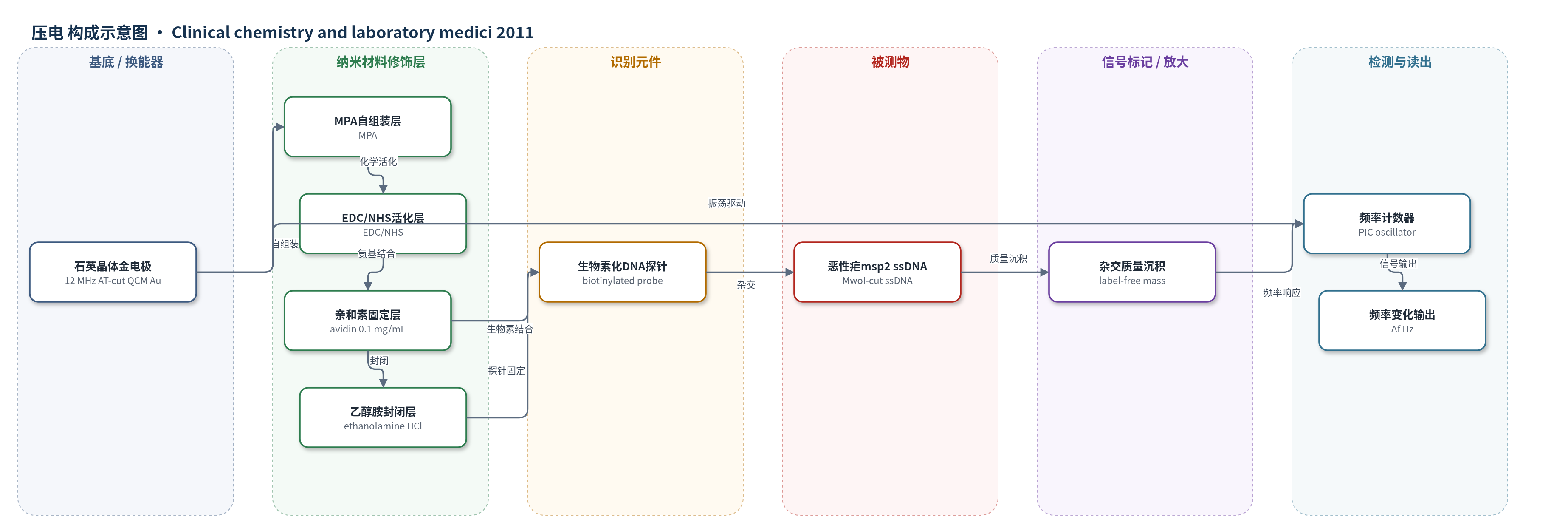
点击图片查看大图 · 依据论文自动绘制
传感器类型
压电(QCM)生物传感器
检测对象
恶性疟原虫(Plasmodium falciparum)msp2基因DNA(PCR扩增并经MwoI酶切后的单链DNA片段);样品基质:感染血液/滤纸血样提取的DNA、实验室培养株DNA
检测原理
QCM金表面经MPA自组装、EDC/NHS活化后固定avidin,并用乙醇胺封闭;生物素化msp2探针通过avidin-biotin结合固定。样品中msp2 block 3经PCR扩增、MwoI酶切和热变性,得到适合杂交的单链DNA片段。目标ssDNA与探针杂交后,在传感器表面沉积质量,依据Sauerbrey方程使石英共振频率下降。频率变化随目标DNA质量/浓度增加而增大,0–25 ng/mL呈线性,25–250 ng/mL饱和。该方法无标记、无酶促信号放大,酶切主要用于缩短片段并区分FC27/IC1等位家族。
检测灵敏度
LOD: 0.025 ng/mL;线性范围: 0–25 ng/mL
效应效果
该传感器对恶性疟原虫具有高度特异性:11例临床样本中,单纯或混合感染 P. falciparum 的样本均出现显著频率变化,而 P. vivax 样本(3、11号)频率变化<10 Hz,与阴性对照无显著差异。基因分型方面,K1(FC27)与3D7(IC1)杂交频率变化分别为89±7 Hz和36.67±5.51 Hz,差异显著(p<0.05)。室温密封保存180 d后诊断与分型能力无显著变化。作者认为其灵敏度与PCR等分子方法可比,且石英晶体双面可用,成本降低50%,适合现场应用。
传感器的构成
- 基底/换能器:12 MHz AT-cut石英晶体,双面4 mm金电极(0.1257 cm2),提供压电振荡与质量传感。
- 表面清洗层:热piranha solution(H2O2 30%、H2SO4 70%,1:3)清洗金表面,提高后续自组装洁净度。
- 自组装修饰层:3-mercaptopropionic acid(MPA,10 mM)在金表面形成含羧基的自组装单分子层。
- 化学活化层:EDC(1-ethyl-3(3-dimethylaminopropyl) carbodiimide hydrochloride,20 mM)与NHS(N-hydroxysuccinimide,50 mM)活化羧基,形成NHS酯以结合avidin氨基。
- 蛋白固定层:avidin(0.1 mg/mL)通过氨基结合于活化表面,提供生物素结合位点。
- 封闭层:ethanolamine hydrochloride(1 mM)封闭非特异性结合位点。
- 识别元件:biotinylated DNA probe(5'-CTAGAACCATGCATATGTCC-3')通过avidin-biotin结合固定,与msp2 block 3多态区互补。
- 读出装置:自制频率计数器(PIC-microcontroller、oscillator circuit、read out display),监测QCM共振频率变化。
中文摘要
恶性疟原虫感染是热带和亚热带地区的重要公共卫生问题。血涂片镜检是标准诊断方法,但在低原虫血症或混合感染中敏感性不足,因此分子技术被广泛应用。本研究开发了一种基于石英晶体微天平(QCM)的无标记DNA生物传感器,用于诊断和基因分型恶性疟原虫。利用亲和素-生物素相互作用将特异性生物素化探针固定于QCM金表面;扩增编码裂殖子表面蛋白2(msp2)的基因,并用限制性内切酶MwoI酶切PCR产物,使片段适合QCM检测。探针与酶切DNA片段杂交引起QCM频率变化。该传感器对实验室株和临床分离株均有效,灵敏度达亚纳克水平,仅特异性检测恶性疟原虫,与间日疟原虫无交叉反应,室温稳定保存可达6个月。选择msp2作为靶基因和分型标记,使该QCM可同时用于诊断与基因分型,并成功区分FC27和IC1两个等位家族。
英文摘要
BACKGROUND: Malaria infection with Plasmodium falciparum is an important basic health problem in the tropical and sub-tropical countries. The standard diagnostic method is blood film examination to visualize parasite morphology. However, in cases of low parasitemia or mixed infection with very low cryptic species, microscopy is not sensitive enough. Therefore, molecular techniques have been widely employed.
METHODS: A label-free DNA biosensor based on quartz crystal microbalance (QCM) to diagnose and genotype P. falciparum was developed. Avidin-biotin interaction was used to coat the specific biotinylated probe on the gold surface of QCM. The gene encoding merozoite surface protein 2 (msp2) was amplified and the PCR products were then cut with restriction enzyme (MwoI). Enzymatic cutting made the PCR products suitable for QCM development. Hybridization between probe and enzymatic cutting DNA fragments resulted in frequency changes of the QCM.
RESULTS: The newly developed QCM was tested for its diagnosis ability using both malaria laboratory strains and clinical isolates. The biosensor was sensitive at the sub-nanogram level, specific for only P. falciparum detection, no cross-reaction with P. vivax, and stable at room temperature for up to 6 months. Selection of msp2 as a target gene and a geno-typing marker made the QCM potentially useful for falciparum diagnosis simultaneously with genotyping. Potency was tested by genotyping two allelic families of P. falciparum, FC27 and IC1, using malaria laboratory strains, K1 and 3D7, respectively.
CONCLUSIONS: The dual function QCM was successfully developed with high sensitivity and specificity, and was cost-effective, stable and field adaptable.