组成图示
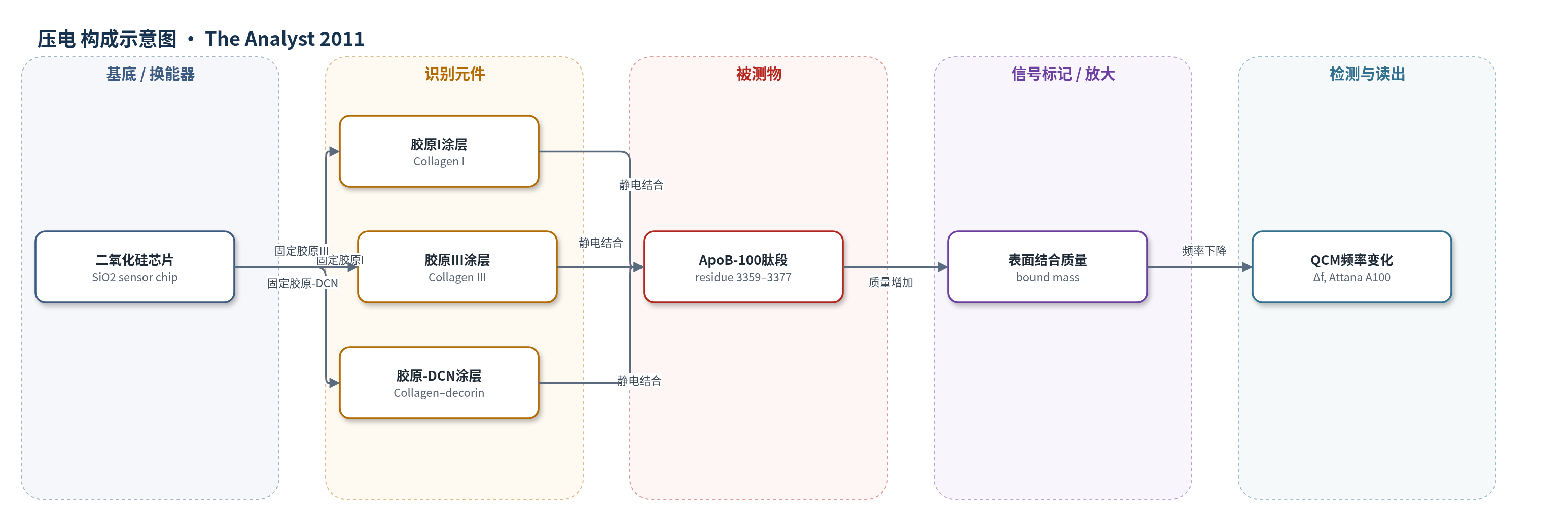
点击图片查看大图 · 依据论文自动绘制
传感器类型
压电(QCM)生物传感器
检测对象
载脂蛋白B-100肽段3359–3377(ApoB-100 peptide residue 3359–3377);样品基质:20 mM 磷酸盐或 HEPES 缓冲液(pH 7.4)
检测原理
将胶原 I、胶原 III 或胶原–decorin 涂层固定于二氧化硅 QCM 芯片表面。胶原分子表面因羟基脯氨酸等基团呈负电性,ApoB-100 肽段 3359–3377 含多个赖氨酸和精氨酸,净电荷为 +6,可与胶原负电残基发生静电/亲和结合。结合事件使芯片表面质量增加,石英晶体谐振频率随之下降;分析物浓度越高,结合质量越大,频率偏移越大。解离阶段反映结合强度,decorin 使胶原表面更负、更有序,从而增强结合。该体系无额外信号放大,直接以质量换能实现在线亲和检测。
检测灵敏度
原文未报告 LOD、线性范围、灵敏度斜率或相关系数。
效应效果
QCM 传感器图显示 ApoB-100 肽段结合引起的频率偏移随浓度增加而增大,且呈双相结合,提示胶原表面存在多个负电结合位点。胶原 I、胶原 III 和胶原 I–decorin 的 KD 分别为 8.9 ± 0.2 mM、5.5 ± 0.1 mM 和 5.4 ± 0.1 mM;胶原 III–decorin 因表面聚集、再生困难而表现为极强结合,无法计算 KD。AFM 显示 decorin 可改变胶原纤维直径并使涂层更均匀,如胶原 I 在熔融石英上 FWHM 为 7.72 ± 0.75 nm。论文未报告选择性、实际样品回收率或方法对比,但作者认为该 QCM 平台可在线评估胶原与 LDL 相关蛋白的亲和机制。
传感器的构成
- 基底/换能器:二氧化硅传感器芯片(silicon dioxide sensor chip,Attana A100 QCM biosensor),提供压电换能与固定表面
- 识别元件:胶原 I(Collagen I)或胶原 III(Collagen III)自组装涂层,提供带负电结合位点
- 识别元件修饰:decorin 与胶原预混形成胶原–decorin 涂层,增强表面负电荷并促进结合
- 分析物/配体:载脂蛋白 B-100 肽段 3359–3377(ApoB-100 peptide residue 3359–3377),含正电赖氨酸/精氨酸残基
- 运行介质:20 mM 磷酸盐或 HEPES 缓冲液(pH 7.4),维持结合与解离环境
- 再生介质:NaCl 溶液,用于结合后表面再生
中文摘要
胶原蛋白是细胞外基质的主要成分,也是人体中最丰富的蛋白质,参与动脉粥样硬化发生。本研究将 I 型和 III 型胶原固定于熔融石英毛细管内壁,并用原子力显微镜(AFM)观察其形貌、尺寸和结构;同时以云母表面作为对照。结果表明,胶原的吸附模式不仅随胶原类型变化,基底材料也显著影响纤维形成过程。Decorin 可促进低密度脂蛋白(LDL)颗粒与胶原结合,作者考察了其对胶原纤维形成的影响:在两种基底上,加入 decorin 均明显降低胶原纤维直径,并使胶原膜更均匀、有序。此外,采用基于石英晶体微天平(QCM)的生物传感器方法,评估固定于二氧化硅传感器芯片上的不同胶原涂层对 LDL 主要蛋白载脂蛋白 B-100(ApoB-100)正电残基的亲和力。结果证实,胶原类型及其纤维形成状态会影响 ApoB-100 正电残基与带负电胶原表面之间的结合。
英文摘要
Collagen, the major component of extracellular matrix (ECM) and the most abundant protein in the human body, is implicated in the development of atherosclerosis. Collagen types I and III were immobilized on fused-silica capillary to investigate their shape, size and structure by atomic force microscopy (AFM). For comparison, collagen was also immobilized on a mica surface. Our studies demonstrated that not only does the adsorption pattern on the substrate vary with the type of collagen, but also the substrate material plays an important role in the fibril formation process. Decorin, which promotes the binding of low-density lipoprotein (LDL) particles with collagen, was investigated for its effect on the fibrillogenesis. On both substrate materials, addition of decorin clearly reduced the fibril diameter of collagen surfaces. Moreover, a quartz crystal microbalance (QCM)-based biosensor approach was applied to clarify and evaluate the affinity of different collagen coatings immobilized on a silicon dioxide sensor chip toward apolipoprotein B-100, the major protein of LDL. The results confirmed the importance of collagen type and their fibrillogenesis on the binding of the positive residues of apolipoprotein B-100 on negatively charged collagen surfaces.