组成图示
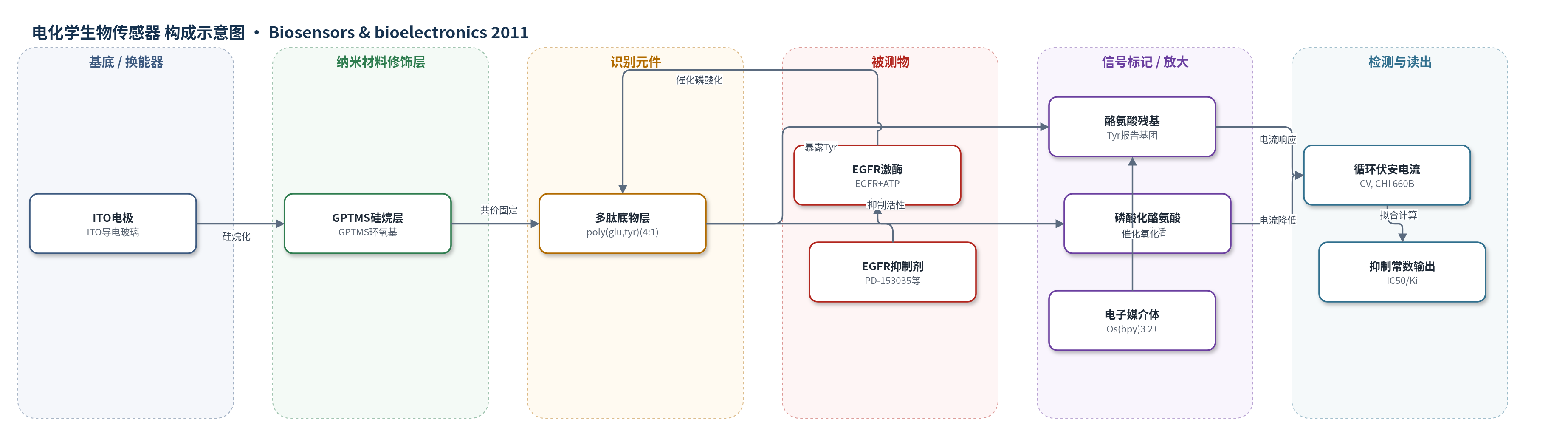
点击图片查看大图 · 依据论文自动绘制
传感器类型
电化学生物传感器
检测对象
蛋白酪氨酸激酶活性(protein tyrosine kinase activity, PTK activity,以EGFR活性单位U mL−1表示)、EGFR小分子抑制剂(PD-153035、OSI-774、ZD-1839);样品基质:体外激酶反应缓冲液(HEPES/PB,含ATP、MnCl2、MgCl2、Na3VO4)
检测原理
该传感器以ITO/GPTMS/poly(glu,tyr)(4:1)电极为识别界面,EGFR作为被测激酶在含ATP、Mn2+、Mg2+和Na3VO4的缓冲液中催化多肽Tyr残基磷酸化。未磷酸化Tyr的酚羟基可被Os(bpy)3 2+/3+媒介体电催化氧化:电极将Os(bpy)3 2+氧化为Os(bpy)3 3+,Os3+再氧化TyrO−生成TyrO•并再生Os2+,形成催化电流。Tyr磷酸化后羟基被磷酸基取代,无法发生该氧化过程,电流下降。因此EGFR活性越高,pTyr越多,电流越低;在2–100 U mL−1范围内电流与EGFR浓度线性相关。加入EGFR抑制剂会抑制磷酸化,保留可氧化Tyr,使电流回升,据此可计算IC50和Ki。
检测灵敏度
LOD: 1 U mL−1;线性范围: 2–100 U mL−1;I = −8.5197c + 905.71;R^2 = 0.9854
效应效果
该传感器选择性良好:PKA不能磷酸化poly(glu,tyr)(4:1),信号几乎不变;PKA底物Kemptide固定后无响应;PKA抑制剂ellagic acid在20 μM下不改变信号。50 U mL−1 EGFR的批内和批间RSD分别为5.5%和6.2%。对三种EGFR抑制剂测得IC50/Ki:PD-153035为26.0±4.7 pM/2.3±0.4 pM,OSI-774为4.7±0.5 nM/0.4±0.1 nM,ZD-1839为49.6±5.8 nM/4.5±0.5 nM,与传统激酶测定一致。作者认为可阵列化用于PTK活性高通量检测和抑制剂筛选,适用于诊断与药物发现。
传感器的构成
- 基底/换能器电极:ITO导电玻璃(indium tin oxide, ITO),提供导电基底与电化学换能界面,表面亲水且化学惰性,减少大分子非特异吸附
- 硅烷修饰层:GPTMS((3-glycidoxypropyl)trimethoxysilane,3-缩水甘油氧基丙基三甲氧基硅烷),在ITO表面形成环氧基功能化层,用于共价固定多肽并调控电子传递
- 底物/识别元件:poly(glu, tyr)(4:1)多肽,作为EGFR底物共价固定于GPTMS层,提供可磷酸化的酪氨酸残基
- 信号报告基团:Tyr(tyrosine,酪氨酸)残基,未磷酸化时可被Os(bpy)3 2+电催化氧化产生电流,磷酸化后电流消失
- 封闭剂:Tris–HCl(pH 8.5,1.0 M),封闭GPTMS残余反应位点,降低非特异结合
- 电子媒介体/反应体系:Os(bpy)3 2+(bpy=2,2'-bipyridine)催化Tyr氧化;磷酸化反应含ATP、MnCl2、MgCl2、Na3VO4和HEPES缓冲液
中文摘要
本文报道了一种用于测定蛋白酪氨酸激酶(PTK)活性的新型无标记电化学方法。以与多种实体瘤相关的表皮生长因子受体(EGFR)为模型激酶,将EGFR底物poly(glu, tyr)(4:1)多肽通过硅烷化学共价固定于氧化铟锡(ITO)电极表面。多肽中的酪氨酸(Tyr)残基作为电化学信号报告基团,其伏安电流可被溶解态电子媒介体Os(bpy)3 2+(bpy为2,2'-联吡啶)催化氧化而增强。Tyr发生磷酸化后失去电化学氧化电流,从而形成PTK活性的传感机制。作者系统优化了ITO表面硅烷化和多肽固定条件,以提高Tyr电化学信号。该生物传感器灵敏度高、稳定性好,EGFR检出限为1 U mL−1。此外,基于抑制剂浓度依赖的电化学信号,可定量分析激酶抑制,估算PD-153035、OSI-774和ZD-1839的IC50与Ki,结果与传统激酶测定一致。该电化学生物传感器可阵列化用于体外PTK活性高通量检测和抑制剂筛选,具有诊断和药物发现应用潜力。
英文摘要
A novel label-free electrochemical method for measuring the activity of protein tyrosine kinases (PTK) has been developed. Epidermal growth factor receptor (EGFR), a typical PTK associated with a large percentage of all solid tumors, was used as the model kinase. Poly(glu, tyr) (4:1) peptide, as a substrate of EGFR, was covalently immobilized on the surface of indium tin oxide (ITO) electrode by silane chemistry. The tyrosine (Tyr) residue in the polypeptide served as an electrochemical signal reporter. Its voltammetric current was catalyzed by a dissolved electron mediator Os(bpy)(3)(2+) (bpy=2,2'-bipyridine) for increased sensitivity. Phosphorylation of the Tyr led to a loss of its electrochemical current, thus providing a sensing mechanism for PTK activity. Experimental conditions for the silanization of ITO surface and immobilization of polypeptide were investigated in details to facilitate the generation of Tyr electrochemical signal. The proposed biosensor exhibited high sensitivity and excellent stability. The limit of detection for EGFR was 1 UmL(-1). Furthermore, this biosensor can also be used for quantitative analysis of kinase inhibition. On the basis of the inhibitor concentration dependent electrochemical signal, the half-maximal inhibition value IC(50) of three EGFR inhibitors, PD-153035, OSI-774 and ZD-1839, and their corresponding inhibition constants K(i) were estimated, which were in agreement with those obtained from the conventional kinase assay. This electrochemical biosensor can be implemented in an array format for the high throughput assay of in vitro PTK activity and PTK inhibitors screening for practical diagnostic application and drug discovery.