组成图示
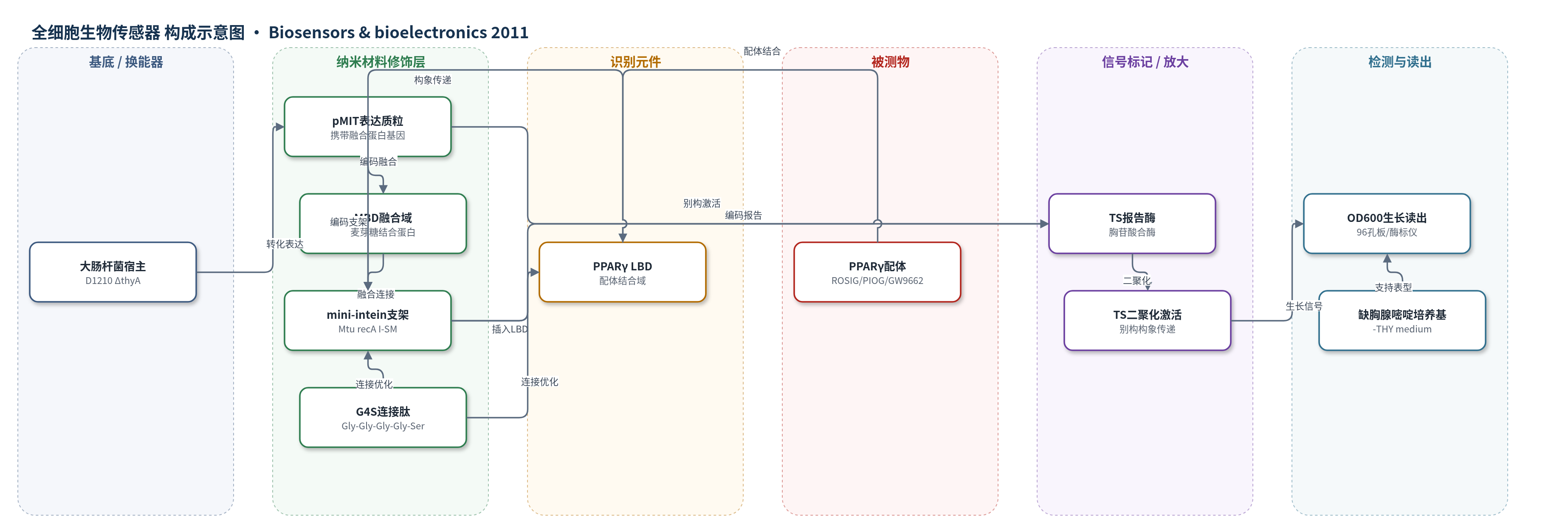
点击图片查看大图 · 依据论文自动绘制
传感器类型
全细胞生物传感器
检测对象
PPARγ配体(peroxisome proliferator-activated receptor gamma ligands):罗格列酮(rosiglitazone, ROSIG)、吡格列酮(pioglitazone, PIOG)、15-脱氧-Δ12,14-前列腺素J2(15-deoxy-Δ12,14-prostaglandin J2, 15D-PGJ2)、GW9662(PPARγ拮抗剂);样品基质为DMSO稀释后加入缺胸腺嘧啶大肠杆菌液体培养基(-THY medium)。
检测原理
PPARγ LBD被插入Mtu mini-intein支架的110/383位点,N端融合MBD,C端融合TS,并通过N/C端连接肽与intein相连。PPARγ配体结合LBD后改变helix 12构象,经连接肽改变intein折叠与取向,解除对TS二聚化的空间阻碍,使TS报告酶激活。TS缺陷大肠杆菌在缺胸腺嘧啶培养基中只有TS活性才能合成胸苷酸并生长;激动剂促进生长,拮抗剂通常抑制生长,某些C端G4S连接肽下拮抗剂可呈表观激动。配体浓度升高时,TS激活/二聚化增强,OD600增长加快,ΔOD600增大。截短或G4S连接肽优化可降低基础生长、提高信噪比和表观配体效力,温度通过改变LBD构象平衡影响敏感性。
检测灵敏度
原文未报告LOD、线性范围、灵敏度斜率或R^2。报告EC50/IC50(μM):ROSIG 3.4 ± 0.2(110PPARγ383)、4.6 ± 0.4(110PPARγ 3GS 403)、1.4 ± 0.1(94 1GS PPARγ 1GS 403);PIOG 8.2 ± 1.1、8.5 ± 3.4、4.9 ± 0.8;GW9662 1.8 ± 1.2、1.1 ± 0.2、0.5 ± 0.1。
效应效果
该传感器能区分PPARγ激动剂与拮抗剂,E2非结合对照无显著效应。原型110PPARγ383对ROSIG和PIOG的EC50分别为3.4±0.2 μM和8.2±1.1 μM,GW9662抑制生长;优化株94 1GS PPARγ 1GS 403将ROSIG、PIOG和GW9662的EC50降至1.4±0.1、4.9±0.8和0.5±0.1 μM。C端G4S连接肽使GW9662呈表观激动,信号约为原型10倍;30℃下对弱配体15D-PGJ2响应最强。未报告RSD和实际样品回收率。作者认为其不受内源真核因子干扰、无需纯化核受体,可用普通分光光度计读OD600,适合PPARγ配体筛选。
传感器的构成
- 宿主细胞/换能器:TS缺陷大肠杆菌 D1210 ΔthyA::KanR,作为生长表型换能器,在缺胸腺嘧啶培养基中依赖胸苷酸合酶活性生长
- 表达载体:pMIT 骨架质粒(由 pMIT::ERγ* 衍生,AgeI/XhoI 克隆),携带四域融合蛋白基因并提供氨苄青霉素筛选
- 识别元件:人 PPARγ 配体结合域 LBD(residues 232–505),插入 mini-intein 110/383 位点,识别 PPARγ 配体并发生 helix 12 构象变化
- 别构支架:Mycobacterium tuberculosis recA mini-intein(Mtu I-SM mini-intein,N/C 端拼接域),作为稳定支架传递 LBD 构象变化
- 连接肽优化层:N/C 端 intein-LBD 连接肽,截短或 G4S(Gly-Gly-Gly-Gly-Ser)重复,调节别构信号效率与保真度
- 报告酶/信号元件:大肠杆菌胸苷酸合酶 TS(thymidylate synthase),其二聚化活性决定细胞在 -THY 培养基中生长
- 辅助融合域:大肠杆菌麦芽糖结合蛋白 MBD(maltose binding protein),N 端融合,参与融合蛋白表达/稳定
中文摘要
过氧化物酶体增殖物激活受体γ(PPARγ/PPARG)属于核受体超家族,是多种疾病的潜在药物靶点。本研究构建了一系列用于鉴定功能性PPARγ配体的细菌生物传感器。这些传感器由携带四域融合蛋白的改造大肠杆菌组成,融合蛋白包括PPARγ配体结合域(LBD)、工程化mini-intein域、大肠杆菌麦芽糖结合蛋白(MBD)和胸苷酸合酶(TS)报告酶。表达该蛋白的大肠杆菌表现出依赖激素配体的生长表型。与已发表的雌激素受体(ER)和甲状腺受体(TR)生物传感器不同,经典PPARγ传感器细胞在无配体时显示明显生长,但仍能区分激动剂和拮抗剂。为提高配体敏感性,作者尝试工程化并优化PPARγ LBD插入位点两侧的连接肽。截短原始连接肽降低基础生长并显著提高配体敏感性;用优化的G4S(Gly-Gly-Gly-Gly-Ser)连接肽替代天然连接肽进一步提高敏感性。研究表明连接肽性质,尤其C端连接肽,显著影响配体结合诱导的别构信号效率与保真度。该工作提出在不改变功能LBD的情况下增强多域传感器蛋白别构行为的方法。
英文摘要
The peroxisome proliferator-activated receptor gamma (PPARγ or PPARG) belongs to the nuclear receptor superfamily, and is a potential drug target for a variety of diseases. In this work, we constructed a series of bacterial biosensors for the identification of functional PPARγ ligands. These sensors entail modified Escherichia coli cells carrying a four-domain fusion protein, comprised of the PPARγ ligand binding domain (LBD), an engineered mini-intein domain, the E. coli maltose binding protein (MBD), and a thymidylate synthase (TS) reporter enzyme. E. coli cells expressing this protein exhibit hormone ligand-dependent growth phenotypes. Unlike our published estrogen (ER) and thyroid receptor (TR) biosensors, the canonical PPARγ biosensor cells displayed pronounced growth in the absence of ligand. They were able to distinguish agonists and antagonists, however, even in the absence of agonist. To improve ligand sensitivity of this sensor, we attempted to engineer and optimize linker peptides flanking the PPARγ LBD insertion point. Truncation of the original linkers led to decreased basal growth and significantly enhanced ligand sensitivity of the PPARγ sensor, while substitution of the native linkers with optimized G(4)S (Gly-Gly-Gly-Gly-Ser) linkers further increased the sensitivity. Our studies demonstrate that the properties of linkers, especially the C-terminal linker, greatly influence the efficiency and fidelity of the allosteric signal induced by ligand binding. Our work also suggests an approach to increase allosteric behavior in this multidomain sensor protein, without modification of the functional LBD.