组成图示
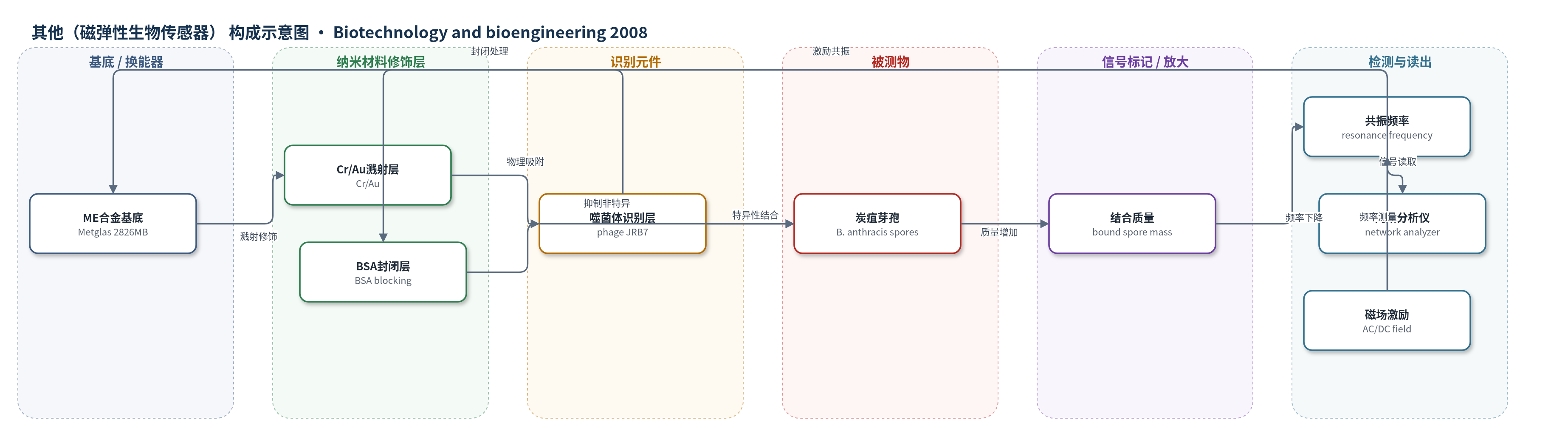
点击图片查看大图 · 依据论文自动绘制
传感器类型
其他(磁弹性生物传感器)
检测对象
炭疽芽孢杆菌芽孢(Bacillus anthracis Sterne strain spores);样品基质:水/流动系统(spore solutions in water)
检测原理
磁弹性(ME)基底为铁磁非晶合金,在交流磁场激励下发生纵向机械共振,其基频由材料弹性、密度、泊松比和几何尺寸决定;直流偏置磁场用于放大共振信号。噬菌体JRB7通过物理吸附固定于金表面,BSA封闭非特异性位点。当炭疽芽孢与噬菌体特异性结合后,传感器表面增加非磁性质量Δm,根据Δf≈-f/2·Δm/M,共振频率发生下降。频率变化可被网络分析仪远程无线读取,因此信号随芽孢浓度增加而降低。盐浓度通过改变噬菌体轴向电荷密度和静电相互作用,影响噬菌体束状聚集;420 mM NaCl使噬菌体均匀分散,暴露更多结合位点,提高质量响应。
检测灵敏度
最低可检测浓度(first detectable drop): 5 × 10^3 cfu/mL;线性范围: 5 × 10^2–5 × 10^8 cfu/mL;灵敏度: 202 Hz/decade;R^2 = 0.98
效应效果
在140–840 mM NaCl条件下,420 mM时频率响应最大;噬菌体浓度为1×10^11 vir/mL时结合最多。SEM计数显示该条件下结合芽孢约370,800个,显著高于1×10^10和1×10^12 vir/mL条件。TEM证实低盐和高盐均促进噬菌体束状聚集,420 mM有利于解聚和均匀分布。动态流动测试中,传感器对5×10^1–5×10^8 cfu/mL芽孢产生阶梯式频率下降,最高浓度总频移1,420 Hz;线性范围5×10^2–5×10^8 cfu/mL,灵敏度202 Hz/decade,R^2=0.98。每组为5个传感器平均,多批次结果一致,但未报告RSD、实际样品回收率或ELISA/qPCR对比。作者认为该无线磁弹性传感器可用于炭疽芽孢的快速、便携、实时检测。
传感器的构成
- 基底/换能器:Metglas 2826MB 非晶磁弹性合金(Fe40Ni38Mo4B18),尺寸2.0×0.4×0.015 mm,提供磁弹性共振换能
- 界面/导电层:铬(Cr)溅射层,增强金层与Metglas基底粘附
- 生物活性/防腐层:金(Au)溅射层,提供生物活性与耐腐蚀,作为噬菌体物理吸附表面
- 识别元件:亲和筛选丝状噬菌体fd克隆JRB7,物理吸附固定,特异性识别B. anthracis芽孢
- 封闭剂:牛血清白蛋白(BSA,1 mg/mL),封闭金表面非特异性结合位点
- 激励与读出:交流磁场线圈、直流偏置磁体与网络分析仪,激发共振并无线读取频率变化
中文摘要
本文研究盐浓度和噬菌体浓度对磁弹性(ME)生物传感器结合亲和力的影响。该传感器通过在磁弹性平台表面固定丝状噬菌体,用于检测炭疽芽孢杆菌芽孢。当芽孢与表面噬菌体结合时,传感器质量增加,导致共振频率下降。作者利用透射电镜(TEM)考察不同盐/噬菌体浓度下噬菌体的聚集与束状结构,发现噬菌体溶液化学会改变其束状特性,从而影响传感器灵敏度和检测限。通过测量频率响应,确定盐浓度对传感器性能的影响;扫描电镜(SEM)用于确认并定量芽孢在传感器表面的结合。结果表明,在噬菌体浓度为1×10^11 vir/mL、盐浓度为420 mM时,固定噬菌体在传感器表面分布最优,有利于芽孢结合。随后在流动系统中将传感器暴露于5×10^1至5×10^8 cfu/mL的炭疽芽孢悬液,结果显示该磁弹性生物传感器在线性范围内的灵敏度为202 Hz/decade。
英文摘要
This article presents an investigation of the effect of salt and phage concentrations on the binding affinity of magnetoelastic (ME) biosensors. The sensors were fabricated by immobilizing filamentous phage on the ME platform surface for the detection of Bacillus anthracis spores. In response to the binding of spores to the phage on the ME biosensor, a corresponding decrease occurs in resonance frequency. Transmission electron microscopy (TEM) was used to verify the structure of phage under different combinations of salt/phage concentration. The chemistry of the phage solution alters phage bundling characteristics and, hence, influences both the sensitivity and detection limit of the ME biosensors. The frequency responses of the sensors were measured to determine the effects of salt concentration on the sensors' performance. Scanning electron microscopy (SEM) was used to confirm and quantify the binding of spores to the sensor surface. This showed that 420 mM salt at a phage concentration of 1 x 10(11) vir/mL results in an optimal distribution of immobilized phages on the sensor surface, consequently promoting better binding of spores to the biosensor's surface. Additionally, the sensors immobilized with phage under this condition were exposed to B. anthracis spores in different concentrations ranging from 5 x 10(1) to 5 x 10(8) cfu/mL in a flowing system. The results showed that the sensitivity of this ME biosensor was 202 Hz/decade.