组成图示
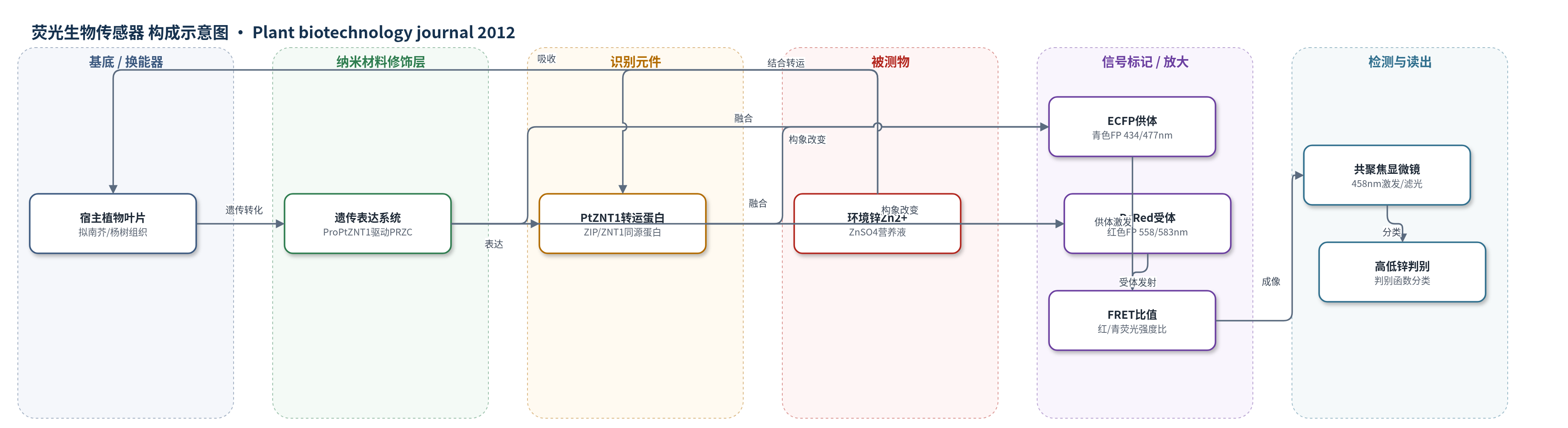
点击图片查看大图 · 依据论文自动绘制
传感器类型
荧光生物传感器
检测对象
锌(Zinc, Zn/Zn2+);样品基质:植物叶片组织(经 Hoagland 营养液/ZnSO4 暴露,无菌砂培养)
检测原理
植物根系吸收营养液中的 Zn2+ 并转运至叶片,Zn2+ 与 PtZNT1 相互作用后引起该锌转运蛋白构象变化。由于 ECFP 与 DsRed 分别融合在 PtZNT1 两端,构象变化改变供体-受体间距与取向,从而改变 FRET 效率。用 458 nm 光激发 ECFP,通过 LP475 与 BP560-615 滤光片分别采集青色与红色荧光,计算 FRET=(RedTissue-RedBackground)/(CyanTissue-CyanBackground)。锌浓度越高,植物体内锌积累越多,FRET 比值越高(拟南芥约 1.4 倍、杨树约 1.3 倍),再经判别函数区分低/高锌暴露。
检测灵敏度
原文未报告 LOD、线性范围、灵敏度斜率或 R^2。
效应效果
在恒定 pH 等条件下,FRET 对锌梯度响应显著。拟南芥 Line 7 中 FRET 随锌升高增加 1.4 倍;判别分析总体错误率 8.3%,无 II 类错误,I 类错误 16.7%;独立验证 96 h 后无 I 类错误、II 类错误 33%。杨树 Line 3 中 FRET 增加 1.3 倍,总体错误率 22.35%,II 类错误 36.4%、I 类错误 8.3%。120 h 后叶片锌积累分别为对照的 3.3 倍(拟南芥)和 4.7 倍(杨树)。作者认为该活体 FRET 传感器可跨物种转移,用于大面积环境锌监测,但厚叶、厚角质层和毛状体会降低成像灵敏度。
传感器的构成
- 宿主植物/活体换能平台:拟南芥 Arabidopsis thaliana 或杨树 Populus tremula·Populus alba 叶片组织,吸收并转运 Zn2+,承载 FRET 信号
- 表达调控层:杨树 PtZNT1 启动子 ProPtZNT1,驱动 PRZC 融合蛋白在植物细胞中表达
- 识别/响应元件:杨树锌转运蛋白 PtZNT1(ZIP 家族 ZNT1 同源蛋白),响应 Zn2+ 并结合/转运,发生构象变化
- 供体荧光标记:增强青色荧光蛋白 ECFP(吸收/发射约 434/477 nm),作为 FRET 供体
- 受体荧光标记:DsRed 红色荧光蛋白(吸收/发射约 558/583 nm),作为 FRET 受体
- 嵌合蛋白层:ProPtZNT1-DsRed-PtZNT1-ECFP(PRZC)融合蛋白,将 Zn 诱导构象变化转换为 ECFP-DsRed 间距/能量转移变化
- 光学读出层:458 nm 青色激发光与 LP475/BP560-615 滤光片,配合共聚焦显微镜采集红/青荧光并计算 FRET 比值
中文摘要
重金属在环境中积累对动植物构成风险,但监测潜在累积点存在规模与经济挑战。本研究提出并测试了一种基于植物荧光共振能量转移(FRET)变化响应锌(Zn)积累的方法,以植物体内锌水平作为环境健康代理。作者将植物锌转运蛋白两端融合荧光蛋白,构建 ProPtZNT1-DsRed-PtZNT1-ECFP(PRZC)嵌合蛋白,并转入拟南芥和杨树两个物种。在拟南芥中,共聚焦显微镜监测到 FRET 强度随金属浓度升高增加 1.4 倍;在 96 h 后区分对照(1 µM Zn)与高处理(10 mM Zn)的总体错误率为 16.7%。杨树中 FRET 值也升高 1.3 倍,但总体错误率为 22.4%。结果表明,植物积累锌时蛋白构象改变导致荧光蛋白相互作用变化,从而在适当光源和滤光片下产生更高 FRET。该构建体可跨物种转移,包括树种,有望用于大面积土地锌积累监测,并可改造用于其他环境风险重金属。
英文摘要
Heavy metal accumulation in the environment poses great risks to flora and fauna. However, monitoring sites prone to accumulation poses scale and economic challenges. In this study, we present and test a method for monitoring these sites using fluorescent resonance energy transfer (FRET) change in response to zinc (Zn) accumulation in plants as a proxy for environmental health. We modified a plant Zn transport protein by adding flanking fluorescent proteins (FPs) and deploying the construct into two different species. In Arabidopsis thaliana, FRET was monitored by a confocal microscope and had a 1.4-fold increase in intensity as the metal concentration increased. This led to a 16.7% overall error-rate when discriminating between a control (1μm Zn) and high (10mm Zn) treatment after 96h. The second host plant (Populus tremula×Populu salba) also had greater FRET values (1.3-fold increase) when exposed to the higher concentration of Zn, while overall error-rates were greater at 22.4%. These results indicate that as plants accumulate Zn, protein conformational changes occur in response to Zn causing differing interaction between FPs. This results in greater FRET values when exposed to greater amounts of Zn and monitored with appropriate light sources and filters. We also demonstrate how this construct can be moved into different host plants effectively including one tree species. This chimeric protein potentially offers a method for monitoring large areas of land for Zn accumulation, is transferable among species, and could be modified to monitor other specific heavy metals that pose environmental risks.