组成图示
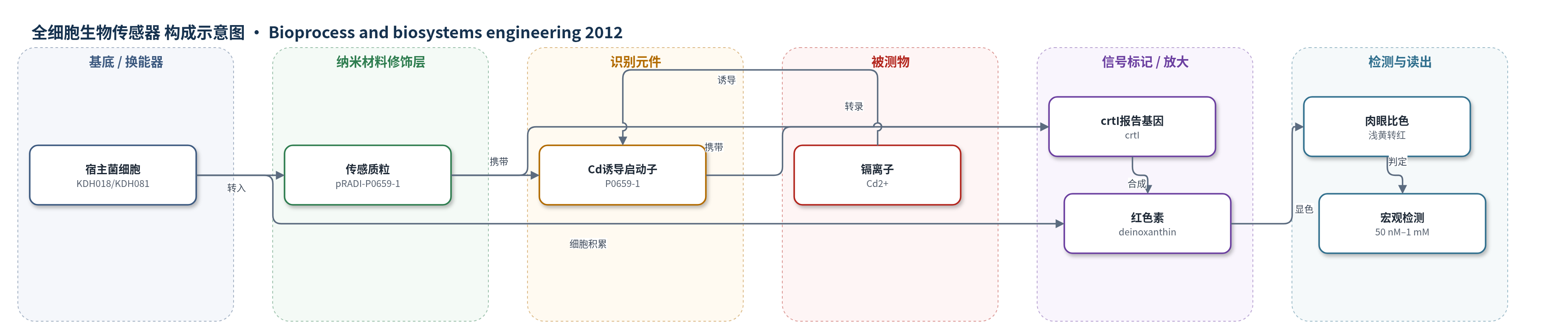
点击图片查看大图 · 依据论文自动绘制
传感器类型
全细胞生物传感器
检测对象
镉(cadmium, Cd2+);样品基质:TGY培养基或环境样品(文中实验为培养基加标)
检测原理
Cd2+进入D. radiodurans KDH081后,与细胞内Cd响应调控元件/转录因子相互作用,使DR_0659来源的393 bp启动子P0659-1转录活性增强。启动子激活后驱动下游crtI转录,crtI编码phytoene脱氢酶,将无色phytoene转化为红色lycopene/deinoxanthin类胡萝卜素。色素在菌体内酶促合成并积累,使菌落/培养液颜色由浅黄变为红色,形成肉眼可见的比色信号。该过程利用全细胞内基因表达与酶促色素合成实现信号放大,无需外加底物或昂贵仪器。LacZ报告显示Cd在10 nM–1 mM范围内可检测,100 μM前表达增加,高浓度因毒性下降;宏观比色在50 nM–1 mM可识别,100 nM–200 μM变化清晰。
检测灵敏度
LacZ报告: 最低可检测Cd浓度: 10 nM;检测范围: 10 nM–1 mM;LacZ表达在Cd≤100 μM时增加,>100 μM时急剧下降。宏观比色: 检测范围: 50 nM–1 mM;100 nM–200 μM颜色变化清晰,>500 μM色度降低,最高1 mM。
效应效果
该传感器对Cd具有较高选择性,LacZ报告实验和宏观比色实验均显示其他金属/类金属(Cr、Pb、Ni、Zn、Fe、Cu、As、Mn、Hg等)不引起显著颜色或酶活响应。LacZ最低可检测Cd浓度为10 nM,检测范围10 nM–1 mM;宏观比色检测范围50 nM–1 mM,100 nM–200 μM颜色变化清晰,>500 μM因Cd毒性导致色度降低,最高1 mM。与已有Cd生物传感器相比,本文系统无需昂贵底物、荧光或发光检测设备,可在1天内肉眼识别,适合低成本、现场化监测。文中未报告长期稳定性、RSD、实际样品回收率或加标回收数据。
传感器的构成
- 宿主菌/换能器:基因工程耐辐射奇球菌 D. radiodurans KDH081(crtI缺失突变株KDH018携带pRADI-P0659-1),作为活细胞传感平台与信号发生器
- 识别元件:Cd诱导启动子P0659-1(DR_0659来源393 bp片段),响应Cd并启动下游基因转录
- 报告基因/信号标记物:crtI(phytoene dehydrogenase,phytoene脱氢酶),催化无色phytoene生成红色lycopene/deinoxanthin类胡萝卜素
- 表达载体:pRADI-P0659-1(含P0659-1-crtI表达盒及Cmr抗性标记),在D. radiodurans中复制并表达
- 宿主基因组修饰:ΔcrtI::kan(crtI被kan/aph卡那霉素抗性基因替代),消除本底红色素,使颜色变化仅由Cd诱导crtI表达产生
- 样品基质/培养环境:TGY培养基(0.5%胰蛋白胨、0.3%酵母提取物、0.1%葡萄糖)或含Cd样品,承载菌体生长与颜色变化
- 信号读出:肉眼比色/宏观颜色观察(浅黄到红色),无需特殊仪器
中文摘要
本研究利用基因工程红色素产生菌耐辐射奇球菌(Deinococcus radiodurans)构建镉(Cd)比色全细胞生物传感器。基于芯片数据,筛选高Cd诱导基因DR_0070、DR_0659、DR_0745和DR_2626的假想启动子,构建lacZ报告盒并转入D. radiodurans R1评估活性与特异性。DR_0659启动子对Cd特异性、敏感性和活性最高;其393 bp缺失片段P0659-1仍保留Cd诱导活性,但片段表达模式提示调控复杂。LacZ检测范围为10 nM–1 mM Cd,表达在100 μM前增加,更高浓度因毒性下降。为宏观检测,将含crtI报告基因并受P0659-1控制的质粒pRADI-P0659-1转入crtI缺失突变株KDH018,获得KDH081。加Cd后菌体由浅黄变红,对其他金属无显著响应;颜色变化1天内肉眼可辨,检测范围50 nM–1 mM Cd。结果表明KDH081可宏观监测Cd。
英文摘要
In this study, a colorimetric whole-cell biosensor for cadmium (Cd) was designed using a genetically engineered red pigment producing bacterium, Deinococcus radiodurans. Based on the previous microarray data, putative promoter regions of highly Cd-inducible genes (DR_0070, DR_0659, DR_0745, and DR_2626) were screened and used for construction of lacZ reporter gene cassettes. The resultant reporter cassettes were introduced into D. radiodurans R1 to evaluate promoter activity and specificity. Among the promoters, the one derived from DR_0659 showed the highest specificity, sensitivity, and activity in response to Cd. The Cd-inducible activity was retained in the 393-bp deletion fragment (P0659-1) of the P0569 promoter, but the expression pattern of the putative promoter fragments inferred its complex regulation. The detection range was from 10 to 1 mM of Cd. The LacZ expression was increased up to 100 μM of Cd, but sharply decreased at higher concentrations. For macroscopic detection, the sensor plasmid (pRADI-P0659-1) containing crtI as a reporter gene under the control of P0659-1 was introduced into a crtI-deleted mutant strain of D. radiodurans (KDH018). The color of this sensor strain (KDH081) changed from light yellow to red by the addition of Cd and had no significant response to other metals. Color change by the red pigment synthesis could be clearly recognized in a day with the naked eye and the detection range was from 50 nM to 1 mM of Cd. These results indicate that genetically engineered D. radiodurans (KDH081) can be used to monitor the presence of Cd macroscopically.