组成图示
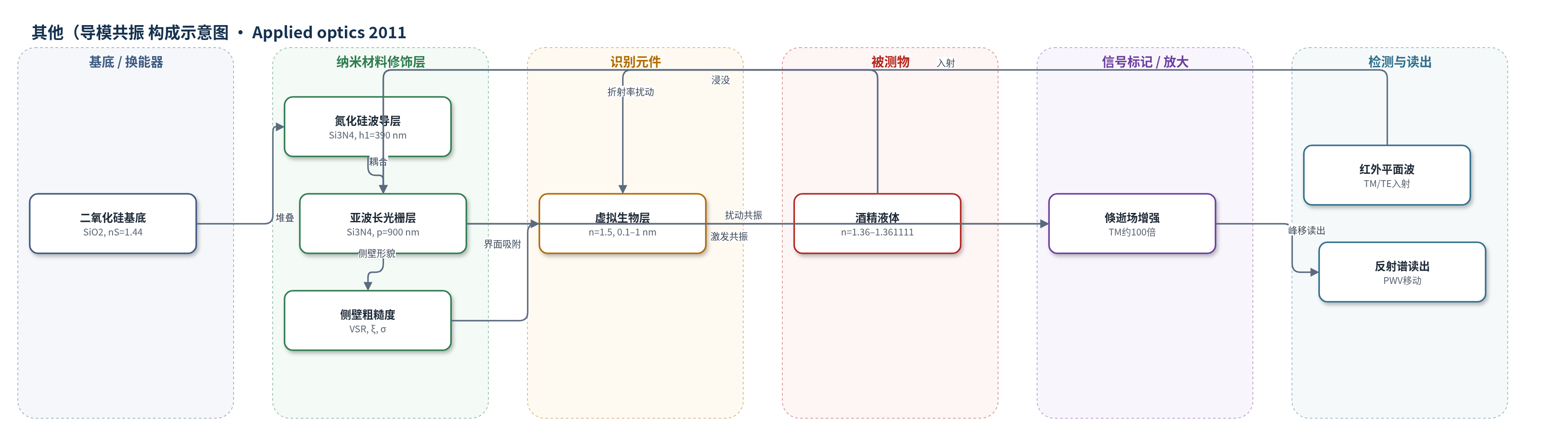
点击图片查看大图 · 依据论文自动绘制
传感器类型
其他(导模共振(GMR)光学生物传感器)
检测对象
虚拟生物层(virtual biolayer,n=1.5,0.1–1 nm,模拟生物分子吸附层)、酒精液体(liquid alcohol,n=1.36–1.361111,样品基质为液体/溶液)
检测原理
红外平面波以TM或TE偏振入射到Si3N4亚波长光栅/波导结构上,激发导模共振,反射谱出现极窄共振峰PWV。当虚拟生物层吸附或酒精液体折射率变化时,光栅上方有效折射率和边界条件改变,使共振峰发生红移。TM偏振在波导层具有约100倍倏逝场增强,因此对界面扰动更敏感,信号放大主要依靠窄线宽共振和场增强。系统通过光谱仪读取反射峰波长移动,实现无标记、无信号标记物的折射率/生物层传感。
检测灵敏度
生物层厚度范围: 0.1–1 nm;TM PWV 移动: 0.43 nm(1 nm 生物层);TE PWV 移动: 0.3 nm(1 nm 生物层);TM 灵敏度: 0.04 nm/0.1 nm;TE 灵敏度: 0.03 nm/0.1 nm;液体折射率范围: 1.36–1.361111;TM PWV 移动: 45.77 nm;TE PWV 移动: 21.08 nm;理论超灵敏度: 1000 nm/RIU(TM)、100 nm/RIU(TE)
效应效果
本文以RCWA模拟验证,未报告RSD、实际样品回收率或选择性实验。改进设计使TM FWHM由6.5 nm降至0.34 nm,TE由9.3 nm降至3.6 nm;TE/TM PWV偏差由85.8 nm增至116.7 nm,TM场增强约100倍、TE约20倍。TM对生物层和液体折射率变化均更灵敏,理论灵敏度达1000 nm/RIU,与文献2000 nm/RIU的先进水平可比。VSR方面,σ=1 nm可致0.1 nm PWV偏移,σ=5 nm最大0.3 nm;但在特定ξ类带隙区,σ达10 nm时PWV仍基本恒定,说明粗糙度可容忍,有利于线宽缩小至几十纳米的超灵敏GMR生物传感器。
传感器的构成
- 基底:SiO2(二氧化硅,nS=1.44),提供光学支撑与低损耗基底
- 波导层:Si3N4(氮化硅,nH=1.97,h1=390 nm),形成导模并增强倏逝场
- 亚波长光栅层:Si3N4(h2=600 nm,p=900 nm,f=0.1),产生导模共振反射峰并作为光学换能器
- 侧壁粗糙度:VSR(相关长度ξ、最大粗糙度偏差均方根σ),位于Si3N4光栅侧壁,影响PWV稳定性
- 识别/传感层:虚拟生物层(n=1.5,0.1–1 nm),模拟无标记生物分子吸附,改变界面有效折射率
- 样品介质:酒精液体(n=1.36–1.361111),用于验证液体折射率变化检测
中文摘要
本文研究了垂直侧壁粗糙度(VSR)对用于红外照明下超灵敏生物传感器的亚波长光栅导模共振(GMR)滤波器的影响。为突出灵敏度和VSR效应,将光栅滤波器光谱半高宽设计得尽可能窄。考虑并评估了光栅上三种VSR形貌,以相关长度ξ和最大粗糙度偏差均方根σ表征。采用严格耦合波分析(RCWA)定量计算光栅滤波器反射共振峰波长值(PWV)的偏移。模拟表明,对于特定ξ值,即使σ增大到10 nm,PWV仍保持恒定;这显示出显著的类带隙条纹,类似于我们在ξ–σ图中提出的光子晶体能带图中观察到的带隙。换言之,当ξ位于某些带内时,VSR对GMR生物传感器性能影响可忽略;因此,即使滤波器线宽缩小到几十纳米,这种粗糙度也高度可容忍。
英文摘要
In this paper, we present our investigations of the effects of vertical-sidewall roughness (VSR) on guided-mode resonance (GMR) filters made of subwavelength grating for applications to ultrasensitive biosensors operated under IR illumination. We designed the spectral FWHM of the grating filter to be as narrow as possible in order to emphasize the sensitivity and VSR effects. Three types of VSR morphologies on the grating-in terms of the correlation length ξ and the rms of the maximum roughness deviation σ-were considered and evaluated. Rigorous coupled-wave analysis was then implemented to quantify the shifts in the reflective resonance peak wavelength value (PWV) of the grating filter. Our simulations show that for specific ξ values, the PWVs remain constant even if σ becomes as large as 10 nm; this indicates dramatic bandgaplike stripes, which are similar to the bandgaps observed in the band diagrams of photonic crystals in the ξ-σ diagram that we have proposed in this study. In other words, the effects of VSR on the GMR biosensor performance are insignificant when ξ is located at certain bands; therefore, this type of roughness is highly tolerable even if the linewidth of the filter is decreased to only a few tens of nanometers.