组成图示
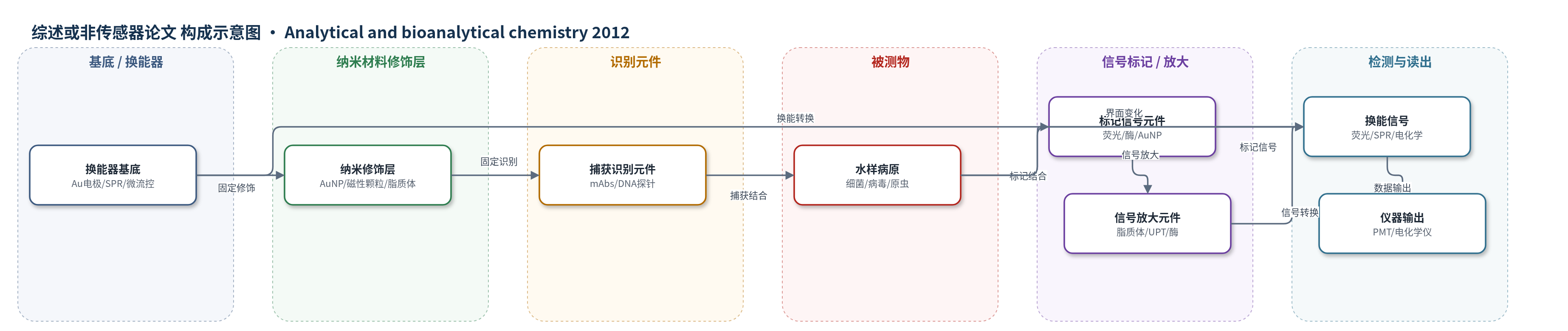
点击图片查看大图 · 依据论文自动绘制
传感器类型
综述或非传感器论文
检测对象
检测对象为水传播病原微生物,包括大肠杆菌O157:H7(E. coli O157:H7)、沙门氏菌(Salmonella enterica)、隐孢子虫(Cryptosporidium spp.)、贾第鞭毛虫(Giardia lamblia)、肠道病毒(enteroviruses)、诺如病毒(noroviruses)、轮状病毒(rotavirus)、粪肠球菌(enterococci)等;样品基质为饮用水、环境水样、污水、地表水、地下水、城市径流水及海水/贝类相关水样。
检测原理
生物传感器由生物识别元件与换能器组成。抗体、寡核苷酸探针、酶、适配体、噬菌体或细胞表面分子与病原结合后,引起表面质量、折射率、电荷、阻抗或光学标记变化。光学换能可通过荧光、化学发光、SPR、SERS或波导检测标记/界面变化;电化学换能可检测电流、阻抗或电阻变化;机械换能如QCM/SAW检测质量变化。信号放大可采用酶催化、脂质体封装染料、AuNPs、磁性颗粒、UPT以及PCR/NASBA等。被测物浓度越高,结合事件越多,信号通常越强或响应变化越大。
检测灵敏度
综述未报告统一传感器灵敏度;文中提及示例:LOD: 10^2 Cryptosporidium spp. oocysts、10^3 Giardia lamblia cysts、10^1 Entamoeba histolytica trophozoites;LOD: 0.2 CFU μL−1;LOD: 10^2 PFU mL−1;LOD: 10^3 CFU mL−1;LOD: 1 CFU mL−1;LOD: 10−3 PFU in 10 μL;LOD: 0.25 fmol target DNA;LOD: 135 ng total bacterial RNA;LOD: 3 amol of specific target DNA;LOD: 1 ng genomic DNA (approximately 10^6 bacterial cells)。
效应效果
综述比较显示,培养法可检测单CFU/PFU但需数天至数周;PCR/NASBA数小时且可单细胞,但需核酸提取;免疫法10 min出结果,LOD多为10^3–10^6 cells/mL。RAPTOR 10 min可检测5×10^4 G. lamblia、10^5 C. parvum、10^4 E. coli O157:H7及10^3 S. enterica。脂质体裂解使E. coli O157:H7 LOD由10^3降至1 CFU/mL;SPR磁性珠80倍放大;AuNP使SAW灵敏度提高4个数量级。作者认为微流控与信号放大可替代金标准。
传感器的构成
- 基底/换能器:金电极、玻璃毛细管、光纤/波导、微流控芯片、SPR芯片、SAW/QCM器件,用于固定识别元件并转换生物结合信号
- 纳米材料修饰层:磁性纳米颗粒(MNPs)、金纳米颗粒(AuNPs)、脂质体(liposomes)、上转换磷光体(UPT),用于捕获、标记或信号放大
- 识别元件:单克隆抗体(mAbs)、寡核苷酸探针(oligonucleotide probes)、酶、适配体(aptamers)、噬菌体(phages)、细胞表面分子,用于特异性识别病原
- 信号标记物:荧光染料(fluorophores)、酶标记物、脂质体封装染料、AuNPs、UPT,用于产生光学或电化学信号
- 样品前处理模块:膜过滤、免疫磁分离(IMS)、微流控浓缩,用于富集病原并去除抑制物
- 读出系统:荧光显微镜/流式细胞仪、电化学仪、SPR仪、SERS、PMT、QCM/SAW,用于信号检测与定量
中文摘要
水传播细菌、病毒和寄生虫病原是全球公共卫生问题,在受污染饮用水中快速、特异性检测至关重要。已有多种生物传感器利用不同生物识别分子和换能方法报道,有望在短时间内高灵敏、高特异地检测目标分析物。然而,水传播病原检测面临若干障碍:环境中浓度通常极低,且环境样品含有大量酶反应抑制剂、干扰微生物和颗粒物。本文综述了当前生物传感器技术在水传播病原检测中的现状,讨论了相对于标准检测方法所需改进以及真实环境样品带来的挑战,并指出未来需要重点关注的方向,以开发能够取代现有金标准的新检测装置。
英文摘要
Waterborne bacterial, viral and parasitic pathogens are a global health concern and their rapid and specific detection in contaminated potable water is of utmost importance. Biosensors using a variety of biorecognition molecules and transduction methodologies have been reported, and have the potential to enable highly sensitive detection of the analyte of interest in a short time with high specificity. However, there are several obstacles to the detection of waterborne pathogens-they tend to be present at very low concentrations in the environment and environmental samples contain numerous inhibitors of enzymatic reactions and interfering organisms and particulates. Here we present a review of the current state of biosensor technology with regard to the improvements needed over standard detection methods and the challenges presented by real environmental samples. Further, we identify future areas of focus necessary to realize novel detection devices capable of supplanting the gold standards of today.