组成图示
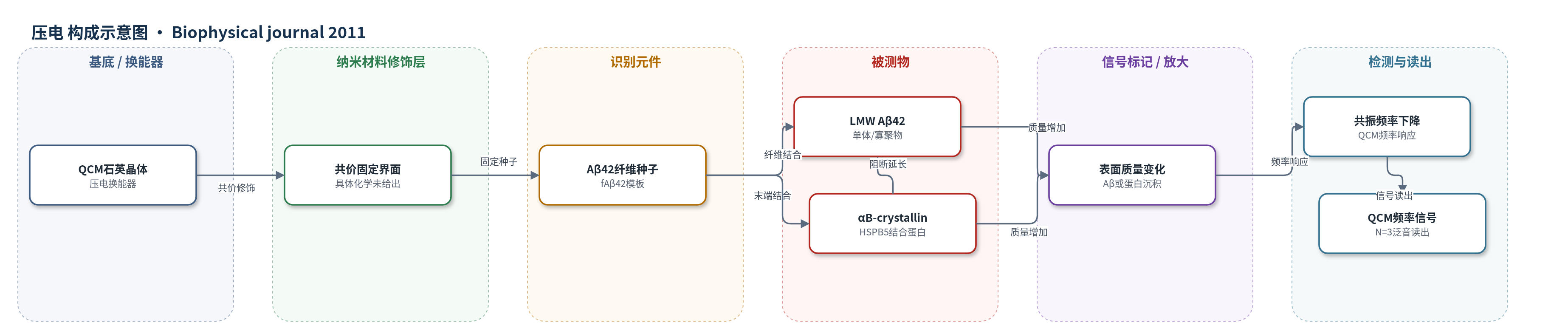
点击图片查看大图 · 依据论文自动绘制
传感器类型
压电(QCM)生物传感器
检测对象
Aβ42淀粉样纤维延长(Aβ42 fibril elongation)、αB-crystallin结合(αB-crystallin binding);样品基质:100 mM磷酸盐缓冲液(pH 7.4)中的低分子量Aβ42(LMW Aβ42)溶液
检测原理
QCM传感器表面共价固定Aβ42淀粉样纤维种子(fAβ42),作为识别与延长模板。当磷酸盐缓冲液中的低分子量Aβ42(LMW Aβ42)接触表面时,单体/寡聚物在纤维末端结合,使表面质量增加;QCM压电晶体共振频率随之下降,频率下降速率反映纤维延长速率。αB-crystallin(HSPB5)可结合纤维全长及末端,占据生长位点并阻断后续Aβ单体沉积,因此出现可饱和的质量增加后延长停止。该过程不依赖荧光标记或酶放大,直接以质量换能读出;洗脱变性剂使αB-crystallin解离后,纤维可恢复延长。
检测灵敏度
未报告LOD、线性范围、灵敏度斜率或相关系数。
效应效果
选择性方面,GFP和UCH-L3在相同条件下不与Aβ42纤维共沉淀,提高离子强度仅轻微改变沉降,排除单纯静电作用;免疫电镜未见非特异免疫金标记。QCM无种子表面接触LMW Aβ42时无显著频率变化,αB-crystallin非特异吸附小于有种子表面。αB-crystallin对Aβ42纤维Kd为2.1±0.4 μM,MMBR为0.57±0.08;对Aβ42arc为0.77±0.24 μM和0.34±0.03。3 M盐酸胍洗脱后纤维恢复延长,表明抑制可逆;AFM证实纤维延长。作者认为该机制是分子伴侣抑制淀粉样纤维增殖的通用策略。
传感器的构成
- 基底/换能器:石英晶体微天平(QCM)晶体,压电换能器,通过共振频率变化监测表面质量变化
- 固定界面:共价固定界面(具体化学未给出),用于将Aβ42纤维种子固定到晶体表面
- 识别/模板层:Aβ42淀粉样纤维种子(fAβ42),作为纤维延长模板与结合位点
- 结合/抑制层:αB-crystallin(HSPB5),结合纤维全长及末端,阻断进一步Aβ单体沉积
- 信号读出:QCM共振频率(泛音N=3),频率下降对应表面质量增加
中文摘要
αB-crystallin是一种小热休克蛋白,在多种应激刺激下上调,并与阿尔茨海默病特征性细胞外斑块中的Aβ淀粉样纤维共定位。本研究在体外考察该典型小热休克蛋白能否与Aβ纤维相互作用。结果表明,αB-crystallin以微摩尔级亲和力结合野生型Aβ42纤维,也结合Aβ42 E22G Arctic突变纤维;免疫电镜证实结合发生在纤维全长及末端。通过溶液ThT荧光和石英晶体微天平(QCM)生物传感器研究种子介导的Aβ纤维生长,发现αB-crystallin结合种子纤维后强烈抑制其延长。由于S形纤维组装动力学中的滞后阶段主要由延长和断裂速率决定,该分子伴侣机制可有效抑制纤维增殖。结合此前αB-crystallin与α-突触核蛋白和胰岛素纤维相互作用的观察,结果提示该机制是分子伴侣对抗淀粉样纤维形成的通用保护方式。
英文摘要
The molecular chaperone αB-crystallin is a small heat-shock protein that is upregulated in response to a multitude of stress stimuli, and is found colocalized with Aβ amyloid fibrils in the extracellular plaques that are characteristic of Alzheimer's disease. We investigated whether this archetypical small heat-shock protein has the ability to interact with Aβ fibrils in vitro. We find that αB-crystallin binds to wild-type Aβ(42) fibrils with micromolar affinity, and also binds to fibrils formed from the E22G Arctic mutation of Aβ(42). Immunoelectron microscopy confirms that binding occurs along the entire length and ends of the fibrils. Investigations into the effect of αB-crystallin on the seeded growth of Aβ fibrils, both in solution and on the surface of a quartz crystal microbalance biosensor, reveal that the binding of αB-crystallin to seed fibrils strongly inhibits their elongation. Because the lag phase in sigmoidal fibril assembly kinetics is dominated by elongation and fragmentation rates, the chaperone mechanism identified here represents a highly effective means to inhibit fibril proliferation. Together with previous observations of αB-crystallin interaction with α-synuclein and insulin fibrils, the results suggest that this mechanism is a generic means of providing molecular chaperone protection against amyloid fibril formation.