组成图示
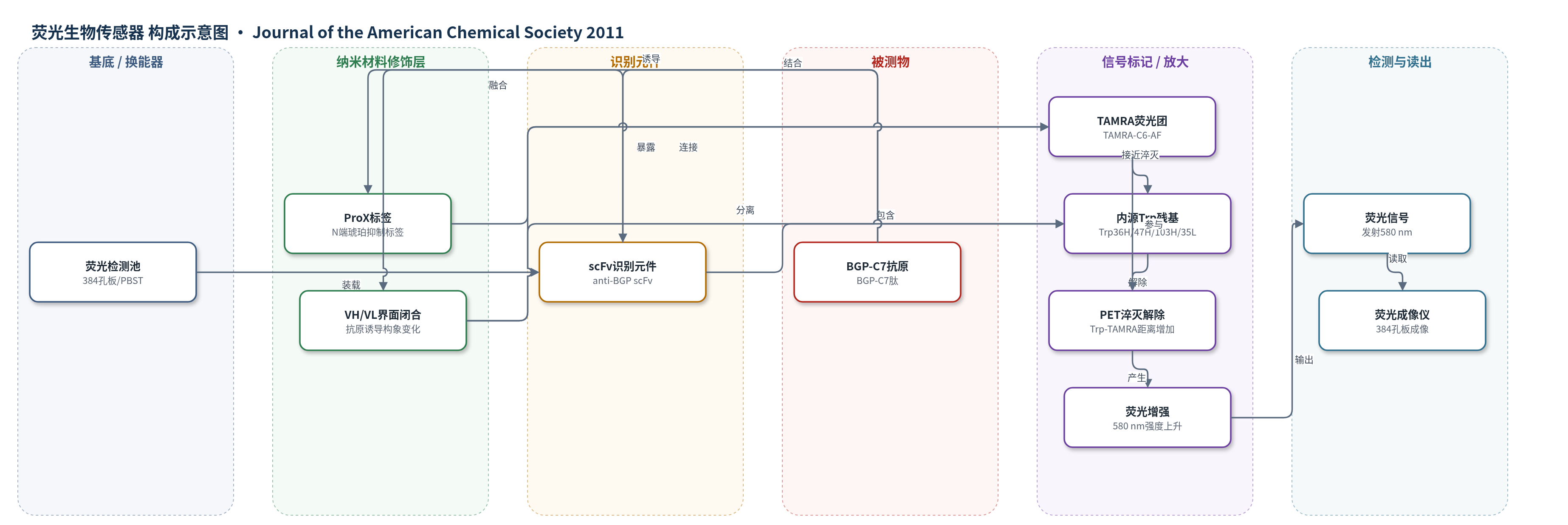
点击图片查看大图 · 依据论文自动绘制
传感器类型
荧光生物传感器
检测对象
骨钙素(osteocalcin/BGP)及其C端肽(BGP-C7、BGP-C10)、双酚A(bisphenol A, BPA)、鸡卵白溶菌酶(hen egg lysozyme, HEL)、牛/人血清白蛋白(BSA/HSA)、17β-雌二醇(17β-estradiol)、吗啡-6-葡萄糖醛酸(morphine-6-glucuronide, M6G)及吗啡/可待因/海洛因;样品基质:PBST缓冲液、50%人血浆、溶液样品。
检测原理
TAMRA-C6-AF 经琥珀抑制 tRNA 定点掺入 scFv N端 ProX 标签,并通过柔性连接臂靠近 scFv VH/VL 界面附近的内源 Trp 残基。无抗原时,Trp 作为电子供体与 TAMRA 发生光诱导电子转移(PET),动态淬灭荧光,580 nm 发射强度较低。抗原与 scFv 结合后,VH/VL 界面闭合或构象收紧,使 TAMRA 与 Trp 残基距离增加、取向改变,PET 效率下降,淬灭解除,荧光增强。荧光增强幅度随抗原浓度升高而增大,可用荧光光谱或微孔板成像定量。该策略无需酶、纳米材料或二次标记,信号放大来自抗体自身 Trp 残基的淬灭开关。
检测灵敏度
ED50: 2.5×10^-8 M(BGP-C7)、1.1×10^-7 M(BGP)、7.5×10^-9 M(HEL)、~10^-5 M(HSA);ED50(competitive ELISA): 8.8×10^-8 M(BGP-C7);EC50: 2.0×10^-8 M(BPA)、1.9×10^-8 M(codeine)、3.7×10^-8 M(heroin)、5.2×10^-8 M(morphine);IC50: 1.4×10^-9 M(BPA, competitive ELISA)、26±12 nM(morphine, competitive ELISA);可检测范围: 1–100 ng/mL(吗啡相关药物,3 min)。
效应效果
该探针保持抗体特异性:BGP-C10 引起 5.8 倍荧光增强,而缺少关键谷氨酸的 BGP-C10dV 无显著增强;Trp 突变体增强幅度下降,说明信号依赖 Trp 淬灭。FCS 显示抗原结合后扩散时间增加,排除荧光单体增加导致假阳性。在 50% 人血浆中,BGP-C7 剂量响应与 PBST 几乎一致,最大荧光达 7 倍,优于 OS-ELISA 在血清样品中易受干扰的表现。吗啡相关探针 3 min 内可检测 1–100 ng/mL 吗啡、可待因和海洛因,对纳洛酮、可卡因、氯胺酮和甲基苯丙胺无显著响应。作者认为其无需洗涤和额外试剂,适用于体外诊断、药物检测及原位/体内成像。
传感器的构成
- 识别元件:抗骨钙素(anti-BGP)scFv 或抗吗啡 scFv,负责特异性结合抗原。
- 信号标记物:TAMRA-C6-AF(5-羧基四甲基罗丹明-己基-苯丙氨酸),经琥珀抑制 tRNA 定点掺入 scFv N端 ProX 标签,作为荧光报告基团。
- 连接臂:ProX 标签及 (Gly4Ser)3 或 (Gly3Ser)n 柔性肽链,连接 TAMRA 与 scFv,调节染料与 Trp 残基距离。
- 淬灭元件:scFv 内源半保守色氨酸(Trp33H、Trp36H、Trp47H、Trp103H、Trp35L),通过 PET 淬灭 TAMRA 荧光。
- 换能/读出:荧光光谱仪或 384 孔板荧光成像仪,检测 580 nm 发射强度变化。
- 样品基质:PBST 缓冲液或 50% 人血浆,用于缓冲和实际样品检测。
中文摘要
本文报道一种新型无试剂荧光生物传感器策略,其原理是抗体结构域上荧光团的淬灭效应随抗原结合而被解除。作者利用无细胞翻译介导的位置特异性蛋白标记系统,将荧光团定点引入抗体单链可变区(scFv)N端,发现 N端标记的 scFv 在结合抗原后出现显著荧光增强。以羧基四甲基罗丹明(TAMRA)标记的抗骨钙素 scFv 为模型,通过突变分析发现抗原依赖性荧光增强依赖于 VH/VL 界面附近半保守色氨酸残基。结果表明,抗原结合使原本靠近连接臂荧光团的 Trp 残基与染料分离,从而中断光诱导电子转移(PET)淬灭。基于 TAMRA-scFv,可定量检测多种靶标,包括肽、蛋白及吗啡相关小分子。即使在人血浆中,其灵敏度与竞争 ELISA 相当或更高。该“淬灭抗体”具有通用性,有望用于体外诊断和多种靶标的原位成像。
英文摘要
Here, we describe a novel reagentless fluorescent biosensor strategy based on the antigen-dependent removal of a quenching effect on a fluorophore attached to antibody domains. Using a cell-free translation-mediated position-specific protein labeling system, we found that an antibody single chain variable region (scFv) that had been fluorolabeled at the N-terminal region showed a significant antigen-dependent fluorescence enhancement. Investigation of the enhancement mechanism by mutagenesis of the carboxytetramethylrhodamine (TAMRA)-labeled anti-osteocalcin scFv showed that antigen-dependency was dependent on semiconserved tryptophan residues near the V(H)/V(L) interface. This suggested that the binding of the antigen led to the interruption of a quenching effect caused by the proximity of tryptophan residues to the linker-tagged fluorophore. Using TAMRA-scFv, many targets including peptides, proteins, and haptens including morphine-related drugs could be quantified. Similar or higher sensitivities to those observed in competitive ELISA were obtained, even in human plasma. Because of its versatility, this "quenchbody" is expected to have a range of applications, from in vitro diagnostics, to imaging of various targets in situ.