组成图示
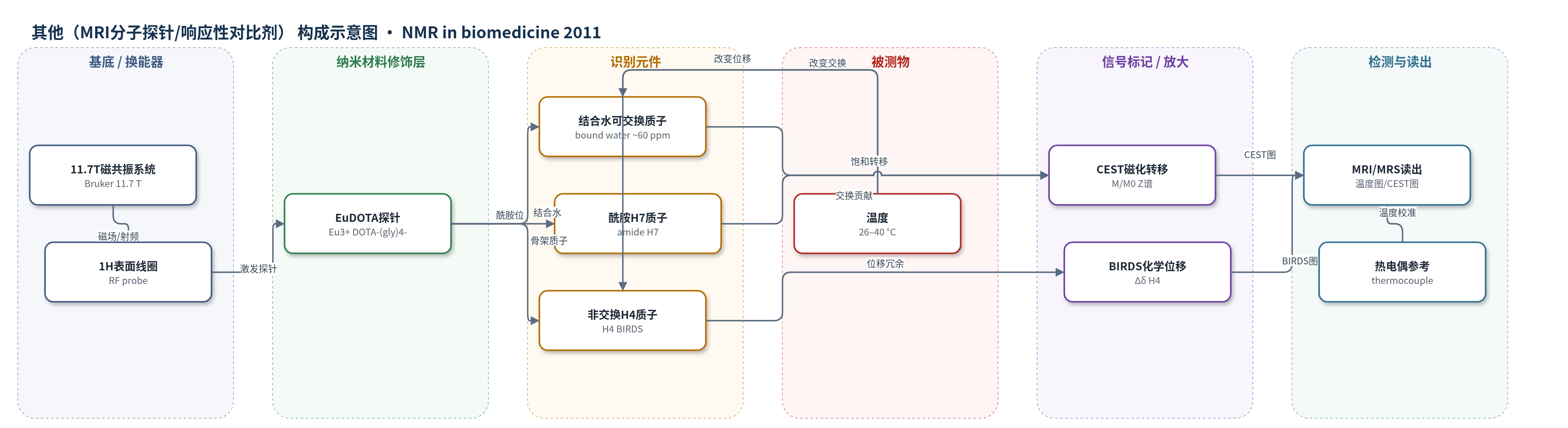
点击图片查看大图 · 依据论文自动绘制
传感器类型
其他(MRI分子探针/响应性对比剂)
检测对象
温度(temperature);样品基质:磷酸盐缓冲液(pH 6.5–8.0)及含 10% D2O 水溶液(体外样品/phantom)
检测原理
EuDOTA-(gly)4- 中 Eu3+ 的顺磁效应使内球结合水质子相对体水产生约 60 ppm 的大化学位移。当射频脉冲预饱和该结合水频率时,结合水与体水之间的质子交换将饱和磁化转移至体水,使体水信号下降,形成 CEST 对比;温度升高加快水交换,CEST 幅度先增大,超过约 40 °C 后因交换过快而下降。同时,DOTA 骨架非交换 H4 质子的化学位移随温度呈二次关系变化,BIRDS 通过化学位移成像测量 H4 位移并用多项式计算绝对温度。该定量温度图可用于校正 CEST 对温度、浓度和实验条件的依赖,实现高空间分辨率的定量分子成像。
检测灵敏度
温度范围: 26–40 °C;温度灵敏度: H4 -0.1299 ± 0.0003 ppm/°C;结合水频率温度灵敏度: 约 -0.22 ppm/°C at 35 °C;相关系数: R = 0.99998;温度标准差: <0.07 °C (SNR 10–30),SNR=25 时 0.01 °C。
效应效果
体外 BIRDS 温度图分别为 22.1 ± 0.1 °C 和 41.6 ± 0.1 °C,与热电偶约 22 °C、42 °C 一致,误差在 0.1 °C 内。CEST 图像体水强度变化为 15 ± 3% 和 32 ± 7%。pH 6.5–8.0 对 CEST 影响较小,TR 影响较小,但 CEST 幅度强烈依赖探针浓度。BIRDS 基于化学位移,受 B0/B1 不均匀性和浓度影响较小;0.8×0.8×2 mm3 体素、SNR 10–30 时温度标准差小于 0.07 °C,与 NAA-水法(0.06 °C,1.6×1.6×4 mm3)相当且分辨率更高。RF 加热较小:CSI 4.5 min 升温 0.024 ± 0.019 °C,CEST MRI 7 min 升温 0.3 ± 0.1 °C。作者认为可用于高空间分辨率定量分子成像。
传感器的构成
- 换能器/检测平台:11.7 T Bruker 磁共振波谱/成像系统,1H 表面线圈射频探头(RF probe),提供 B0/B1 场并接收 1H 信号
- 分子探针主体:EuDOTA-(gly)4-,由 Eu3+ 与 DOTA-(gly)4- 配体配位形成,作为响应性对比剂(RCA)
- CEST 识别/传感位点:配体结合水内球质子(bound water,约 60 ppm)及酰胺 H7 可交换质子,与体水发生质子交换
- BIRDS 识别/传感位点:DOTA 骨架非交换质子(尤其 H4,温度灵敏度最高),其化学位移随温度变化用于定量校准
- 样品基质/缓冲体系:磷酸盐缓冲液(5 mM,pH 6.5–8.0)或含 10% D2O 水溶液,维持 pH 并降低体水背景
- 温度参考/校准:热电偶(thermocouple)与氘代甲醇化学位移法,用于验证样品温度
中文摘要
由镧系(III)离子与1,4,7,10-四氮杂环十二烷-1,4,7,10-四乙酸(DOTA4-)衍生物组成的响应性对比剂(RCA)在磁共振分子成像中具有重要潜力。化学交换饱和转移(CEST)通过检测体水与配体可交换位点或内球结合水之间的质子交换产生对比,其中顺磁镧系离子使结合水信号发生显著化学位移。生物传感器成像冗余位移偏差(BIRDS)则直接观测探针本身,利用其非交换质子共振中储存的温度和/或pH等环境因素冗余信息进行定量成像。CEST与BIRDS分别依赖可交换质子和非交换质子实现生物传感。本文提出将两种传感特性整合于同一RCA中,并采用Eu3+与DOTA-四甘氨酸[DOTA-(gly)4-]形成的EuDOTA-(gly)4-进行验证。体外结果表明,该配合物保留CEST特性,同时可检测BIRDS性质;利用其温度敏感性,可用BIRDS定量磁共振映射校准CEST定性磁共振对比,从而实现高空间分辨率的定量分子成像。
英文摘要
Responsive contrast agents (RCAs) composed of lanthanide(III) ion (Ln3R) complexes with a variety of1,4,7,10-tetraazacyclododecane-1,4,7,10-tetraacetate (DOTA4S) derivatives have shown great potential as molecular imaging agents for MR. A variety of LnDOTA–tetraamide complexes have been demonstrated as RCAs for molecular imaging using chemical exchange saturation transfer (CEST). The CEST method detects proton exchange between bulk water and any exchangeable sites on the ligand itself or an inner sphere of bound water that is shifted by a paramagnetic Ln3R ion bound in the core of the macrocycle. It has also been shown that molecular imaging is possible when the RCA itself is observed (i.e. not its effect on bulk water) using a method called biosensor imaging of redundant deviation in shifts (BIRDS). The BIRDS method utilizes redundant information stored in the nonexchangeable proton resonances emanating from the paramagnetic RCA for ambient factors such as temperature and/or pH.Thus, CEST and BIRDS rely on exchangeable and nonexchangeable protons, respectively, for biosensing. We posited that it would be feasible to combine these two biosensing features into the same RCA (i.e. dual CEST and BIRDS properties). A complex between europium(III) ion (Eu3R) and DOTA–tetraglycinate [DOTA–(gly)S4] was used to demonstrate that its CEST characteristics are preserved, while its BIRDS properties are also detectable. The in vitro temperature sensitivity of EuDOTA–(gly)S4 was used to show that qualitative MR contrast with CEST can be calibrated using quantitative MR mapping with BIRDS, thereby enabling quantitative molecular imaging at high spatial resolution.