组成图示
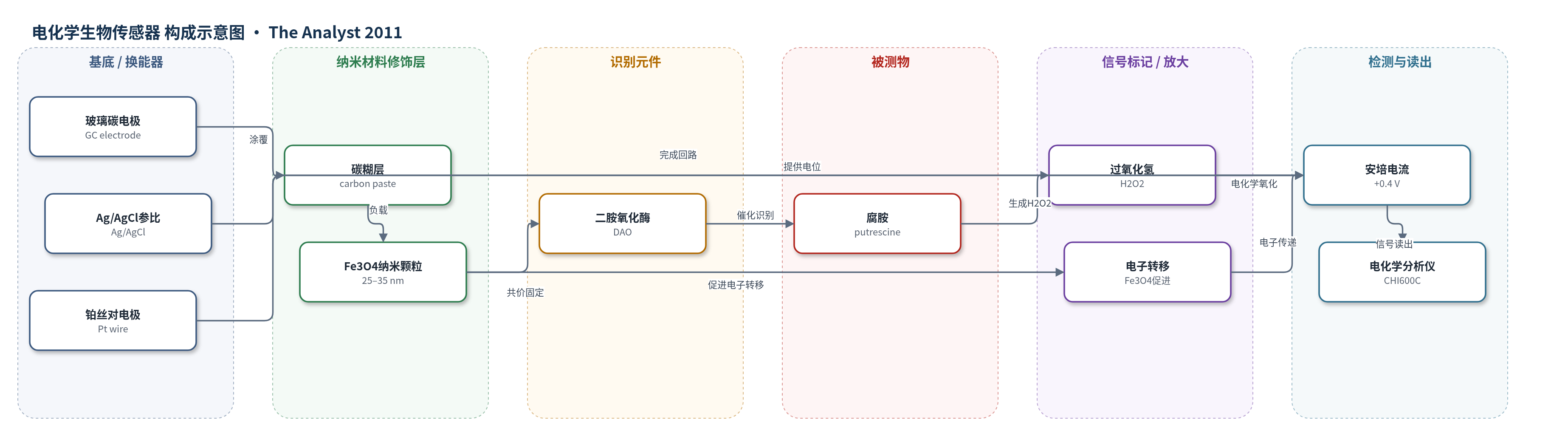
点击图片查看大图 · 依据论文自动绘制
传感器类型
电化学生物传感器
检测对象
腐胺(putrescine,1,4-diaminobutane);样品基质:0.1 M磷酸盐缓冲液(pH 7.2),文中提及可用于血浆/血液等临床样品
检测原理
该传感器以二胺氧化酶(DAO)为识别元件,催化腐胺(putrescine)氧化:腐胺 + H2O + O2 在DAO作用下生成4-氨基丁醛、NH3和H2O2。Fe3O4纳米颗粒通过碳糊负载于玻璃碳电极表面,并经Nafion保护,形成纳米界面,提高酶负载量并促进电子从酶/反应产物向电极传递。生成的H2O2在+0.4 V(vs Ag/AgCl)恒电位下于玻璃碳电极表面发生电化学氧化,反应为H2O2 → 2H+ + O2 + 2e-,产生与H2O2浓度成正比的安培电流。随着腐胺浓度增加,电流呈阶梯式上升。Fe3O4纳米颗粒降低H2O2氧化过电位,使未修饰玻璃碳电极通常需要约+1.2 V的电位降至+0.4 V,从而提高电子转移速率和响应速度。
检测灵敏度
LOD: 0.65 nM;线性范围: 2–8 nM
效应效果
该传感器在2–8 nM范围内对腐胺呈线性响应,最低检测限0.65 nM,响应时间0.3 s,优于引言中报道的50 nM、25 μM等安培法检测限。选择性方面,抗坏血酸(ascorbic acid)在相同电位下可氧化,但加入后未引起电流响应,表明DAO纳米界面传感器具有较高特异性。稳定性方面,连续循环伏安测量50次,10次后峰电流下降4%;将修饰电极储存于pH 7.4磷酸盐缓冲液中,6天后第7天电流下降35%。原文未报告实际生物样品加标回收率、RSD或与ELISA/HPLC/qPCR的直接对比。作者认为该传感器可用于临床和分析样品中低浓度腐胺的快速、灵敏检测。
传感器的构成
- 基底/换能器:玻璃碳电极(GC electrode),提供电化学惰性导电基底并用于安培检测
- 嵌入界面:碳糊(carbon paste),涂覆于GC表面,作为GC与DAO标记Fe3O4纳米颗粒之间的嵌入界面
- 纳米材料修饰层:四氧化三铁纳米颗粒(Fe3O4 nanoparticles,25–35 nm),热共沉淀法合成,提供高比表面积并促进电子转移
- 识别元件:二胺氧化酶(DAO,porcine kidney diamine oxidase),通过碳二亚胺(EDC)活化共价连接于Fe3O4表面,催化腐胺氧化生成H2O2
- 保护/封闭层:Nafion 溶液(5 μL),涂覆于酶标记纳米颗粒表面,起保护酶和纳米颗粒的作用
- 电化学池:Ag/AgCl 参比电极与铂丝对电极,配合CHI600C电化学分析仪完成恒电位安培检测
中文摘要
腐胺(1,4-丁二胺)是一种具有生物活性的二胺,在临床诊断与分析检测中具有重要价值。本研究开发了一种基于二胺氧化酶(DAO)与四氧化三铁(Fe3O4)纳米颗粒构建的电化学生物传感器,用于定量检测由鸟氨酸脱羧产生的腐胺。Fe3O4纳米颗粒采用热共沉淀法合成,粒径为25–35 nm,具有制备简单、比表面积大和成本低等优点。DAO通过碳二亚胺活化与Fe3O4表面共价连接,并经傅里叶变换红外光谱(FT-IR)确认。检测时,将酶标记的Fe3O4纳米颗粒涂覆于玻璃碳工作电极表面,在+0.4 V(vs Ag/AgCl)恒电位下进行安培检测,铂丝作为对电极。DAO催化腐胺氧化生成过氧化氢(H2O2),H2O2在电极表面发生电化学反应产生电流。传感器在2–8 nM范围内呈线性响应,最低检测限为0.65 nM,响应时间为0.3 s。抗坏血酸等常见干扰物不产生响应,表明该纳米界面酶传感器具有较高特异性,可用于临床和分析样品中低浓度腐胺的快速检测。
英文摘要
Putrescine (1,4-diaminobutane) a biologically active diamine has been found to be a valuable analyte for several clinical and analytical purposes. The present work deals with diamine oxidase immobilized on iron oxide nanoparticles for quantifying the amount of putrescine produced, by the decarboxylation of ornithine, which is converted into hydrogen peroxide by the enzyme diamine oxidase (DAO). This reaction can be quantified using electrochemical techniques, which forms the basis of this work. Iron oxide (Fe(3)O(4)) nanoparticles, synthesized using thermal co-precipitation, were chosen for immobilization of DAO due to its simple preparation procedure, high surface area and cost-effectiveness. The size of the particles was in the range of 25-35 nm and the enzyme was linked covalently by carbodiimide activation and confirmed using FT-IR. For detecting the hydrogen peroxide released in the reaction, a glassy carbon-working electrode coated with enzyme linked iron oxide nanoparticles was poised at +0.4 V versus an Ag/AgCl reference electrode and a platinum wire was used as the counter electrode. A step-wise increase in current was observed and linearity was obtained in the range of 2-8 nM, with 0.65 nM as the minimum detection limit and the response time was found to be 0.3 seconds. Ascorbic acid, a common interfering molecule in biological samples, did not interfere with the measurements indicating the high degree of specificity of the diamine oxidase-based nano-interfaced biosensor.