组成图示
点击图片查看大图 · 依据论文自动绘制
传感器类型
综述或非传感器论文
检测对象
人Raf-1蛋白激酶Ras结合域(hRaf-1 RBD,GST-hRaf-1 RBD)、ABP-hRaf-15-143融合蛋白;样品基质为重组蛋白溶液、细胞裂解液或HBS-ET缓冲液
检测原理
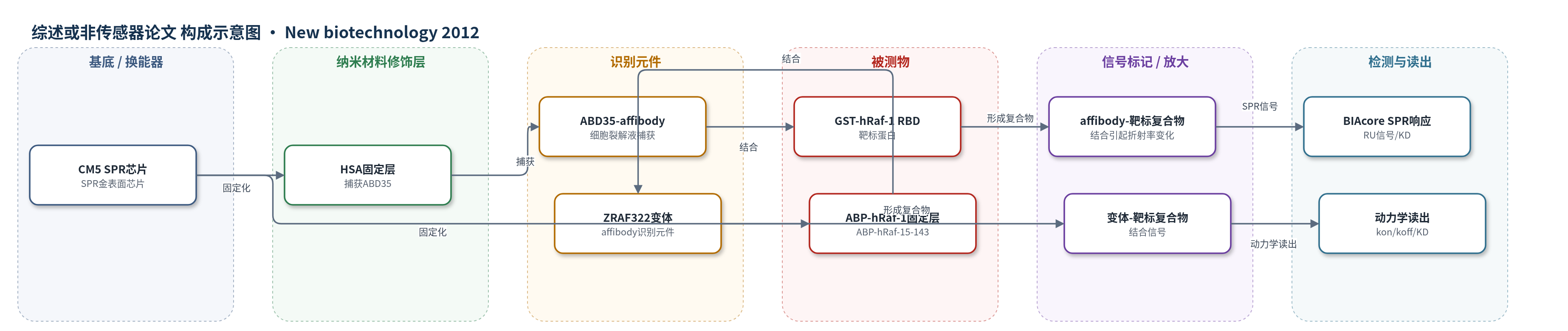
本文使用SPR生物传感器监测affibody与hRaf-1的结合。CM5芯片表面固定HSA或ABP-hRaf-15-143。ABD35-affibody融合蛋白经HSA捕获后,流动GST-hRaf-1 RBD;或affibody变体直接结合固定ABP-hRaf-15-143。识别事件使芯片金表面附近质量/折射率增加,SPR共振角改变,BIAcore以响应单位(RU)记录结合与解离曲线。结合量随靶标或affibody浓度变化,1:1 Langmuir模型拟合得到kon、koff和KD。该过程无化学放大,信号直接反映结合事件;通过参考通道和缓冲液扣除消除非特异结合。
检测灵敏度
原文未报告LOD、线性范围、灵敏度斜率或相关系数。
效应效果
两轮epPCR-RD进化后,第二轮选择池对hRaf-1 RBD的SPR结合响应较亲本ZRAF322约提高2倍。测序显示A27V在83%克隆中富集,并伴随F5Y、N10Y、A12V、I31V等替换。四个单克隆变体ZRAF322:01–04对ABP-hRaf-15-143的KD为190–90 nM,较亲本1.9 μM提高13–27倍,主要源于koff降低。CD显示二级结构保持,Tm为50.3–51.4°C,ZRAF322:04为43.3°C;热变性后重折叠谱完全重叠。77个人源蛋白片段微珠多重分析显示各变体选择性结合ABP-hRaf-15-143,信背比高。作者认为这些变体可作研究MAPK/ERK通路的亲和试剂。
传感器的构成
- SPR基底:CM5 sensorchip,作为表面等离子共振换能芯片,用于固定化与结合监测
- 捕获固定层:人血清白蛋白(HSA,约9000 RU),固定于CM5表面,用于捕获ABD35-affibody融合蛋白
- 识别/结合元件:ABD35-affibody融合蛋白或ZRAF322变体,ABD35结合HSA,affibody结合hRaf-1 RBD
- 靶标固定层:ABP-hRaf-15-143(约2950 RU),固定于CM5表面,用于结合affibody变体并测定动力学
- 分析物:GST-hRaf-1 RBD或ABP-hRaf-15-143,作为hRaf-1 RBD靶标,与捕获的affibody结合
- 缓冲/再生体系:HBS-ET缓冲液和10 mM glycine-HCl pH 2,用于流动、结合与表面再生
中文摘要
本文首次报道基于逐步体外分子进化的Affibody亲和力成熟:对ZRAF322全部58残基三螺旋束基因进行错误PCR(epPCR)扩增引入多样性,再用核糖体展示(RD)筛选。ZRAF322以1.9 μM KD结合人Raf-1(hRaf-1),后者是MAPK/ERK通路关键蛋白激酶。进化过程通过DNA测序和SPR生物传感器结合分析在基因与蛋白水平监测。两轮多样化-选择后,选定池结合响应显著提高;测序显示A27V替换在83%克隆中富集,并伴随F5Y、N10Y、A12V、I31V等替换。最终获得对hRaf-1亲和力提高最多26倍的变体,且最高亲和力变体在框架位点也出现替换。热熔分析显示亲和力提高可伴随更高或更低Tm。所有变体重折叠性能优异,并在多重微珠结合分析中选择性结合hRaf-1,可作细胞生物学研究亲和试剂。
英文摘要
The use of library technologies for the generation of affinity proteins often includes an affinity maturation step, based on the construction of secondary libraries from which second generation variants with improved affinities are selected. Here, we describe for the first time the affinity maturation of affibody molecules based on step-wise in vitro molecular evolution, involving cycles of error-prone PCR (epPCR) amplification for the introduction of diversity over the entire 58-residue three-helix bundle structure and ribosome display (RD) for the selection of improved variants. The model affibody molecule for the process was Z(RAF322), binding with a 1.9μm equilibrium dissociation constant (K(D)) to human Raf-1 (hRaf-1), a protein kinase of central importance in the MAPK/ERK proliferation pathway. The molecular evolution process was followed on both gene and protein levels via DNA sequencing and a biosensor-based binding analysis of pools of selected variants. After two cycles of diversification and selection, a significant increase in binding response of selected pools was seen. DNA sequencing showed that a dominant alanine to valine substitution had been effectively enriched, and was found in 83% of all selected clones, either alone or in combination with other enriched substitutions. The evolution procedure resulted in variants showing up to 26-fold increases in affinity to the hRaf-1 target. Noteworthy, for the two variants showing the highest affinities, substitutions were also found in affibody framework positions, corresponding to regions of the protein domain not addressed by traditional affibody molecule affinity maturation strategies. Interestingly, thermal melting point (T(m)) analyses showed that an increased affinity could be associated with both higher and lower T(m) values. All investigated variants showed excellent refolding properties and selective binding to hRaf-1, as analysed using a multiplexed bead-based binding assay, making them potentially valuable affinity reagents for cell biology studies.