组成图示
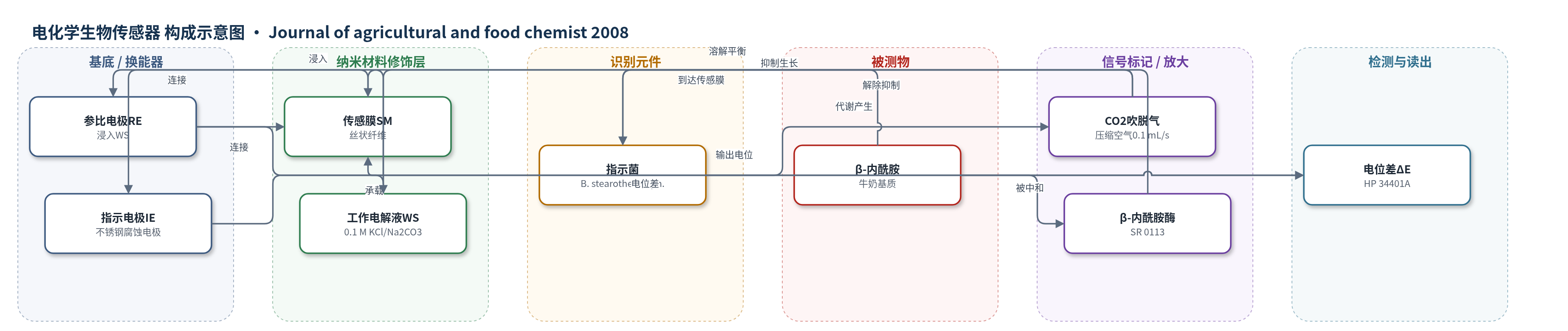
点击图片查看大图 · 依据论文自动绘制
传感器类型
电化学生物传感器
检测对象
β-内酰胺类抗生素残留(β-lactam residues,包括青霉素类 penicillins:青霉素G penicillin G、氨苄西林 ampicillin、阿莫西林 amoxicillin、苯氧甲基青霉素 oxacillin、氯唑西林 cloxacillin、双氯西林 dicloxacillin;头孢菌素类 cephalosporins:头孢哌酮 cefoperazone、头孢唑林 cefazolin);样品基质:生乳/牛奶(raw milk/milk)
检测原理
该混合生物传感器以 Bacillus stearothermophilus var. calidolactis 作为生物识别元件。指示菌在63 °C牛奶中生长代谢并产生CO2;当牛奶中存在β-内酰胺时,抗生素抑制菌体生长,使CO2产生速率下降。压缩空气以0.1 mL/s将微生物产生的CO2吹脱并送入电化学CO2传感器。CO2溶解于工作电解液(0.1 M KCl/Na2CO3,CO2饱和)后改变碳酸盐平衡,使参比电极与不锈钢指示电极之间的电位差ΔE降低。ΔE与CO2浓度相关,CO2浓度又反映菌生长程度,因此β-内酰胺浓度越高,抑制越强,ΔE下降越明显。加入广谱β-内酰胺酶可选择性水解β-内酰胺,使CO2产生恢复,用于推定鉴定。
检测灵敏度
线性范围: from 10 to 10^4 µL L-1;校准测试范围: 348–6600 µL of CO2 L-1 of synthetic air;灵敏度斜率(k value): about 20 mV;分辨率: 0.5 µL L-1 at 400 µL L-1;相关系数: r2 = 0.9991;校准方程: y = 0.0011x + 1.6173
效应效果
方法对8种β-内酰胺在MRL水平下均可从120 min检出,180 min时ΔE下降40%–52%(青霉素G -51%,氨苄西林/头孢哌酮 -42%);高浓度下青霉素G -52%。ANOVA除MRL奥沙西林P<0.05外均P<0.001。CO2标准物质准确度97%–106%,CV 0.8%–2.4%,r2=0.9991。相比常规微生物抑制法节省45–60 min,60–120 min后延长孵育不影响结果,避免额外15 min孵育假阴性。电化学读数避免指示剂主观判读。广谱β-内酰胺酶可中和高浓度β-内酰胺,未中和抑制提示非β-内酰胺抑制剂。作者认为符合Decision 2002/657/EC,适用于牛奶β-内酰胺定性筛查。
传感器的构成
- 换能器电极:混合生物传感器(HyBS)原电池(galvanic cell),参比电极(RE)浸入工作电解液(WS),通过丝状纤维(silk filament)连接不锈钢指示电极(IE),将CO2浓度变化转换为电位差ΔE
- 传感膜/电解液:丝状纤维(SM,亲水材料)承载工作电解液(WS,0.1 M KCl、Na2CO3 10^-4–10^-2 M、CO2饱和),用于CO2溶解平衡并减少其他气体干扰
- 生物识别元件:Bacillus stearothermophilus var. calidolactis 孢子悬液(5×10^4 cfu/mL,Mueller-Hinton broth),在63 °C生长并产生CO2,受β-内酰胺抑制
- 样品反应体系:生乳(raw milk)及β-内酰胺加标乳,提供被测物与微生物抑制反应基质
- 推定鉴定试剂:广谱β-内酰胺酶混合物(broad spectrum β-lactamase mixture,SR 0113,Oxoid;β-lactamase I/II),选择性中和β-内酰胺并恢复CO2产生
- 吹脱气源:压缩空气(compressed air in cylinder,0.1 mL/s),将微生物产生的CO2吹脱并输送至电化学装置
- 信号读出:电位计/多用电表(Hewlett-Packard 34401A)与计算机(Agilent Intui Link),采集并处理ΔE数据
中文摘要
本文报道了一种新型混合生物传感器,用于牛奶中β-内酰胺类抗生素残留的检测与推定鉴定。该方法基于对二氧化碳(CO2)的测量,CO2的产生与指示菌 Bacillus stearothermophilus var. calidolactis 的微生物生长相关。牛奶中β-内酰胺的存在会抑制该菌生长,从而降低CO2产生速率。分析通过比较含β-内酰胺加标的牛奶样品与同时加入广谱β-内酰胺酶的孪生样品之间的CO2变化实现,并设置空白牛奶作为对照;电化学装置记录CO2浓度变化对应的电位差。实验在63 °C孵育条件下进行,所有受试β-内酰胺在最大残留限量水平下均可从120 min开始检出,180 min时电位差下降约40%–52%。由于该方法能识别多种β-内酰胺,当需要后续化学鉴定和定量时可缩短总分析时间。作者认为该方法适用于牛奶质量控制中的定性筛查,并符合欧盟 Decision 2002/657/EC 对筛查方法的要求。
英文摘要
A novel application of a hybrid biosensor is here employed as an analytical method for the detection and presumptive identification of beta-lactam residues in milk. The method is based on measurements of carbon dioxide (CO2), the production of which is related to the microbial growth of the test microorganism Bacillus stearothermophilus var. calidolactis. The presence of beta-lactams in milk inhibits microbial growth and, consequently, the CO2 production rate. The analysis is based on the variation of CO2 between a milk sample spiked with beta-lactams and a twin milk sample containing beta-lactams plus a broad spectrum beta-lactamase, using an electrochemical device of biosensor. A blank milk sample is included as control. The result is obtained starting from the first 120 min. Moreover, the ability to recognize all of the beta-lactams speeds the total time of analysis when chemical identification and quantification are required. The analytical method appears to be adequate for milk control for qualitative screening purposes, complying with the requirements stated in Decision 2002/657/EC.