组成图示
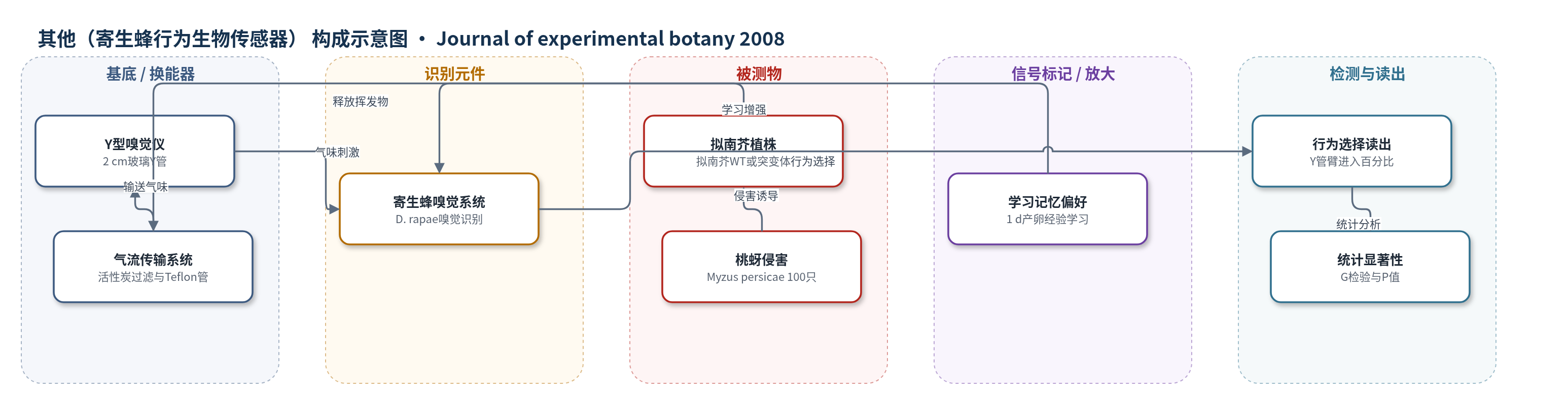
点击图片查看大图 · 依据论文自动绘制
传感器类型
其他(寄生蜂行为生物传感器)
检测对象
蚜虫诱导拟南芥挥发物(aphid-induced Arabidopsis volatiles);样品基质:拟南芥植株或桃蚜侵害植株释放的挥发物气流
检测原理
桃蚜 Myzus persicae 取食拟南芥后,激活植物十八碳烷酸/茉莉酸(JA)、乙烯(ET)和水杨酸(SA)等伤口响应通路,诱导释放特定挥发物混合物。挥发物经 1.0 L 瓶收集,由活性炭过滤空气和 Teflon 管以 400 ml/min 双路气流送入 Y 型嗅觉仪。经 1 d 产卵经验学习过受侵害野生型拟南芥挥发物的雌性 Diaeretiella rapae 寄生蜂,其嗅觉系统识别进入选择区的气味,并与学习模板匹配;挥发物组成和浓度越接近学习模板,寄生蜂进入相应臂的倾向越强。行为选择比例作为信号读出,反映挥发物组成与浓度差异。该传感不依赖化学标记或电子放大,而依靠寄生蜂学习记忆与趋化行为实现高选择性检测。
检测灵敏度
原文未报告 LOD、线性范围、灵敏度斜率或相关系数。
效应效果
双选择实验中,学习过的雌性 D. rapae 显著偏好受桃蚜侵害野生型拟南芥挥发物(G1=15.90,P<0.001),也偏好未损伤 cev1 突变体(G1=8.66,P<0.01)。受侵害野生型比受侵害 coi1-16 更吸引(G1=4.28,P<0.05),而受侵害与未损伤 coi1-16 无显著差异(G1=2.34,P>0.05),支持 COI1/JA 通路必要性。受侵害野生型比受侵害 NahG 更吸引(G1=4.61,P<0.05),受侵害 NahG 比未损伤 NahG 更吸引(G1=11.25,P<0.001)。每组每天 4–7 只蜂,多日重复。作者认为该寄生蜂生物传感器比传统分析设备更敏感,可用于解析植物信号通路并开发蚜虫生物防治方法。
传感器的构成
- 换能器基底:玻璃 Y 型嗅觉仪(2 cm 直径、18 cm 主干、16 cm 臂、100°角),提供双路气味选择空间。
- 气流传输层:活性炭过滤空气、Teflon 管、T 型分流和流量计(400 ml/min),将挥发物以双路气流送入 Y 管。
- 样品源:拟南芥 Arabidopsis thaliana 野生型(WT)或突变体(cev1、coi1-16、NahG、npr-1),未损伤或 100 只桃蚜 Myzus persicae 侵害 3 d,释放挥发物。
- 挥发物源容器:1.0 L 快速盖玻璃瓶,放置植株并收集挥发物。
- 识别元件:雌性 Diaeretiella rapae 寄生蜂,经 1 d 产卵经验学习受侵害 WT 挥发物,作为学习型生物识别单元。
- 信号读出:寄生蜂在 Y 管选择区(每臂前 3 cm)进入某一臂的行为选择,记录吸引百分比并用 G 检验分析。
中文摘要
昆虫食草造成的植物损伤可诱导植物释放挥发物,这些挥发物能吸引食草昆虫的天敌,但蚜虫诱导植物挥发物产生的生化通路仍不清楚。蚜虫寄生蜂 Diaeretiella rapae 能够检测并响应拟南芥(Arabidopsis thaliana)受桃蚜侵害后释放的挥发物;在获得相应挥发物经验后,它可学习这些线索,并可作为新型生物传感器用于检测这些挥发物。本研究通过比较 D. rapae 对多种拟南芥转基因突变体及野生型植株挥发物的行为响应,解析蚜虫诱导挥发物产生的通路。突变体分别涉及十八碳烷酸(octadecanoid, OD)、乙烯(ethylene, ET)或水杨酸(salicylic acid, SA)伤口响应通路,植株处于未损伤或受桃蚜 Myzus persicae 侵害状态。结果表明,OD 通路,尤其是 COI1 基因,是蚜虫诱导挥发物产生所必需的;水杨酸的存在也参与挥发物产生。该模型结合单点基因突变拟南芥,有望精确解析蚜虫诱导挥发物产生的生化通路。
英文摘要
Feeding damage to plants by insect herbivores induces the production of plant volatiles, which are attractive to the herbivores natural enemies. Little is understood about the plant biochemical pathways involved in aphid-induced plant volatile production. The aphid parasitoid Diaeretiella rapae can detect and respond to aphid-induced volatiles produced by Arabidopsis thaliana. When given experience of those volatiles, it can learn those cues and can therefore be used as a novel biosensor to detect them. The pathways involved in aphid-induced volatile production were investigated by comparing the responses of D. rapae to volatiles from a number of different transgenic mutants of A. thaliana, mutated in their octadecanoid, ethylene or salicylic acid wound-response pathways and also from wild-type plants. Plants were either undamaged or infested by the peach-potato aphid, Myzus persicae. It is demonstrated that the octadecanoid pathway and specifically the COI1 gene are required for aphid-induced volatile production. The presence of salicylic acid is also involved in volatile production. Using this model system, in combination with A. thaliana plants with single point gene mutations, has potential for the precise dissection of biochemical pathways involved in the production of aphid-induced volatiles.