组成图示
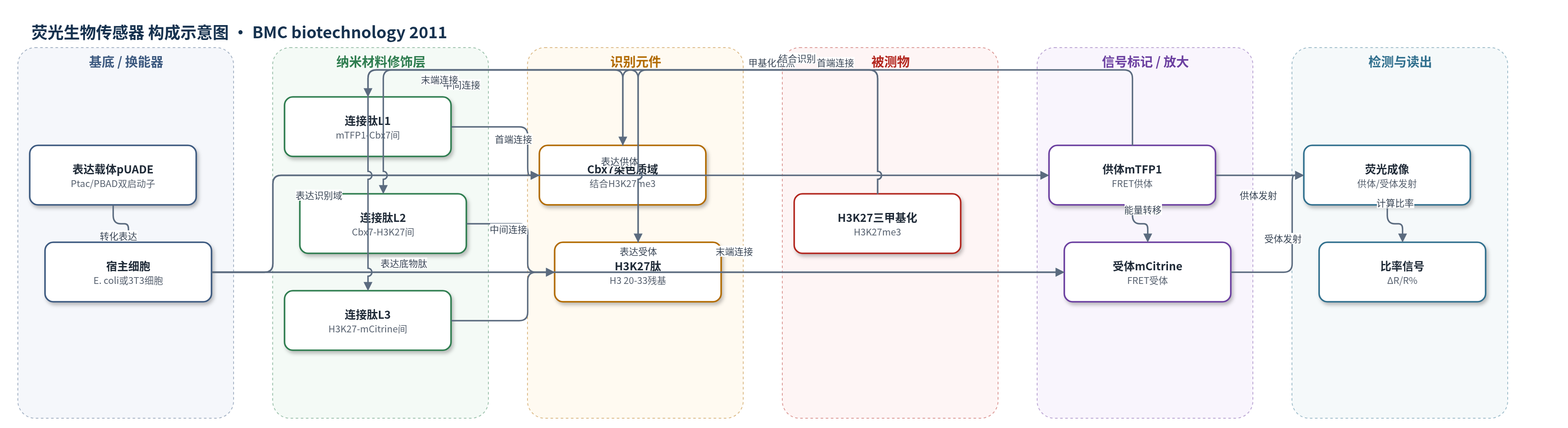
点击图片查看大图 · 依据论文自动绘制
传感器类型
荧光生物传感器
检测对象
H3K27 三甲基化(H3K27 trimethylation, H3K27me3)、H3K27 甲基转移酶活性(H3K27 methyltransferase activity);样品基质:大肠杆菌菌落表达体系、体外重组蛋白缓冲液、3T3 细胞染色质。
检测原理
该传感器为遗传编码 FRET 荧光蛋白,由 mTFP1 供体、Cbx7 染色质域、含 H3K27 的组蛋白 H3 20-33 肽和 mCitrine 受体经连接肽串联。未甲基化时,Cbx7 不结合 H3K27,构象较伸展,供体-受体距离较大,FRET 效率低,供体发射强而受体敏化发射弱。当 vSET 在 SAM 存在下将 H3K27 三甲基化后,Cbx7 结合 H3K27me3,诱导构象压缩,缩短或改变 mTFP1 与 mCitrine 的距离/取向,FRET 效率升高,能量从 mTFP1 转移至 mCitrine,供体发射下降、受体发射上升。通过 494 nm 供体与 526 nm 受体发射比率(或受体/供体)读出,信号随甲基化程度增加而升高。菌落筛选中,L-阿拉伯糖诱导 vSET 表达,使同一克隆在诱导与抑制条件下产生可比较的 FRET 比率变化。
检测灵敏度
未报告LOD、线性范围、灵敏度斜率或相关系数。
效应效果
筛选显示 Cbx7 为最优识别域:高 ΔR/R% 克隆中 9 个含 Cbx7、1 个含 Cbx7 A91K,低响应克隆未检出 Cbx7。低分辨率连接肽文库平均比率变化 14%(SD 4%),高分辨率文库平均 38%(SD 16%)。优化后 H3K27-MetBio2 为 37%,H3K27-MetBio3 为 66%,较初始 H3K27-MetBio1 的 29% 提高 2.3 倍;三种传感器被 vSET 甲基化速率相近。3T3 细胞表达 H2B-H3K27-MetBio3 后存活并进入有丝分裂,间期染色质出现与抗 H3K27 免疫荧光相似的斑点状高 FRET 区域,但仍需共定位验证。作者认为该均相 FRET 检测比现有组蛋白甲基转移酶体外检测所需试剂和移液步骤更少,适用于高通量筛选 H3K27 甲基转移酶抑制剂。
传感器的构成
- 表达载体:pUADE 质粒,Ptac 驱动传感器、PBAD 驱动 vSET,实现双表达与诱导
- 供体荧光蛋白:mTFP1,FRET 供体,激发 426-446 nm,发射 460-500 nm
- 连接肽 L1:mTFP1 与 Cbx7 间柔性连接肽,H3K27-MetBio3 中为 -2 残基
- 识别域:Cbx7 chromodomain,特异性结合三甲基化 H3K27
- 底物/识别肽:组蛋白 H3 20-33 残基(含 H3K27),提供甲基化位点并参与 Cbx7 识别
- 连接肽 L2:Cbx7 与 H3K27 肽间连接肽,H3K27-MetBio3 中为 20 残基,调节未甲基化态距离
- 连接肽 L3:H3K27 肽与 mCitrine 间连接肽,H3K27-MetBio3 中为 -2 残基,压缩甲基化态 FRET 对
- 受体荧光蛋白:mCitrine,FRET 受体,发射 520-550 nm
- 诱导酶:vSET,PBAD 诱导表达,催化 H3K27 三甲基化,用于菌落功能筛选
中文摘要
基于荧光蛋白(FP)的分子内 Förster 共振能量转移(FRET)生物传感器可在活细胞中可视化多种生化事件。构建此类传感器需要在两种不同颜色 FP 之间插入经过选择的分子识别元件。当识别元件与目标分析物相互作用并发生构象变化时,由于 FRET 效率改变,构建体的比率发射信号发生变化。此类传感器的灵敏度与比率发射变化成正比,因此迫切需要方法最大化现有 FRET 构建体的比率变化,以扩大其应用范围。为加速改进型 FRET 生物传感器的开发与优化,作者建立了一种在大肠杆菌菌落中对生物传感器变体进行功能性高通量筛选的方法。作者以检测组蛋白 H3 第 27 位赖氨酸甲基化(H3K27)的生物传感器为模型,构建了 3 个文库并进行筛选:包含多个经噬菌体展示筛选获得的工程化结合域的域文库、低分辨率连接肽文库和高分辨率连接肽文库。应用该文库筛选方法获得了优化的 H3K27 三甲基化生物传感器,其发射比率变化为 66%,较初始构建体的 29% 提高 2.3 倍。
英文摘要
BACKGROUND: Fluorescent protein (FP)-based biosensors based on the principle of intramolecular Förster resonance energy transfer (FRET) enable the visualization of a variety of biochemical events in living cells. The construction of these biosensors requires the genetic insertion of a judiciously chosen molecular recognition element between two distinct hues of FP. When the molecular recognition element interacts with the analyte of interest and undergoes a conformational change, the ratiometric emission of the construct is altered due to a change in the FRET efficiency. The sensitivity of such biosensors is proportional to the change in ratiometric emission, and so there is a pressing need for methods to maximize the ratiometric change of existing biosensor constructs in order to increase the breadth of their utility.
RESULTS: To accelerate the development and optimization of improved FRET-based biosensors, we have developed a method for function-based high-throughput screening of biosensor variants in colonies of Escherichia coli. We have demonstrated this technology by undertaking the optimization of a biosensor for detection of methylation of lysine 27 of histone H3 (H3K27). This effort involved the construction and screening of 3 distinct libraries: a domain library that included several engineered binding domains isolated by phage-display; a lower-resolution linker library; and a higher-resolution linker library.
CONCLUSION: Application of this library screening methodology led to the identification of an optimized H3K27-trimethylation biosensor that exhibited an emission ratio change (66%) that was 2.3 × improved relative to that of the initially constructed biosensor (29%).