组成图示
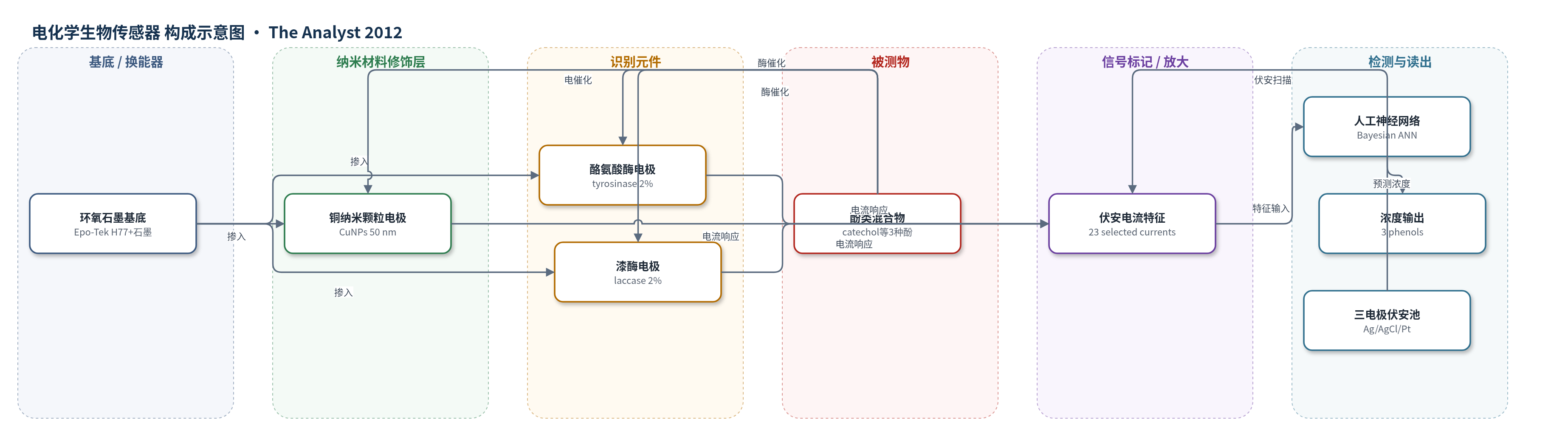
点击图片查看大图 · 依据论文自动绘制
传感器类型
电化学生物传感器
检测对象
儿茶酚(catechol)、咖啡酸(caffeic acid)、(−)-儿茶素((−)-catechin);样品基质为 0.1 M 磷酸盐缓冲液(含 0.1 M KCl,pH 6.5)及加标葡萄酒
检测原理
酚类被测物与阵列中不同酶/纳米材料发生差异化反应:酪氨酸酶以 O2 将单酚羟基化为邻苯二酚并进一步氧化为邻醌,邻醌在负电位被电化学还原为邻二酚,形成催化循环;漆酶将酚氧化为苯氧自由基并进一步生成醌,醌同样可被电化学还原;铜纳米颗粒提供电催化响应。上述界面反应使各工作电极在扫描电位下产生随酚浓度变化的伏安电流,但峰位重叠。系统从 4 个电极的伏安图中提取 23 个特征电流,作为 ANN 输入,通过多元校准解卷积重叠信号,分别输出三种酚的浓度。
检测灵敏度
predicted vs. expected slope: >0.970(外部测试集,n=10);浓度范围: 0–200 mM(每种多酚);示例相关系数: catechin 训练 r=0.983,测试 r=0.961
效应效果
该 BioET 对三种酚的分辨定量能力良好,外部测试集预测-期望斜率优于 0.970。与单电极伏安图建模相比,阵列模型 RMSE 为 5–6 mM,而单传感器为 9–13 mM;单传感器比较斜率低于 0.9(最差约 0.3),相关系数可低至 0.90,咖啡酸甚至约 0.80。加标葡萄酒经重新训练和留一法验证后,平均回收率为儿茶酚 104.0%、咖啡酸 116.7%、儿茶素 121.9%,表明系统可缓解基质效应。作者认为其可作为与 HPLC 相当、用于葡萄酒及其他饮料中酚类混合物分辨的实用工具。
传感器的构成
- 基底/工作电极:环氧树脂 Epo-Tek H77 与固化剂(20:3 w/w)及 15% 石墨粉混合,形成导电环氧-石墨伏安工作电极
- 识别/催化元件1:酪氨酸酶(tyrosinase,2% w/w)整体掺入环氧-石墨,催化酚羟基化/氧化并产生差异化伏安响应
- 识别/催化元件2:漆酶(laccase,2% w/w)整体掺入环氧-石墨,催化酚氧化为苯氧自由基/醌,提供第二响应通道
- 纳米修饰/催化元件:铜纳米颗粒(CuNPs,50 nm,2% w/w)整体掺入环氧-石墨,提供电催化/混合响应
- 参比电极:Ag/AgCl 电极(Orion 900200),用于三电极伏安测量电位参考
- 辅助电极:铂电极(Crison 52-67),完成伏安测量回路
- 化学计量读出模块:人工神经网络(ANN,Bayesian regularization/BP-ANN),对 23 个特征电流进行多元校准并输出三种酚浓度
中文摘要
本文报道了一种由酶生物传感器阵列构成的生物电子舌(BioET)系统,用于多酚分析,重点针对葡萄酒中的主要多酚。该传感器阵列由环氧-石墨生物传感器组成,整体掺入不同氧化还原酶(酪氨酸酶和漆酶)及铜纳米颗粒,以同时测定不同多酚。原始信息为传感器阵列产生的一组伏安图,通过选取若干特征电流对数据进行降维,供人工神经网络(ANN)使用。经ANN模型优化后,用于混合物中各化合物的分辨与定量。儿茶酚、咖啡酸和儿茶素构成三分析物案例研究,获得了良好的预测能力,外部测试集(n=10)预测值与期望值斜率优于0.970,可实现三种酚的分别定量。此外,BioET在加标葡萄酒样品中测试,回收率分别为104%、117%和122%。
英文摘要
This work reports the application of a Bio-Electronic Tongue (BioET) system made from an array of enzymatic biosensors in the analysis of polyphenols, focusing on major polyphenols found in wine. For this, the biosensor array was formed by a set of epoxy-graphite biosensors, bulk-modified with different redox enzymes (tyrosinase and laccase) and copper nanoparticles, aimed at the simultaneous determination of the different polyphenols. Departure information was the set of voltammograms generated with the biosensor array, selecting some characteristic features in order to reduce the data for the Artificial Neural Network (ANN). Finally, after the ANN model optimization, it was used for the resolution and quantification of each compound. Catechol, caffeic acid and catechin formed the three-analyte case study resolved in this work. Good prediction ability was attained, therefore allowing the separate quantification of the three phenols with predicted vs. expected slope better than 0.970 for the external test set (n = 10). Finally, BioET has been also tested with spiked wine samples with good recovery yields (values of 104%, 117% and 122% for catechol, caffeic acid and catechin, respectively).