组成图示
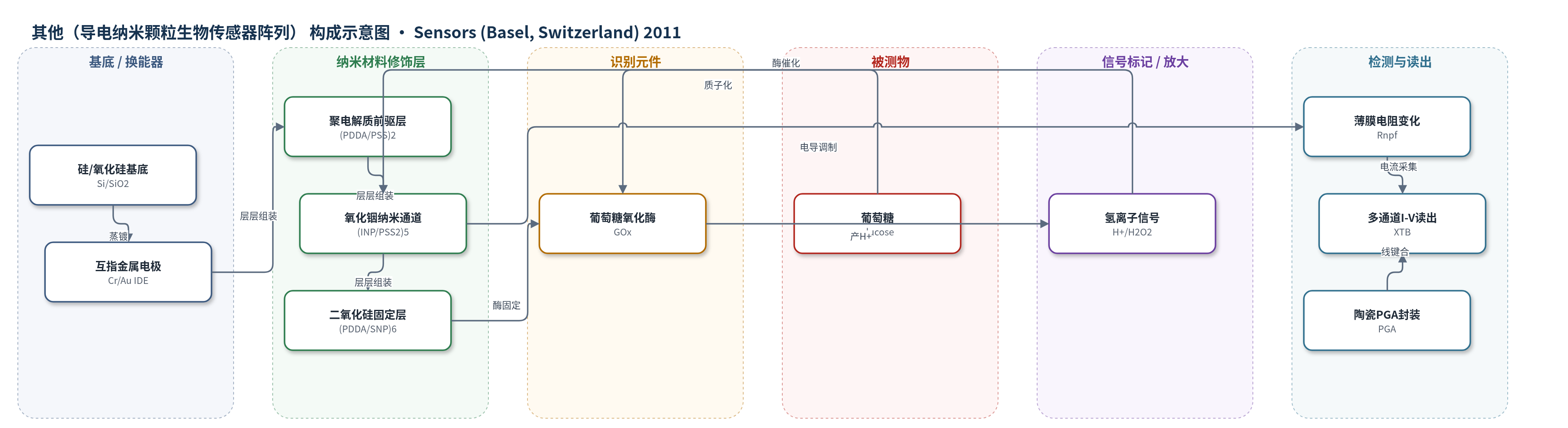
点击图片查看大图 · 依据论文自动绘制
传感器类型
其他(导电纳米颗粒生物传感器阵列)
检测对象
葡萄糖(glucose);样品基质:PBS缓冲液/标准葡萄糖溶液
检测原理
葡萄糖氧化酶(GOx)催化葡萄糖氧化,生成葡萄糖酸/过氧化氢并释放氢离子(H+)。H+扩散至n型氧化铟(In2O3)纳米颗粒薄膜附近,使表面羟基发生质子化/去质子化,增加表面正电荷并打开更多导电通道,从而降低纳米颗粒薄膜电阻(Rnpf)。在互指电极间施加偏压时,由于微缩结构中双电层电容(Cdl)较大且采用直流测量,电流主要经纳米颗粒薄膜而非体相溶液传输,因此电流随葡萄糖浓度升高而增大。高浓度下受酶动力学限制出现饱和,表观Michaelis-Menten常数约20 mM。
检测灵敏度
灵敏度: 4–12 nA/mM(channel lengths of 5–20 µm);表观Michaelis-Menten常数: 20 mM;分通道灵敏度: 5 µm 11.9±3.9 nA/mM、10 µm 5.7±2.6 nA/mM、15 µm 4.4±1.5 nA/mM、20 µm 6.9±2.9 nA/mM;分通道表观K_M: 20.3、20.1、19.6、17.7 mM。
效应效果
在PBS标准葡萄糖溶液中,芯片40个传感位点中的多数位点可检测葡萄糖,单步进样即可获得浓度依赖电流;归一化电流随葡萄糖浓度升高并因酶动力学出现饱和。不同通道长度灵敏度不同:5 µm为11.9±3.9 nA/mM,10 µm为5.7±2.6 nA/mM,15 µm为4.4±1.5 nA/mM,20 µm为6.9±2.9 nA/mM;表观K_M约20 mM,20 µm为17.7 mM,低于游离GOx但高于CNT-LbL GOx的14.2 mM。其他离子影响较小。作者认为该阵列可用于多分析物传感器、生物检测平台和芯片实验室。
传感器的构成
- 基底/换能器电极:硅片热氧化层(SiO2)上电子束蒸发Cr(300 Å)和Au(1000 Å)互指电极,形成源/漏电极与电阻通道
- 表面预处理:O2等离子体处理使表面亲水,便于水相LbL组装
- 前驱多层:(PDDA/PSS)2聚电解质层,增强表面电荷并作为LbL起始层
- 半导体通道层:(INP/PSS2)5氧化铟纳米颗粒/聚苯乙烯磺酸钠层,形成离子敏感导电纳米颗粒薄膜
- 酶固定层:(PDDA/SNP)6聚二烯丙基二甲基氯化铵/二氧化硅纳米颗粒层,提供带电荷表面基团用于酶固定
- 识别元件:葡萄糖氧化酶(GOx)通过(PDDA/GOx)层固定在SNP层,催化葡萄糖氧化
- 样品环境:PBS缓冲液和葡萄糖标准溶液经注射泵进入8 mm微腔,提供反应介质
- 读出封装:陶瓷针栅阵列(PGA)线键合连接多通道I–V测量系统(XTB),施加偏压并采集电流
中文摘要
本文报道了一种导电纳米颗粒生物传感器阵列,用于解决纳米材料生物传感器因纳米颗粒薄膜随机网络特性导致的电学性质显著波动问题。氧化铟纳米颗粒(INP)和二氧化硅纳米颗粒(SNP)通过层层自组装(LbL)选择性组装在电阻的多通道区域。为展示酶传感能力,将葡萄糖氧化酶(GOx)固定在SNP层上用于葡萄糖检测。传感器芯片封装到陶瓷针栅阵列(PGA)上,采用注射泵驱动进样和多通道I–V测量系统进行测试。结果表明,葡萄糖可在芯片内多个不同传感位点被检测,并产生与浓度相关的电流。灵敏度取决于电阻通道长度,在5–20 µm通道长度下为4–12 nA/mM,表观Michaelis–Menten常数约为20 mM。利用传感器阵列,只需单步进样即可获得分析数据。该工作为所开发的纳米颗粒微传感器阵列用于多分析物传感器、新型生物检测平台和芯片实验室中的传感组件提供了依据。
英文摘要
We report a conductometric nanoparticle biosensor array to address the significant variation of electrical property in nanomaterial biosensors due to the random network nature of nanoparticle thin-film. Indium oxide and silica nanoparticles (SNP) are assembled selectively on the multi-site channel area of the resistors using layer-by-layer self-assembly. To demonstrate enzymatic biosensing capability, glucose oxidase is immobilized on the SNP layer for glucose detection. The packaged sensor chip onto a ceramic pin grid array is tested using syringe pump driven feed and multi-channel I-V measurement system. It is successfully demonstrated that glucose is detected in many different sensing sites within a chip, leading to concentration dependent currents. The sensitivity has been found to be dependent on the channel length of the resistor, 4-12 nA/mM for channel lengths of 5-20 μm, while the apparent Michaelis-Menten constant is 20 mM. By using sensor array, analytical data could be obtained with a single step of sample solution feeding. This work sheds light on the applicability of the developed nanoparticle microsensor array to multi-analyte sensors, novel bioassay platforms, and sensing components in a lab-on-a-chip.