组成图示
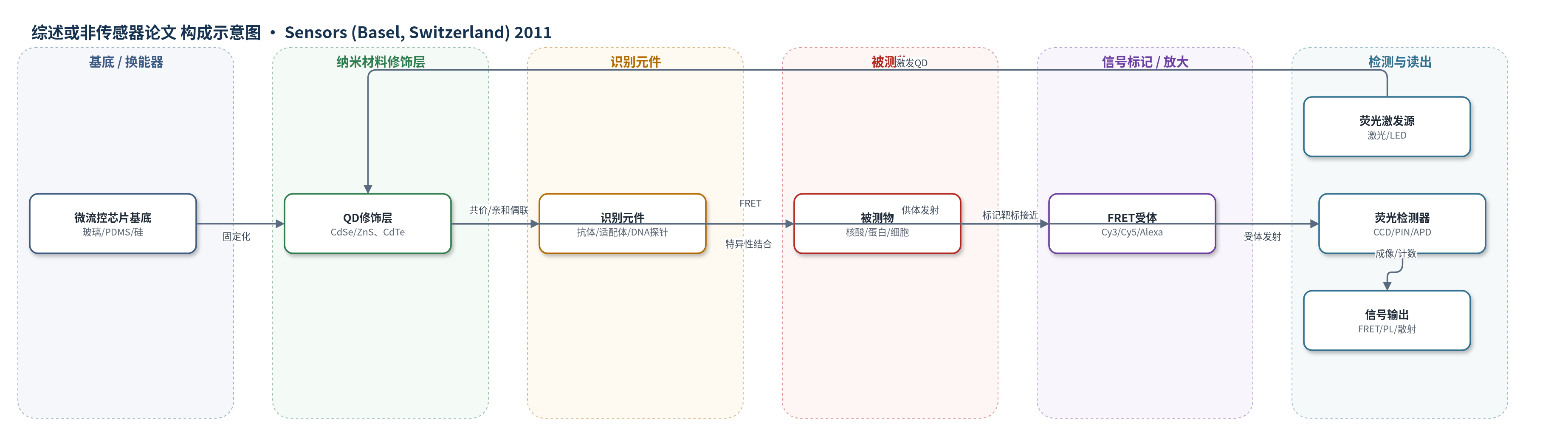
点击图片查看大图 · 依据论文自动绘制
传感器类型
综述或非传感器论文
检测对象
核酸(DNA/RNA,缓冲液)、抗体/蛋白质(缓冲液、人血清)、癌症生物标志物 CEA、CA125、Her-2(人血清、全唾液)、血栓素 thrombin(缓冲液)、大肠杆菌 E. coli(样品/缓冲液)、凋亡细胞(细胞培养液)、有机小分子/氨基酸(溶液、单细胞裂解液)
检测原理
典型 QD 微流控传感以 QD 作为荧光供体或编码标签,表面通过 MPA、streptavidin、PEG 或 EDC/NHS 化学连接抗体、适配体、DNA 探针等识别元件。目标物结合后,使标记有 Cy3、Cy5、Alexa Fluor 等受体的靶标靠近 QD,FRET 效率随供体-受体距离变化,表现为受体荧光增强或供体猝灭;若目标物未标记,则可用 QD 标记检测抗体形成夹心复合物,PL 或散射信号随浓度增加。微流控通过层流、电迁移聚焦、毛细电泳或单分子检测体积提高传质、降低背景并实现多重检测;CRET 中 luminol 激发 QD,活性基团抑制能量转移产生信号。多受体 FRET 和单分子计数提供放大。
检测灵敏度
LOD: 0.1 µg/mL;LOD: 100 ng/mL;LOD: 200 ng/mL;LOD: 50 ng/mL;LOD: 10 ng/mL;线性范围: 0–100 ng/mL、0–60 ng/mL、0–400 U/mL;LOD: 0.02 ng/mL;LOD: 0.27 ng/mL;LOD: 215 mIU/mL;LOD: 158 mIU/mL;LOD: 250 fmol/L;LOD: 2.5 pmol/L
效应效果
综述报道的 QD 微流控体系具有良好选择性与低背景:非互补核酸、非特异适配体、700 倍 HSA 和 72 µg/mL 凝血酶原均无显著信号;单分子检测接近零背景,鞘流减少非特异吸附。灵敏度方面,CRET 比 LIF 高 10–1000 倍,单细胞分泌氨基酸达 attomole/cell;QD 微流控免疫芯片比 ELISA 约高 2 倍,三联感染微流控检测比 FDA 批准方法高 50 倍,样品 <100 µL、分析 <1 h。实际样品中 CEA 人血清 LOD 2.5 pmol/L,血清/全唾液可测 CEA、CA125、Her-2。QD 抗光漂白,表面可再生,适合 POC 多重诊断。
传感器的构成
- 基底/换能器:玻璃、PDMS、硅或塑料微流控芯片,提供微通道与表面固定化平台
- 纳米材料修饰层:CdSe/ZnS、CdTe、CdS、InP 等 QD,作为荧光供体/信号纳米材料
- 识别元件:抗体、适配体、DNA 探针、抗原或酶,固定于 QD 或微球表面用于选择性结合
- 信号标记物:Cy3、Cy5、Alexa Fluor 647/488、FITC、luminol 或 FluoSpheres,用于 FRET/荧光/散射读出
- 封闭/洗涤:BSA、Tween-20 或未标记寡核苷酸,降低非特异吸附并封闭剩余位点
- 读出系统:激光/LED 激发、CCD、PIN/APD 或荧光显微镜,采集 QD 与受体荧光信号
中文摘要
半导体量子点(QD)因其高量子产率、宽吸收、窄对称可调发射、长荧光寿命和优异抗光漂白等光学特性,已成为多种生物传感与生物探针技术中的信号发生平台。QD 在荧光共振能量转移(FRET)中可作为供体,并适合光学多重检测。然而,多数 QD 生物探针和传感技术依赖体相溶液环境,表面选择性结合常需较长时间达到稳态信号。微流控系统(MFS)可将化学与生物过程集成于单一平台,通过样品输送与混合操控流动条件,使反应速率不再完全受扩散控制。将检测体系集成到 MFS 中还可减少试剂和样品用量、实现检测前样品处理、提高灵敏度、通量和分析速度,并支持原位监测。本文系统综述了 QD 基微流控生物传感器的关键概念与应用,重点讨论 QD 生物探针的微流控构建(合成、固定化、原位衍生化)以及快速临床/诊断技术(固定化 QD 检测核酸、多重生物标志物检测和细胞操控),并说明该组合如何推动生物检测设计创新。
英文摘要
Semiconductor quantum dots (QDs) have served as the basis for signal development in a variety of biosensing technologies and in applications using bioprobes. The use of QDs as physical platforms to develop biosensors and bioprobes has attracted considerable interest. This is largely due to the unique optical properties of QDs that make them excellent choices as donors in fluorescence resonance energy transfer (FRET) and well suited for optical multiplexing. The large majority of QD-based bioprobe and biosensing technologies that have been described operate in bulk solution environments, where selective binding events at the surface of QDs are often associated with relatively long periods to reach a steady-state signal. An alternative approach to the design of biosensor architectures may be provided by a microfluidic system (MFS). A MFS is able to integrate chemical and biological processes into a single platform and allows for manipulation of flow conditions to achieve, by sample transport and mixing, reaction rates that are not entirely diffusion controlled. Integrating assays in a MFS provides numerous additional advantages, which include the use of very small amounts of reagents and samples, possible sample processing before detection, ultra-high sensitivity, high throughput, short analysis time, and in situ monitoring. Herein, a comprehensive review is provided that addresses the key concepts and applications of QD-based microfluidic biosensors with an added emphasis on how this combination of technologies provides for innovations in bioassay designs. Examples from the literature are used to highlight the many advantages of biosensing in a MFS and illustrate the versatility that such a platform offers in the design strategy.