组成图示
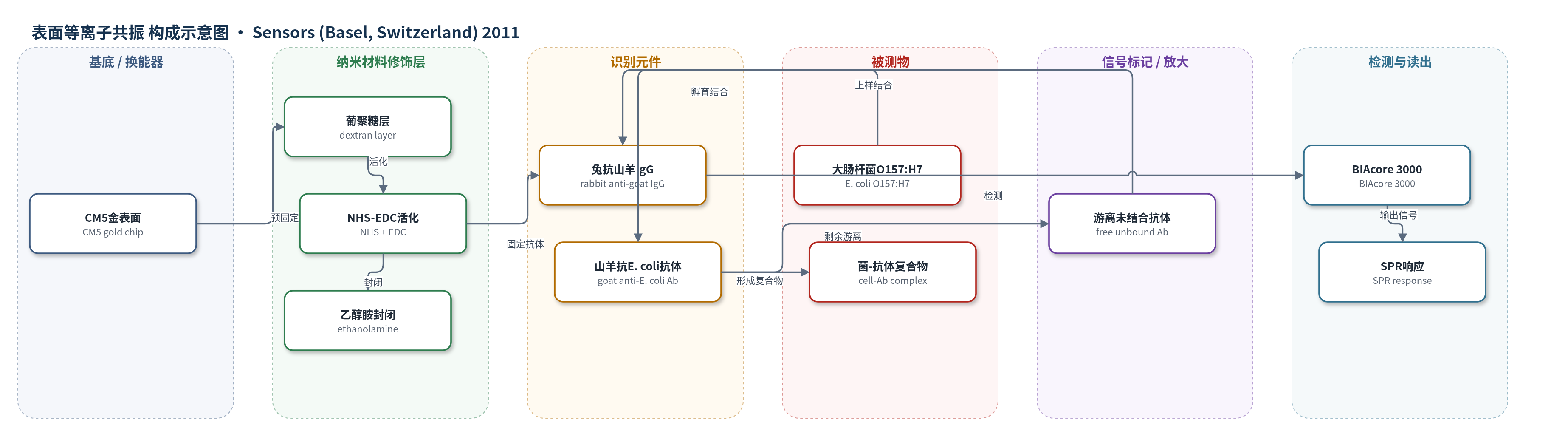
点击图片查看大图 · 依据论文自动绘制
传感器类型
表面等离子共振(SPR)生物传感器
检测对象
大肠杆菌O157:H7(E. coli O157:H7),样品基质为细菌悬液/缓冲液(PBS或HBS运行缓冲液)
检测原理
检测时,E. coli O157:H7菌体与山羊抗E. coli O157:H7多克隆抗体在溶液中短时孵育,菌体表面抗原与抗体结合形成菌-抗体复合物;随后通过逐步离心去除结合抗体的菌体,上清中剩余游离未结合抗体的量随菌浓度升高而减少。将上清注入CM5芯片,游离山羊抗体与芯片上固定的兔抗山羊IgG多克隆抗体发生蛋白-蛋白结合,使SPR界面附近质量/折射率增加,BIAcore 3000以响应单位(RU)记录结合信号。因此菌浓度越高,剩余抗体越少,SPR响应越低。该方法将大尺寸细菌检测转化为小分子蛋白相互作用,避免细菌超出倏逝场约300 nm、微流道剪切力和空间位阻造成的灵敏度损失。
检测灵敏度
LOD: 3.0 × 10^4 cfu/mL;线性范围: 3.0 × 10^4–3.0 × 10^8 cfu/mL
效应效果
该SPR减法抑制法对非目标菌E. coli DH5α(3.0×10^8 cfu/mL)仅产生37 RU的弱交叉响应,而E. coli O157:H7(3.0×10^8 cfu/mL)响应为283 RU,显示良好选择性。标准曲线各点(3.0×10^8至3.0×10^4 cfu/mL)标准偏差分别为7.6%、1.7%、3.1%、5.1%、1.7%,空白对照RSD为3.5%,重现性良好。芯片经50次结合-再生循环后表面活性下降6.0%,稳定性较好。与直接SPR和ELISA(LOD均为3.0×10^5 cfu/mL)相比,本法LOD降至3.0×10^4 cfu/mL,提高一个数量级。作者称检测时间少于2 h,单次样品量仅5 μL,可用于食品中E. coli O157:H7及其他病原的快速监测。
传感器的构成
- 基底/换能器:CM5传感器芯片(CM5 sensor chip,金表面预固定葡聚糖层),提供SPR换能表面与可活化氨基位点
- 活化层:NHS与EDC混合液(0.1 M NHS、0.4 M EDC)活化葡聚糖层,形成与抗体氨基反应的位点
- 识别/捕获元件:兔抗山羊IgG多克隆抗体(rabbit anti-goat IgG polyclonal antibody,100 μg/mL)通过酰胺键固定,捕获游离山羊抗E. coli O157:H7抗体
- 封闭/失活层:1 M乙醇胺(ethanolamine,pH 8.5)封闭未反应位点,降低非特异结合
- 溶液识别元件:山羊抗E. coli O157:H7多克隆抗体(goat polyclonal antibody,25 μg/mL)与菌体孵育,识别E. coli O157:H7
- 分离介质:逐步离心(50、200、400、800、1200、1800、3200 × g,每档2 min)去除菌-抗体复合物,保留游离抗体
- 运行/再生介质:HBS运行缓冲液(10 mM HEPES、150 mM NaCl、3.8 mM EDTA、0.05% Tween)与15 mM NaOH再生液
中文摘要
本文报道了一种基于表面等离子共振(SPR)的免疫传感器,用于检测大肠杆菌O157:H7(E. coli O157:H7)。该方法采用新的减法抑制法:先将E. coli O157:H7菌体与山羊抗E. coli O157:H7多克隆抗体短时孵育,再通过逐步离心去除结合抗体的菌体;随后利用BIAcore 3000生物传感器检测剩余游离未结合抗体,使其与固定在传感器芯片上的兔抗山羊IgG多克隆抗体相互作用。结果表明,SPR信号与E. coli O157:H7浓度在3.0×10^4至3.0×10^8 cfu/mL范围内呈负相关,检出限为3.0×10^4 cfu/mL。与直接固定抗体于芯片表面捕获菌体的SPR方法及ELISA法(本文检出限均为3.0×10^5 cfu/mL)相比,减法抑制法将检出限降低一个数量级。该方法将细菌细胞检测简化为蛋白-蛋白相互作用,有望为E. coli O157:H7及其他病原体的监测提供实用替代方案。
英文摘要
A surface plasmon resonance (SPR) immunosensor was developed for the detection of E. coli O157:H7 by means of a new subtractive inhibition assay. In the subtractive inhibition assay, E. coli O157:H7 cells and goat polyclonal antibodies for E. coli O157:H7 were incubated for a short of time, and then the E. coli O157:H7 cells which bound antibodies were removed by a stepwise centrifugation process. The remaining free unbound antibodies were detected through interaction with rabbit anti-goat IgG polyclonal antibodies immobilized on the sensor chip using a BIAcore 3000 biosensor. The results showed that the signal was inversely correlated with the concentration of E. coli O157:H7 cells in a range from 3.0 × 10(4) to 3.0 × 10(8) cfu/mL with a detection limit of 3.0 × 10(4) cfu/mL. Compared with direct SPR by immobilizing antibodies on the chip surface to capture the bacterial cells and ELISA for E. coli O157:H7 (detection limit: both 3.0 × 10(5) cfu/mL in this paper), the detection limit of subtractive inhibition assay method was reduced by one order of magnitude. The method simplifies bacterial cell detection to protein-protein interaction, which has the potential for providing a practical alternative for the monitoring of E. coli O157:H7 and other pathogens.