组成图示
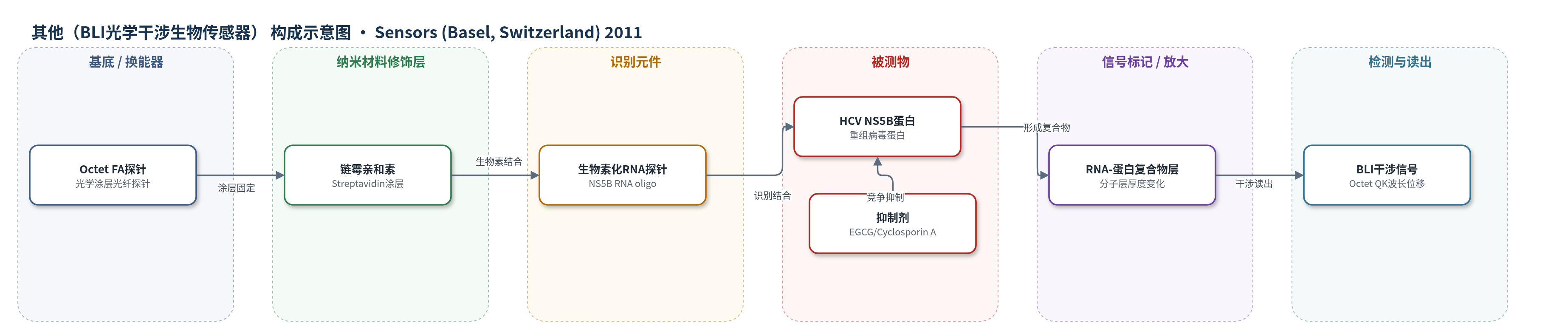
点击图片查看大图 · 依据论文自动绘制
传感器类型
其他(BLI光学干涉生物传感器)
检测对象
HCV NS5B病毒蛋白(Hepatitis C virus NS5B viral protein, HCV NS5B);抑制剂筛选对象包括(-)-表没食子儿茶素没食子酸酯(EGCG)、环孢素A(Cyclosporin A)。样品基质:重组蛋白溶液/磷酸盐缓冲液(10 mmol/L磷酸盐、2 mmol/L EDTA、1 mmol/L PMSF, pH 7.4)。
检测原理
Octet FA探针表面预包被链霉亲和素,生物素化RNA寡核苷酸通过生物素-链霉亲和素作用固定在探针表面,形成捕获层。当样品中的HCV NS5B蛋白与RNA探针特异性结合时,探针表面分子层厚度增加。BLI换能机制利用白光在光纤探针内部参考层与分子层/溶液界面之间的反射干涉:结合物增多使光程差改变,干涉光谱发生波长位移,实时反映结合量。结合和解离阶段可计算kon、koff及kd。NS5B浓度越高,结合信号越强;抑制剂与NS5B结合后竞争阻断RNA探针结合,使信号下降,从而实现定量检测和抑制剂筛选。
检测灵敏度
LOD: 700 pg mL−1;浓度测试范围: 7×100 μg mL−1–7×10⁻⁴ μg mL−1;信号随浓度逐渐增加至 7 μg mL−1;结合亲和力(kd): 6.3 nM
效应效果
该传感器对HCV NS5B具有选择性,BSA作为阴性参考未检测到结合信号,背景与空白相似。RNA探针捕获水平为2.65±0.32 nm,标准差在仪器噪声范围内。方法检测限为700 pg/mL,低于文献报道的ELISA约2 ng/mL和量子点RNA适配体传感器1 ng/mL,结合亲和力kd为6.3 nM。抑制剂筛选中,环孢素A呈浓度依赖性抑制,EGCG显示较强结合抑制,其他黄酮类化合物无抑制。作者认为该方法无标记、实时、快速、低成本、操作简便,可用于HCV NS5B蛋白定量和抗病毒抑制剂高通量筛选。
传感器的构成
- 换能器/基底:Octet FA光纤探针(FA tip),光学涂层光纤,作为BLI干涉换能器
- 修饰层:链霉亲和素(Streptavidin),预包被于FA探针,通过生物素-链霉亲和素作用捕获RNA探针
- 识别元件:生物素化RNA寡核苷酸(biotinylated RNA oligonucleotide, NS5B: 5'-ggccacauugugaggggcuc-3'-biotin),特异性识别HCV NS5B蛋白
- 信号层:RNA-NS5B复合物(label-free molecular layer),结合后增加探针表面分子层厚度
- 信号读出:Octet QK BLI仪器,白光干涉监测分子层厚度变化并输出波长位移
中文摘要
全球约有1.7亿人感染丙型肝炎病毒(HCV),可引发慢性肝炎、肝硬化等严重肝病。检测HCV病毒蛋白对诊断和监测具有重要意义,但现有基于抗体的酶联免疫吸附试验(ELISA)存在早期感染难以检出、假阳性或假阴性等局限。为克服上述瓶颈,RNA适配体作为抗体替代物被用于生物传感器检测病毒蛋白。本研究建立了一种基于链霉亲和素-生物素偶联的RNA适配体传感器系统,利用生物素化RNA寡核苷酸在Octet光学生物传感器上对HCV NS5B病毒蛋白进行无标记、实时定量,检测水平达700 pg/mL。同时,该方法可用于在生物素化RNA寡核苷酸生物传感器上快速、简单地筛选HCV NS5B蛋白抑制剂。在筛选的化合物中,(-)-表没食子儿茶素没食子酸酯(EGCG)对HCV NS5B病毒蛋白表现出较强的结合抑制作用。所提方法可作为HCV病毒蛋白抑制剂筛选的实时监测平台,并有望推广至其他疾病相关靶标检测。
英文摘要
Globally, over 170 million people (ca. 3% of the World's population) are infected with the hepatitis C virus (HCV), which can cause serious liver diseases such as chronic hepatitis, evolving into subsequent health problems. Driven by the need to detect the presence of HCV, as an essential factor in diagnostic medicine, the monitoring of viral protein has been of great interest in developing simple and reliable HCV detection methods. Despite considerable advances in viral protein detection as an HCV disease marker, the current enzyme linked immunosorbent assay (ELISA) based detection methods using antibody treatment have several drawbacks. To overcome this bottleneck, an RNA aptamer become to be emerged as an antibody substitute in the application of biosensor for detection of viral protein. In this study, we demonstrated a streptavidin-biotin conjugation method, namely, the RNA aptamer sensor system that can quantify viral protein with detection level of 700 pg mL(-1) using a biotinylated RNA oligonucleotide on an Octet optical biosensor. Also, we showed this method can be used to screen inhibitors of viral protein rapidly and simply on a biotinylated RNA oligonucleotide biosensor. Among the inhibitors screened, (-)-Epigallocatechin gallate showed high binding inhibition effect on HCV NS5B viral protein. The proposed method can be considered a real-time monitoring method for inhibitor screening of HCV viral protein and is expected to be applicable to other types of diseases.