组成图示
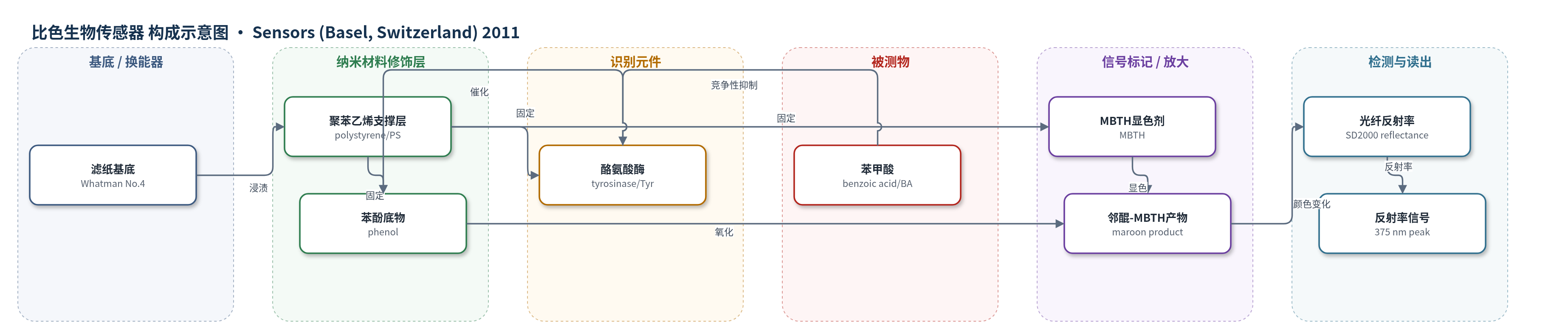
点击图片查看大图 · 依据论文自动绘制
传感器类型
比色生物传感器
检测对象
苯甲酸(benzoic acid, BA);样品基质:食品样品(酱油、蚝油)及苯甲酸水溶液
检测原理
试纸条中固定酪氨酸酶(Tyr)、苯酚和 MBTH。在无苯甲酸时,Tyr 催化苯酚羟基化生成邻苯二酚,并进一步氧化为邻醌;邻醌与无色 MBTH 反应生成栗色邻醌-MBTH 产物,使试纸条呈深栗色。苯甲酸作为竞争性抑制剂与 Tyr 活性位点结合,降低酶-底物复合物形成,减少邻醌和显色产物生成,试纸条颜色变浅。颜色变化通过光纤反射率分光光度计转换为反射率信号,最大反射峰位于 375 nm;苯甲酸浓度越高,反射率越高,在 100–700 ppm 范围内呈线性响应。该过程依赖酶催化显色反应,无额外核酸或酶催化沉积放大。
检测灵敏度
LOD: 73.6 ppm;线性范围: 100–700 ppm;斜率: 92.68 a.u./ppm;R^2 = 0.99
效应效果
试纸条重现性良好,10次重复测量RSD为0.47%。在1:1浓度下,氯化钠、柠檬酸、抗坏血酸和硼酸均产生正干扰,干扰率分别为4.7%、6.8%、13.1%和21.2%,其中硼酸干扰最大,说明其可能轻微抑制酪氨酸酶。试纸条在3 °C保存20天内反射信号基本稳定,之后缓慢下降并失去功能。实际酱油和蚝油样品检测结果与HPLC法一致:酱油HPLC为592.3±0.8 ppm,试纸条为604.0±10 ppm,相对误差+1.9%;蚝油HPLC为662.0±16 ppm,试纸条为680.0±5 ppm,相对误差+2.6%。作者认为该方法简单、快速、成本低,可作为食品中苯甲酸检测的替代手段。
传感器的构成
- 基底/载体:Whatman No.4 滤纸,作为试纸条基质并承载固定组分。
- 识别/催化元件:酪氨酸酶(tyrosinase, Tyr),固定于滤纸,催化苯酚氧化。
- 底物/反应物:苯酚(phenol),固定于滤纸,作为 Tyr 底物生成邻醌前体。
- 显色/信号标记:MBTH(3-methyl-2-benzothiazolinone hydrazone),固定于滤纸,与邻醌结合形成栗色产物。
- 聚合物支撑层:聚苯乙烯(polystyrene, PS),以四氢呋喃(THF)浸渍于试纸条,提供聚合物支撑并稳定组分。
中文摘要
本研究通过浸渍法将酪氨酸酶、苯酚和3-甲基-2-苯并噻唑腙(MBTH)固定于滤纸,并以聚苯乙烯作为聚合物支撑,成功制备了用于检测苯甲酸的光学试纸条。传感机制基于试纸条栗色强度随苯甲酸溶液接触而降低。采用光纤反射光谱对试纸条进行表征,最大反射峰位于375 nm。试纸条对苯甲酸具有高度可重复性,10次重复测量相对标准偏差为0.47%。检测在pH 7下优化,在100–700 ppm苯甲酸范围内呈线性响应,检出限为73.6 ppm。在1:1干扰物比较中,硼酸为主要干扰物。动力学分析表明苯甲酸为酪氨酸酶的竞争性抑制剂,抑制常数Ki为52.9 ppm。试纸条在3 °C保存20天内活性基本保持。将该试纸条用于食品样品中苯甲酸检测,结果与高效液相色谱法相当,可作为食品中苯甲酸检测的替代方法。
英文摘要
Fabrication of a test strip for detection of benzoic acid was successfully implemented by immobilizing tyrosinase, phenol and 3-methyl-2-benzothiazolinone hydrazone (MBTH) onto filter paper using polystyrene as polymeric support. The sensing scheme was based on the decreasing intensity of the maroon colour of the test strip when introduced into benzoic acid solution. The test strip was characterized using optical fiber reflectance and has maximum reflectance at 375 nm. It has shown a highly reproducible measurement of benzoic acid with a calculated RSD of 0.47% (n = 10). The detection was optimized at pH 7. A linear response of the biosensor was obtained in 100 to 700 ppm of benzoic acid with a detection limit (LOD) of 73.6 ppm. At 1:1 ratio of benzoic acid to interfering substances, the main interfering substance is boric acid. The kinetic analyses show that, the inhibition of benzoic is competitive inhibitor and the inhibition constant (K(i)) is 52.9 ppm. The activity of immobilized tyrosinase, phenol, and MBTH in the test strip was fairly sustained during 20 days when stored at 3 °C. The developed test strip was used for detection of benzoic acid in food samples and was observed to have comparable results to the HPLC method, hence the developed test strip can be used as an alternative to HPLC in detecting benzoic acid in food products.