组成图示
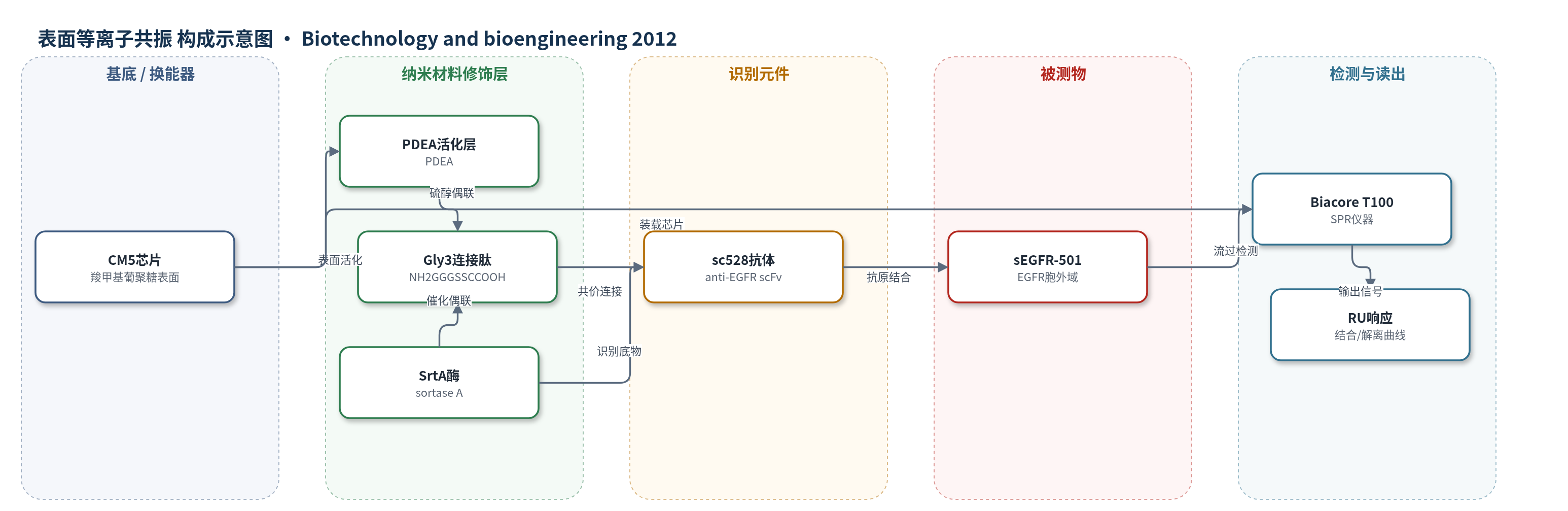
点击图片查看大图 · 依据论文自动绘制
传感器类型
表面等离子共振(SPR)生物传感器
检测对象
重组表皮生长因子受体胞外域(sEGFR-501,SPR运行缓冲液1×HBS-P);A431细胞表面EGFR(固定细胞基质)
检测原理
CM5芯片表面经PDEA活化后,通过硫醇偶联固定Gly3-linker peptide(NH2GGGSSCCOOH),形成SrtA寡甘氨酸受体。将C端含LPETGG序列的sc528与重组SrtA共注入SPR流动池,SrtA识别LPETG并催化sc528 C端与Gly3受体形成共价连接,使抗体以均一、定向方式展示,抗原结合位点朝向溶液。sEGFR-501流过表面后与sc528特异性结合,引起SPR界面折射率变化,Biacore T100记录结合与解离响应(RU)。sEGFR-501浓度越高,结合响应越大;按1:1模型拟合得到ka、kd和KD。该过程无化学放大,主要依靠定向固定提高有效结合容量和动力学数据质量。
检测灵敏度
未报告LOD、线性范围、灵敏度斜率或相关系数。
效应效果
SrtA-生物素化sc528在ELISA和细胞实验中特异性识别sEGFR-501及A431细胞表面EGFR,对ErbB2、MBP等阴性对照无响应;荧光素标记也呈抗原特异性,但受荧光猝灭限制。SPR中,sortase定向偶联sc528的KD为2.94±0.08 nM(ka=2.08±0.02×10^5 M^-1 s^-1,kd=6.1±0.1×10^-4 s^-1),与氨基偶联sc528的KD=3.30±0.02 nM接近,且与亲本mAb 528的KD=2.1 nM一致,说明C端连接未损害抗体亲和力。原位偶联约2 h完成,优于传统过夜反应。作者认为该方法可用于诊断、动力学分析和抗体药物偶联物构建。
传感器的构成
- 基底/换能器:CM5芯片(羧甲基葡聚糖修饰表面),作为SPR换能基底
- 活化修饰层:2-(pyridinyldithio)ethane amine(PDEA)活化羧甲基葡聚糖表面,提供硫醇偶联位点
- 受体连接层:Gly3-linker peptide(NH2GGGSSCCOOH),硫醇偶联于表面,作为SrtA寡甘氨酸受体
- 识别元件:sc528单链抗体(anti-EGFR scFv),C端含LPETGG序列,定向结合EGFR
- 连接酶:重组SrtA酶(金黄色葡萄球菌sortase A),催化LPETGG与Gly3受体共价连接
- 信号读出:Biacore T100 SPR仪器,监测结合/解离响应单位(RU)
中文摘要
Sortase A介导的蛋白连接是一种源自金黄色葡萄球菌细胞壁蛋白展示机制的生物学共价偶联系统,需要三种组分:纯化的SrtA酶、含LPXTG识别序列的底物和寡甘氨酸受体分子。本文从亲本抗EGFR单克隆抗体528克隆其单链Fv片段sc528,并在C端引入LPETGG标签序列。利用重组SrtA,作者成功将GGG-生物素连接至sc528。EGFR是重要肿瘤靶点,在A431等癌细胞中过表达。SrtA-生物素化sc528能特异性结合A431细胞表面EGFR,而不结合阴性对照细胞;用荧光素标记sc528时也观察到抗原特异性标记。该策略可将功能基团以受控、位点特异性方式引入重组抗体,适用于实验、诊断和潜在临床场景。作者进一步在生物传感器流动池中原位加入三种反应组分,实现sc528的定向共价捕获与展示,并精确测定抗体-受体相互作用的亲和力。
英文摘要
Sortase-mediated protein ligation is a biological covalent conjugation system developed from the enzymatic cell wall display mechanism found in Staphylococcus aureus. This three-component system requires: (i) purified Sortase A (SrtA) enzyme; (ii) a substrate containing the LPXTG peptide recognition sequence; and (iii) an oligo-glycine acceptor molecule. We describe cloning of the single-chain antibody sc528, which binds to the extracellular domain of the epidermal growth factor receptor (EGFR), from the parental monoclonal antibody and incorporation of a LPETGG tag sequence. Utilizing recombinant SrtA, we demonstrate successful incorporation of biotin from GGG-biotin onto sc528. EGFR is an important cancer target and is over-expressed in human tumor tissues and cancer lines, such as the A431 epithelial carcinoma cells. SrtA-biotinylated sc528 specifically bound EGFR expressed on A431 cells, but not negative control lines. Similarly, when sc528 was labeled with fluorescein we observed antigen-specific labeling. The ability to introduce functionality into recombinant antibodies in a controlled, site-specific manner has applications in experimental, diagnostic, and potentially clinical settings. For example, we demonstrate addition of all three reaction components in situ within a biosensor flow cell, resulting in oriented covalent capture and presentation of sc528, and determination of precise affinities for the antibody-receptor interaction.