组成图示
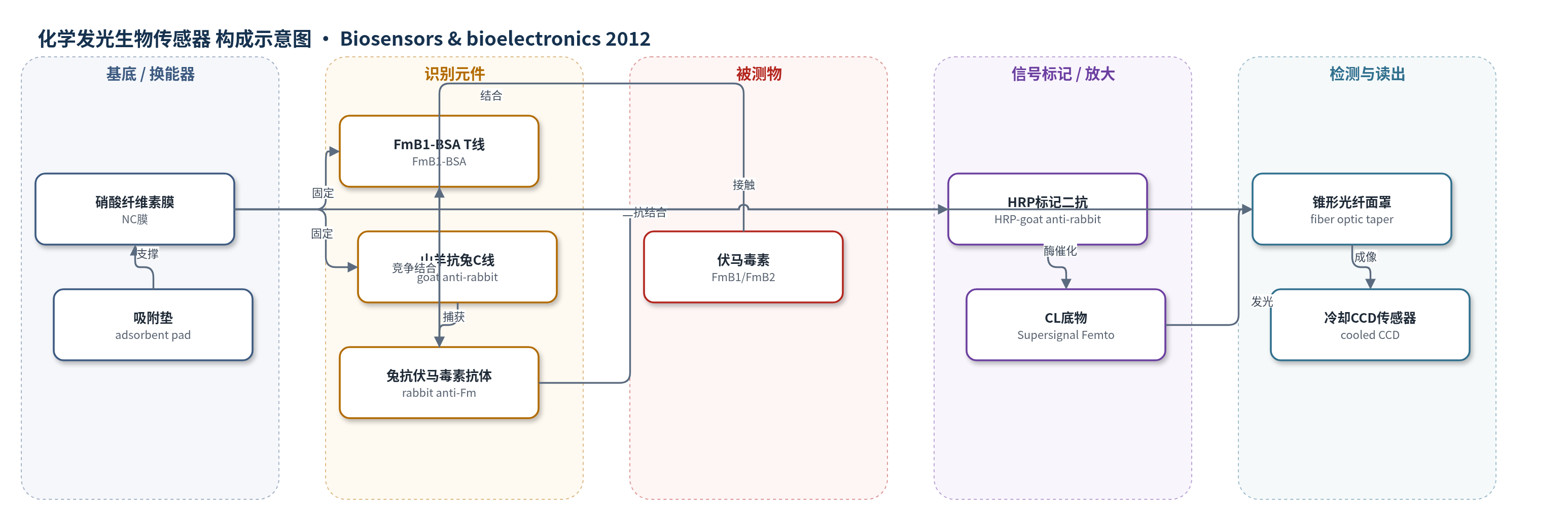
点击图片查看大图 · 依据论文自动绘制
传感器类型
化学发光生物传感器
检测对象
伏马毒素(fumonisins,FmB1 + FmB2),样品基质:玉米粉/玉米样品提取液(maize flour samples / maize sample extract)
检测原理
该传感器采用竞争性侧流免疫层析与酶催化化学发光。样品中伏马毒素与兔抗伏马毒素抗体结合后,会减少该抗体与T线上FmB1-BSA偶联物的结合;未结合的兔抗体在T线被捕获,C线山羊抗兔抗体则捕获兔抗体作为质控。HRP标记山羊抗兔二抗结合兔抗体,将HRP引入T线和C线。加入Supersignal ELISA Femto CL底物后,HRP催化底物产生化学发光。便携式冷却CCD通过锥形光纤面罩接触成像,分别采集T线和C线光子强度,计算T/C及B/B0,并用四参数逻辑方程定量。被测物浓度越高,T线信号越低,T/C下降。样品100°C加热3 min可灭活内源过氧化物酶,降低背景。
检测灵敏度
LOD: 2.5 μg L−1;线性范围: 2.5–500 μg L−1(对应玉米粉 25–5000 μg kg−1);校准范围: 1–500 μg L−1;中点: 20 μg L−1
效应效果
该传感器总检测时间约25 min,包括样品前处理,显著快于需多次孵育洗涤的ELISA。与同一免疫试剂的胶体金侧流试纸条相比,检出限降低5倍。批内CV<12%(n=4),批间CV<18%,可存储校准曲线用于后续样品。加标玉米提取液回收率为90–116%,实际玉米粉样品与LC–MS/MS比较回收率约89–112%(摘要称90–115%)。CCα<100 μg kg−1,低于欧盟最低MRL 200 μg kg−1。接触CCD成像性能与LB-981光度计相当,适合低成本、便携、现场筛查。
传感器的构成
- 试纸条基底:硝酸纤维素膜(nitrocellulose membrane)与吸附垫(adsorbent pad),承载免疫反应并驱动毛细流动
- 捕获识别层:T线固定伏马毒素B1-牛血清白蛋白偶联物(FmB1-BSA),C线固定山羊抗兔抗体(goat anti-rabbit antibody),分别用于检测与质控
- 竞争识别抗体:兔抗伏马毒素抗体(rabbit anti-fumonisin antibody),与样品中伏马毒素竞争结合T线
- 酶标记信号抗体:HRP标记山羊抗兔免疫球蛋白(HRP-labeled goat anti-rabbit immunoglobulin),结合兔抗体并引入辣根过氧化物酶(HRP)
- 化学发光底物:Supersignal ELISA Femto CL substrate,与HRP反应产生光子
- 封闭/缓冲体系:PBS含3% BSA(w/v),稀释抗体并封闭非特异结合
- 光学换能读出:锥形光纤面罩(tapered fiber optic faceplate)连接冷却CCD传感器(cooled CCD sensor),接触成像采集化学发光
中文摘要
本文开发了一种紧凑、便携的化学发光生物传感器,用于玉米中伏马毒素(伏马毒素B1与B2之和)的现场快速、超灵敏定量检测。该传感器将基于酶催化化学发光检测的竞争性侧流免疫层析与高灵敏度便携式电荷耦合器件(CCD)相机相结合,并采用接触成像配置。与常规胶体金标记侧流免疫层析通常只能提供定性或半定量信息不同,化学发光检测可实现准确、客观的分析物定量。该传感器对伏马毒素的检出限为2.5 μg L−1,分析工作范围为2.5–500 μg L−1,按提取方法相当于玉米粉样品中25–5000 μg kg−1。总检测时间约25 min,包括样品前处理。样品前处理采用将玉米粉悬浮于缓冲液中并快速加热以消除内源过氧化物酶活性的简便方法,与LC–MS/MS相比回收率为90–115%。该化学发光免疫层析生物传感器快速、低成本、便携,适用于现场使用。
英文摘要
A compact portable chemiluminescent biosensor for simple, rapid, and ultrasensitive on-site quantification of fumonisins (fumonisin B1+fumonisin B2) in maize has been developed. The biosensor integrates a competitive lateral flow immunoassay based on enzyme-catalyzed chemiluminescence detection and a highly sensitive portable charge-coupled device (CCD) camera, employed in a contact imaging configuration. The use of chemiluminescence detection allowed accurate and objective analyte quantification, rather than qualitative or semi-quantitative information usually obtained employing conventional lateral flow immunoassays based on colloidal gold labeling. A limit of detection of 2.5 μgL(-1) for fumonisins was achieved, with an analytical working range of 2.5-500 μgL(-1) (corresponding to 25-5000 μgkg(-1) in maize flour samples, according to the extraction procedure). Total assay time was 25 min, including sample preparation. A simple and convenient extraction procedure, performed by suspending the sample in a buffered solution and rapidly heating to eliminate endogenous peroxidase enzyme activity was employed for maize flour samples analysis, obtaining recoveries in the range 90-115%, when compared with LC-MS/MS analysis. The chemiluminescence immunochromatography-based biosensor is a rapid, low cost portable test suitable for point-of-use applications.