组成图示
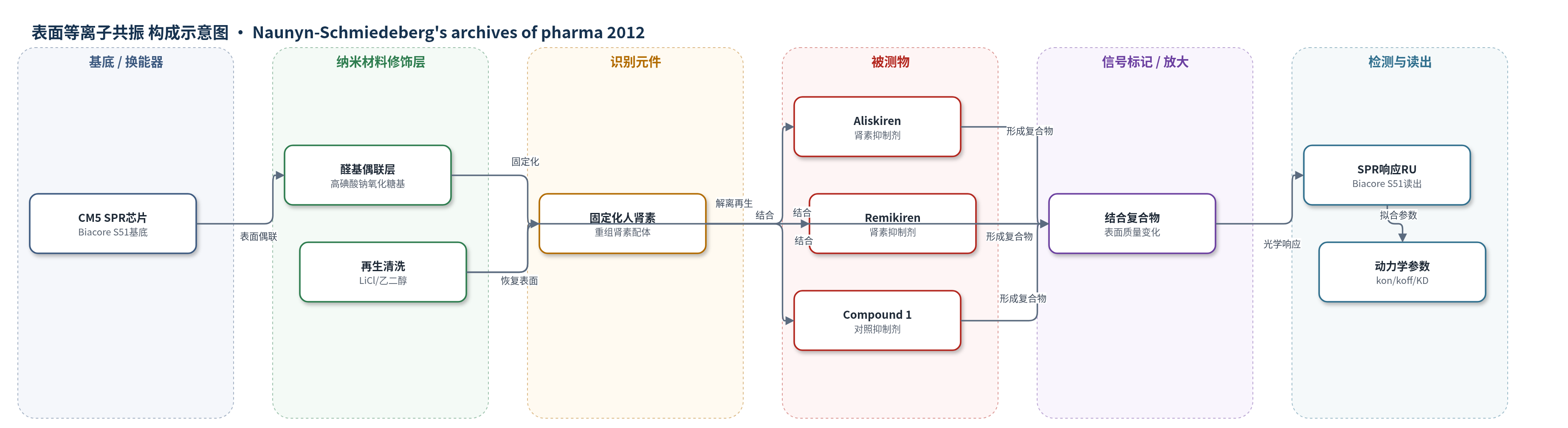
点击图片查看大图 · 依据论文自动绘制
传感器类型
表面等离子共振(SPR)生物传感器
检测对象
被测物:肾素抑制剂 aliskiren、remikiren、compound 1;样品基质:SPR 运行缓冲液 HBS-P 含 3% DMSO(另有人血浆 PRA 基质)
检测原理
该 SPR 生物传感器将重组人肾素通过糖基醛基偶联固定于 CM5 芯片表面,形成稳定配体层。将 aliskiren、remikiren 或 compound 1 溶于 HBS-P/3% DMSO 后注入流动池,抑制剂与固定化肾素活性位点结合,使界面质量/折射率增加,SPR 响应(RU)上升;停止注入后抑制剂解离,响应下降。响应幅度随抑制剂浓度增加而增大,结合相与解离相曲线按 1:1 Langmuir 模型全局拟合,得到 kon、koff 和 KD;驻留时间由 1/koff 计算。该体系无酶促或荧光放大,信号直接来自结合事件,因此可实时区分结合快慢与解离快慢,解释抑制剂长时药效。
检测灵敏度
未报告 LOD、线性范围、灵敏度斜率或相关系数。
效应效果
SPR 表面经醛基偶联固定化肾素后稳定,可连续使用数天而无显著结合能力损失,分析物结合能力为理论最大值的 60–80%,并能耐受多种再生条件;1 M LiCl/50% ethanediol 可完全解离抑制剂并恢复表面。阴性对照 indinavir 不结合,提示特异性。动力学显示 aliskiren KD 0.30±0.09 nM、koff 0.11±0.04×10⁻³ s−1、驻留时间 152 min;remikiren KD 0.24±0.04 nM、koff 0.18±0.05×10⁻³ s−1、驻留时间 93 min;compound 1 KD 2.2±0.3 nM、koff 4.9±0.7×10⁻³ s−1、驻留时间 3.4 min。作者认为慢解离可解释 24 h 抗高血压效应及靶介导药物处置。
传感器的构成
- 基底/换能器:Biacore S51 与 CM5 芯片,提供 SPR 光学换能及表面固定化平台
- 修饰/固定化层:重组人肾素经高碘酸钠(NaIO4)氧化糖基后以醛基偶联固定于 CM5 表面,形成稳定配体层
- 识别元件:固定化人肾素(human renin)活性位点,与注入的肾素抑制剂发生特异性结合
- 运行缓冲液:HBS-P(10 mM HEPES、0.15 M NaCl、0.005% Tween 20,pH 7.4)加 3% DMSO,维持肾素活性并溶解抑制剂
- 再生/清洗:1 M LiCl 于 50% ethanediol,解离抑制剂并恢复表面结合能力
- 信号读出:Biacore S51 监测 SPR 响应(RU),经参考表面与空白扣除后拟合 kon、koff 和 KD
中文摘要
阿利吉仑(aliskiren)是一种已获批用于高血压治疗的选择性肾素抑制剂,其药效持续时间似乎长于根据循环半衰期所能预期的水平。本研究旨在表征阿利吉仑与人肾素相互作用的动力学。作者采用三种方法评估:首先通过监测荧光底物裂解评价重组人肾素抑制;其次通过测量有无抑制剂时 1 h 内生成的血管紧张素 I 监测人血浆肾素活性(PRA);最后使用表面等离子共振(SPR)生物传感器测定亲和力、结合与解离速率常数。结果显示,阿利吉仑与 remikiren 对重组肾素活性具有等效抑制作用(Ki≤0.04 nM),而化合物 1 的 Ki 为 1 nM。PRA 被阿利吉仑和 remikiren 有效抑制,IC50 为 0.2–0.3 nM。remikiren 和阿利吉仑与固定化肾素均呈现长时相互作用,koff 分别为 0.18 和 0.11×10⁻³ s−1,对应驻留时间约 1.5 和 2.5 h;化合物 1 的驻留时间仅约 3 min。因此,阿利吉仑与人肾素的长时相互作用可能有助于临床试验中观察到的 24 h 抗高血压效应,并可能参与靶介导药物处置。
英文摘要
Aliskiren is a selective renin inhibitor recently approved for use in hypertension. Efficacy duration appears longer than what would be expected based on its circulating half-life. The aim was therefore to characterize the kinetics of the interaction between aliskiren and renin. The interaction was evaluated in three assays and compared with two other renin inhibitors including remikiren. First, the inhibition of recombinant human renin was assessed by monitoring the cleavage of fluorescent substrate. Second, human plasma renin activity (PRA) was monitored by measuring generated angiotensin I over 1 h in the presence or absence of inhibitor. Finally, the affinity, association and dissociation rate constants were determined by using a surface plasmon resonance (SPR) biosensor assay. Aliskiren and remikiren were found to be equipotent inhibitors of recombinant renin activity (K(i) ≤ 0.04 nM) while compound 1 displayed a K (i) value of 1 nM. PRA was efficiently inhibited by both aliskiren and remikiren with IC₅₀ values of 0.2-0.3 nM. Remikiren and aliskiren also displayed long-lasting interactions with immobilized renin having k (off) values of 0.18 and 0.11 × 10⁻³ s⁻¹ respectively. These dissociation rate constants corresponded to residence times of 1.5 and 2.5 h, respectively, while compound 1 had a residence time lasting only 3 min. It is therefore concluded that the long-lasting interaction between aliskiren and human renin may contribute to the 24 h anti-hypertensive effect seen in clinical trials and possibly also to target-mediated drug disposition.