组成图示
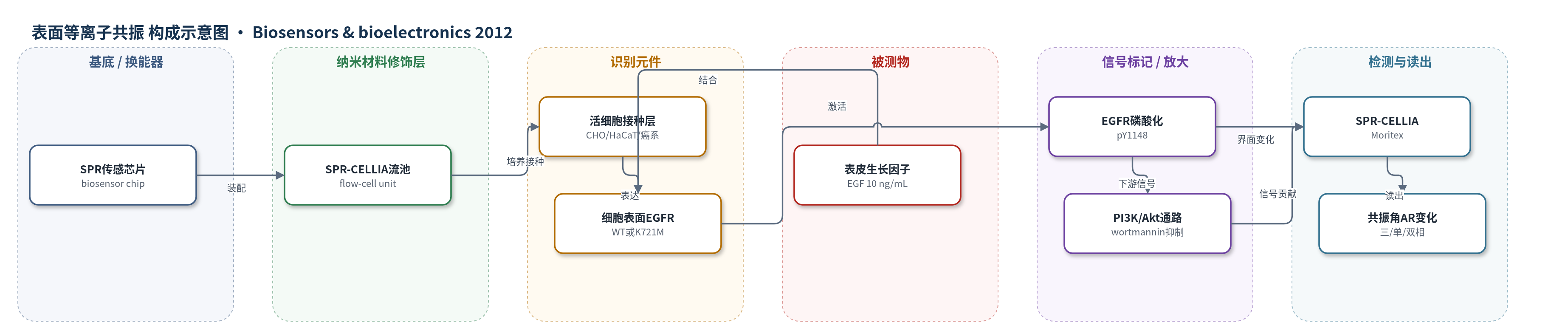
点击图片查看大图 · 依据论文自动绘制
传感器类型
表面等离子共振(SPR)生物传感器
检测对象
表皮生长因子(epidermal growth factor, EGF);样品基质:活细胞培养体系(CHO-K1、HaCaT、MKN-1、MKN-7、TMK-1、MKN-28、DU145、LNCap;葡萄糖生理盐水/Pipes缓冲液)
检测原理
将活细胞接种于SPR芯片表面并置于SPR-CELLIA流池中,用葡萄糖生理盐水/Pipes缓冲液维持细胞活性。EGF与细胞表面EGFR结合后诱导受体二聚化和酪氨酸磷酸化,进而激活PI3K/Akt等下游信号,引起细胞膜、皮层骨架或界面折射率等变化。SPR通过监测芯片表面等离子共振角(AR)的实时变化,将上述细胞界面变化转换为无标记光学信号。激酶失活EGFR(K721M)几乎不产生AR变化,wortmannin抑制第三相,说明信号依赖EGFR磷酸化及PI3K通路;1与10 ng/mL EGF产生相同模式但幅度不同,提示模式主要由细胞类型和信号通路决定。
检测灵敏度
原文未报告LOD、线性范围、灵敏度斜率或相关系数。
效应效果
SPR信号强度在不同实验间可能变化,但AR变化模式具有良好重现性,文中展示为3次独立实验的代表性数据。选择性方面,表达激酶失活EGFR(K721M)的CHO细胞对EGF几乎无AR响应,而野生型EGFR细胞呈三相变化;100 nM wortmannin可减弱第三相,提示信号依赖EGFR磷酸化和PI3K通路。1与10 ng/mL EGF诱导相同模式但幅度不同,说明模式不依赖EGF浓度。6株癌细胞系中,TMK-1呈三相,MKN-1、MKN-7、MKN-28呈双相,DU145和LNCap呈单相,LNCap表现为单相下降且EGFR激酶域无突变。作者认为该SPR方法可实时、无标记地识别癌细胞功能表型,并有望用于肿瘤功能诊断。
传感器的构成
- 换能基底:SPR生物传感芯片(biosensor chip),作为表面等离子共振检测界面,细胞接种于其表面。
- 流动池单元:SPR-CELLIA流池(flow-cell unit),用于灌注缓冲液并实时监测共振角。
- 识别元件:活细胞表面EGFR(epidermal growth factor receptor),包括CHO-K1稳定表达的FLAG-EGFR、EGFR-K721M及HaCaT/癌系内源EGFR。
- 被测刺激物:重组人表皮生长因子(recombinant human EGF),与细胞表面EGFR结合并激活受体。
- 缓冲介质:葡萄糖生理盐水/Pipes缓冲液(glucose saline/Pipes buffer),维持细胞活性并作为SPR流动相。
- 机制验证试剂:wortmannin(100 nM,PI3K抑制剂),用于抑制EGF诱导AR变化的第三相;DMSO为对照。
- 信号标记物:无(label-free),直接以AR变化作为读出信号。
中文摘要
表面等离子共振(SPR)生物传感器可通过共振角(AR)变化实时、无标记地检测活细胞内信号事件。作者此前报道,角质形成细胞上表皮生长因子受体(EGFR)激活会引起独特的三相AR变化,而肥大细胞上IgE受体或腺苷A3受体激活仅引起短暂单相AR升高。为阐明EGFR激活诱导AR变化的机制,作者将野生型和突变型EGFR cDNA导入中国仓鼠卵巢(CHO)细胞,并分析EGF刺激后的AR变化。表达野生型EGFR的CHO细胞呈典型三相AR变化,而表达激酶失活突变EGFR(K721M)的细胞AR变化极小。PI3K抑制剂wortmannin可减弱野生型EGFR细胞AR变化的第三相,且AR变化模式不依赖EGF浓度。作者还分析了非肿瘤角质形成细胞系HaCaT及多种癌细胞的AR变化,以评估SPR生物传感器用于临床诊断的可行性。结果显示,HaCaT细胞和6株癌细胞系中的1株呈完整三相变化,其余5株呈单相或双相变化。结果表明,EGF通过EGFR磷酸化诱导SPR信号,提示SPR生物传感器可用于恶性肿瘤的实时检测与诊断。
英文摘要
Surface plasmon resonance (SPR) biosensor detects intracellular signaling events as a change of the angle of resonance (AR). We previously reported that the activation of epidermal growth factor receptor (EGFR) on keratinocytes causes a unique triphasic change of AR, whereas the activation of other receptors, such as IgE receptor and adenosine A3 receptor on mast cells, causes a transient monophasic increase of AR. To study the mechanism of AR changes induced by EGFR activation, we introduced wild and mutated EGFR cDNAs into Chinese hamster ovary (CHO) cells and analyzed changes of AR in response to EGF. CHO cells expressing wild-type EGFR showed a triphasic change of AR, whereas cells expressing kinase-dead EGFR (K721M) showed minimum change of AR. A phosphatidylinositol 3-kinase inhibitor, wortmannin, attenuated the third phase of AR change in CHO cells expressing wild-type EGFR. The pattern of AR change was independent on the concentration of EGF. We also analyzed changes of AR with a nontumorigenic keratinocyte cell line, HaCaT, and several cell lines of carcinoma to explore the feasibility of SPR biosensor as a tool for clinical diagnosis. The activation of HaCaT cells and one out of six carcinoma cell lines showed a full triphasic change of AR. In contrast, five out of the six cell lines showed mono- or bi-phasic change of AR. These results suggest that EGF induces the SPR signals via the phosphorylation of EGFR, and provide a possibility that the SPR biosensor could be applied to the real-time detection and diagnosis of malignant tumors.