组成图示
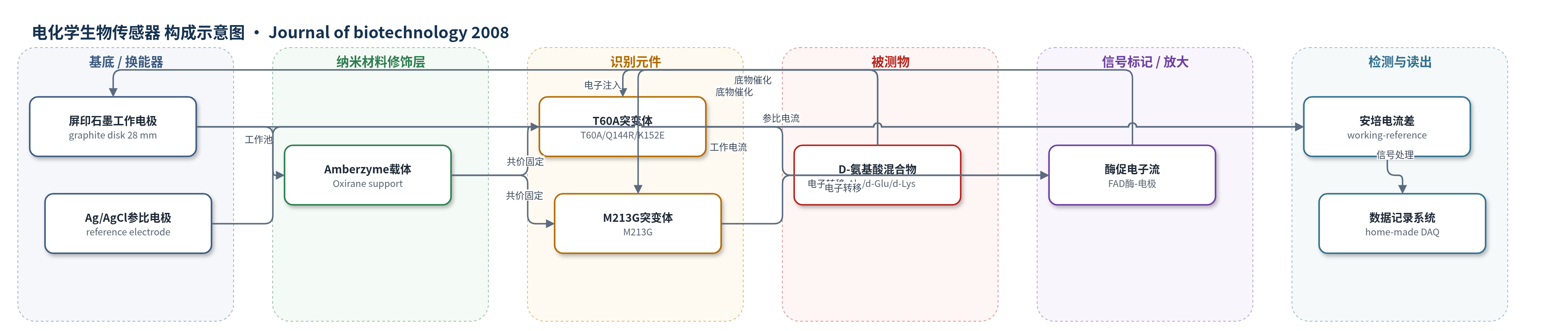
点击图片查看大图 · 依据论文自动绘制
传感器类型
电化学生物传感器
检测对象
D-氨基酸(d-amino acids, DAA;含d-Ala、d-Glu、d-Lys、d-Gln、d-Met等);样品基质:食品(Grana Padano奶酪)、生物样品/缓冲液
检测原理
RgDAAO作为黄素酶识别并催化D-氨基酸氧化:D-氨基酸+O2+H2O→α-酮酸+H2O2+NH3。反应中FAD辅基接受底物电子,电子经酶-电极界面直接传递到屏印石墨工作电极,属于第三代生物传感器,不依赖H2O2检测。工作池含Amberzyme固定化的RgDAAO突变体,参比池不含酶;在250 mV下记录两池安培电流差。D-氨基酸浓度升高时,酶促氧化速率增加,直接电子流增大,电流差随之增大。T60A/Q144R/K152E与M213G突变体对中性、酸性和碱性D-氨基酸均有活性,且固定化后降低表观Km,使响应受底物组成影响较小。
检测灵敏度
LOD: 0.25 mM d-Ala (signal/noise = 3);校准范围: 0.25–5.0 mM(d-Ala standard solutions,Michaelis–Menten 拟合)
效应效果
该传感器对D-氨基酸组成依赖较低:d-Ala≥20%时,M213G与T60A/Q144R/K152E标准误约5%和9%。固定化酶CV≤15%(n=6),响应时间10–15 min。奶酪样品D-氨基酸为6.1±0.5 mM(约6.7 mg/g),与2,4-DNPH法6.0±0.3 mg/g及色谱文献值一致。酶预处理后信号消失,再加1 mM d-Ala恢复同等响应;加标稀释验证中T60A响应为原128±10%,M213G/T60A混合酶为91.8±7.2%。作者认为其比GC/HPLC/CE更简便、快速、低成本,适合食品与生物样品常规质控。
传感器的构成
- 基底/换能器:屏印石墨工作电极(graphite disk,28 mm)与Ag/AgCl参比电极,分别置于两个塑料电化学池,用于安培电流检测。
- 固定化载体:Amberzyme Oxirane环氧基树脂载体,通过蛋白游离氨基共价固定RgDAAO,增强酶与电极接触并提高重复性。
- 识别/催化元件:红发酵母D-氨基酸氧化酶(RgDAAO)突变体T60A/Q144R/K152E和/或M213G,催化D-氨基酸氧化并实现直接电子转移。
- 反应介质:100 mM磷酸钾缓冲液(pH 7.0),维持酶活性与电极测量环境。
- 信号读出:工作池与参比池在250 mV下的安培电流差值,反映D-氨基酸氧化产生的电子流。
中文摘要
测定食品和生物样品中D-氨基酸含量具有重要意义。本研究开发了一种基于红发酵母(Rhodotorula gracilis)黄素酶D-氨基酸氧化酶(RgDAAO)的生物传感器。为使D-氨基酸组成不改变检测结果,作者同时采用野生型及通过理性设计和定向进化获得的突变体。对D-氨基酸氧化酶突变体在不同中性、酸性和碱性底物比例混合物中的活性分析表明,Amberzyme固定化的T60A/Q144R/K152E和M213G突变体表现最佳:当混合物中至少20%的D-氨基酸为D-丙氨酸时,其响应仅受溶液组成有限影响(标准误约5%–9%)。据作者所知,这是首次报道利用屏印电极安培生物传感器测定全部D-氨基酸含量,检出限为0.25 mM,平均响应时间为10–15 min。基于RgDAAO的D-氨基酸检测方法成本低、操作简便、速度快,可用于多种生物样品中D-氨基酸浓度的检测。
英文摘要
Determination of the D-amino acid content in foods and in biological samples is a very important task. In order to achieve this goal we developed a biosensor employing the flavoenzyme D-amino acid oxidase from the yeast Rhodotorula gracilis. To produce a device in which the D-amino acid composition does not alter the results, both the wild-type and a number of mutants obtained by rational design and directed evolution approaches were used. An analysis of D-amino acid oxidase mutants activity on D-amino acid mixtures containing various ratios of neutral, acidic, and basic substrates identified the Amberzyme-immobilized T60A/Q144R/K152E and M213G mutants as the best choice: their response shows an only limited dependence on the solution composition when at least 20% of the D-amino acid is made up of D-alanine (standard error is approximately 5-9%). This is the first report, to our knowledge, demonstrating that the entire D-amino acid content can be determined by using a screen-printed electrode amperometric biosensor, with a detection limit of 0.25 mM and a mean response time of 10-15 min. The D-amino acid assay based on R. gracilis DAAO-biosensor is inexpensive, simple to perform, and rapid: the D-amino acid concentration of a variety of biological samples can be investigated using this assay.