组成图示
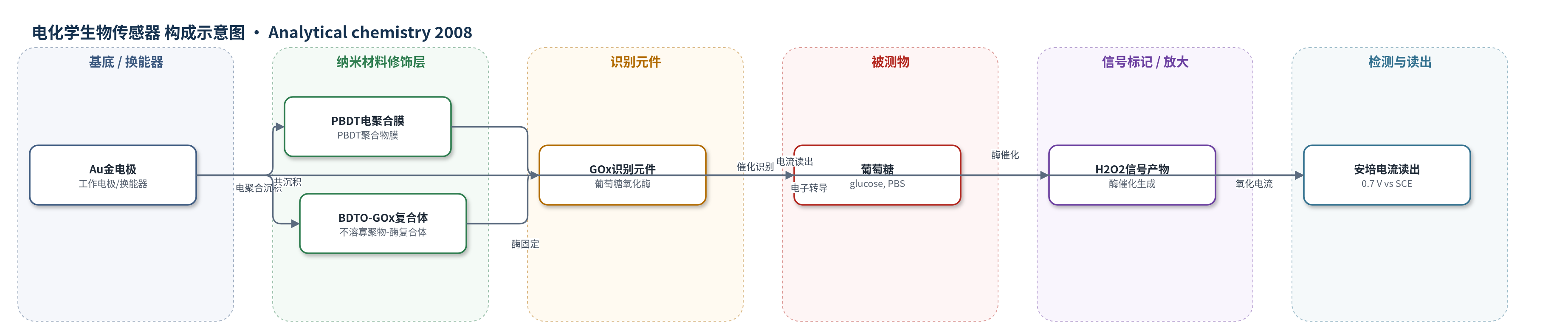
点击图片查看大图 · 依据论文自动绘制
传感器类型
电化学生物传感器
检测对象
葡萄糖(glucose, Glc),样品基质为pH 7.0磷酸盐缓冲液(PBS);苯基磷酸钠(disodium phenyl phosphate, PP),样品基质为0.10 M Tris-HNO3缓冲液(pH 9.0)
检测原理
该传感器采用CPEM策略:难溶BDT在超声和GOx辅助下分散于PBS中,加入K3Fe(CN)6后,BDT的巯基被化学氧化并经S-S连接形成不溶性BDT寡聚物(BDTO)-GOx复合颗粒,酶被原位包裹且构象损失较小;随后在Au电极上以1.3 V恒电位电聚合,BDTO-GOx复合体与PBDT共沉积,形成多孔富硫聚合物酶膜。检测时,葡萄糖扩散进入膜内,被GOx催化氧化生成H2O2;H2O2在0.7 V(vs SCE)金电极上发生氧化,产生与葡萄糖浓度成正比的安培电流。AP传感器中,AP催化苯基磷酸钠(PP)水解生成phenol,phenol在0.6 V氧化产生电流。灵敏度提升主要来自化学预氧化诱导的高负载、高活性酶固定以及多孔膜改善底物/产物传质,而非外源信号放大。
检测灵敏度
GOx葡萄糖传感器(CPEM,BDT,5 mM K3Fe(CN)6):LOD: 0.2 µM;线性范围: 1.2–5.7×10^3 µM;S: 62 µA cm^-2 mM^-1;R^2 = 0.9989。AP苯基磷酸钠传感器(CPEM,BDT,5 mM K3Fe(CN)6):LOD: 0.2 µM;线性范围: 3.0–170 µM;S: 18 µA cm^-2 mM^-1;R^2 = 0.9936。
效应效果
CPEM法PBDT-BDTO-GOx-K3Fe(CN)6电极对2.0 mM葡萄糖响应123±3 µA cm^-2,CEP电极仅4.1±0.4 µA cm^-2。CPEM葡萄糖传感器灵敏度为CEP的32倍(K3Fe(CN)6)或29倍(BQ),LOD低约1个数量级;HDT-BQ体系达49 µA cm^-2 mM^-1,dip-dry法达61 µA cm^-2 mM^-1。响应时间小于10 s,抗AA、UA干扰良好,53 d后保留80%响应。EQCM/UV-vis显示GOx固定量由290±20 Hz增至750±50 Hz,ERA由11±1%升至56±2%;AP灵敏度为CEP的4.5倍、文献值21倍。适用于生物传感、生物催化、生物燃料电池、生物亲和色谱和生物材料。
传感器的构成
- 基底/换能器电极:Au金电极(6.0 mm,0.29 cm2),作为工作电极与电子转导界面
- 化学预氧化剂:K3Fe(CN)6或p-benzoquinone(BQ),氧化BDT/HDT生成不溶性二硫寡聚物并包裹酶
- 酶-寡聚物复合体:BDTO-GOx-K3Fe(CN)6或BDTO-AP-K3Fe(CN)6(约50 nm不溶复合颗粒),实现高负载、高活性酶固定
- 电聚合修饰层:poly(1,4-benzenedithiol)(PBDT)或poly(1,6-hexanedithiol)(PHDT),与复合体共沉积形成多孔富硫聚合物膜
- 识别元件:glucose oxidase(GOx)或alkaline phosphatase(AP),分别催化葡萄糖或苯基磷酸钠反应
- 信号产物/电子供体:H2O2(GOx催化葡萄糖生成)或phenol(AP催化PP生成),在电极氧化产生安培电流
中文摘要
本文提出一种在含酶水悬浮液中进行单体化学预氧化与电聚合的一锅法(CPEM)通用策略,用于高活性、高负载固定酶并构建安培生物传感器。该策略适用于1,4-苯二硫醇(BDT)、1,6-己二硫醇、邻苯二胺、邻氨基苯酚或吡咯单体,K3Fe(CN)6或对苯醌(BQ)预氧化剂,以及葡萄糖氧化酶(GOx)或碱性磷酸酶(AP),可制备GOx葡萄糖传感器和AP苯基磷酸钠传感器。以BDT-GOx为例,超声与GOx协同分散难溶BDT,加入K3Fe(CN)6化学预氧化生成包裹高活性GOx的不溶性BDT寡聚物(BDTO)复合体,再在Au电极上与poly(1,4-benzenedithiol)(PBDT)电聚合共沉积,形成高负载、高活性酶膜。CPEM法葡萄糖传感器灵敏度较无预氧化剂传统电聚合(CEP)法提高32倍。EQCM与紫外-可见光谱法表明,CPEM法显著提高了固定酶数量和酶比活性(ESA)。该策略可用于生物传感、生物催化、生物燃料电池、生物亲和色谱和生物材料。
英文摘要
A protocol of one-pot chemical preoxidation and electropolymerization of monomers (CPEM) in enzyme-containing aqueous suspensions (or solutions) was proposed as a universal strategy for high-activity and high-load immobilization of enzymes to construct amperometric biosensors, which was proven to be effective for the monomer of 1,4-benzenedithiol (BDT), 1,6-hexanedithiol, o-phenylenediamine, o-aminophenol or pyrrole, the preoxidant of K3Fe(CN)6 or p-benzoquinone, and the enzyme of glucose oxidase (GOx) or alkaline phosphatase (AP) to develop GOx-based glucose biosensors or AP-based disodium phenyl phosphate biosensors. As a case examined in detail, a well-dispersed aqueous suspension of the poorly soluble BDT was obtained through its dispersion assisted by ultrasonication and coexisting GOx, which was then subject to chemical preoxidation through adding K3Fe(CN)6, yielding many composites of insoluble BDT oligomers with lots of high-activity enzyme molecules entrapped. Some insoluble composites were then electrochemically codeposited with poly(1,4-benzenedithiol) on an Au electrode, yielding an enzyme film with high-load and high-activity enzyme immobilized. The glucose biosensor prepared here from the CPEM protocol showed much better performance than that from the preoxidant-free conventional electropolymerization (CEP) protocol, with a detection sensitivity increase by a factor of 32 in this case. The GOx-based and AP-based first-generation biosensors developed from the present CPEM protocol all exhibited notably improved performance compared with the analogues from the preoxidant-free CEP protocol. The electrochemical quartz crystal microbalance (EQCM) technique was used to investigate various electrode modification processes. The values of quantity and enzymatic specific activity (ESA) of the immobilized enzymes were evaluated through the EQCM and the conventional UV-vis spectrophotometric method, given that the CPEM protocol notably improved the quantity and the ESA of immobilized enzymes as compared with the preoxidant-free CEP protocol. The proposed CPEM protocol may be interesting in a number of fields, including biosensing, biocatalysis, biofuel cells, bioaffinity chromatography, and biomaterials, and the successful electropolymerization of dithiols in aqueous suspensions (two-phase electropolymerization) may open a new avenue for many monomers that are poorly soluble in neutral aqueous solutions to in situ immobilize biomolecules for bioapplications.