组成图示
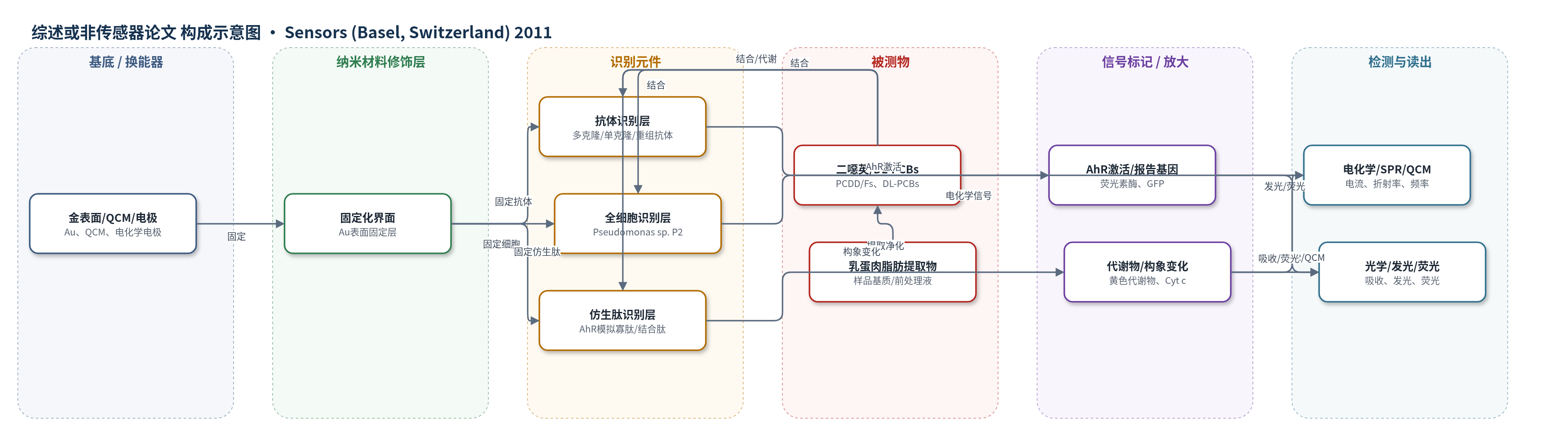
点击图片查看大图 · 依据论文自动绘制
传感器类型
综述或非传感器论文
检测对象
二噁英(PCDD/Fs, dioxins)、二噁英样多氯联苯(DL-PCBs);样品基质:乳、蛋、肉及动物脂肪、饲料、土壤/环境样品。
检测原理
综述所述生物传感器由生物识别元件与换能器组成。免疫传感器中,抗体与二噁英或DL-PCBs结合后,引起电极表面电化学信号或QCM质量变化,信号随目标物浓度增加而改变。全细胞生物传感器(如CALUX)中,二噁英样化合物进入细胞并结合芳烃受体(AhR),激活报告基因(荧光素酶、绿色荧光蛋白GFP)或内源酶(EROD),经基因表达与酶催化放大后产生发光、荧光或酶活性信号。仿生传感器用寡肽或二噁英结合肽模拟AhR结合位点,结合目标物后引起构象变化,通过SPR、QCM或荧光读出。整体信号放大依赖报告基因表达、酶催化或代谢产物积累。
检测灵敏度
LOD: 1 part per trillion(QCM免疫传感器,飞灰);LOD: 0.2 ng TCDD/mL(二噁英结合肽);LOD: 0.1 ppb(细胞色素c SPR);检测范围: TCDD 1–5 ppb、二噁英混合物 1–10 ppb、PCBs 1–20 ppb(仿生QCM);coefficient of variation less than 15%。
效应效果
HRGC-HRMS是金标准,准确灵敏但昂贵、通量低;CALUX适合筛查,与HRGC-HRMS相关,但需提取净化,且可能受AhR激动剂/拮抗剂干扰。生物传感器具快速、现场、低成本潜力,但检测水平常高于食品/饲料pg/g脂肪限量,脂肪基质复杂,需简单前处理。免疫传感器选择性较好但可能交叉反应并受有机溶剂影响;全细胞传感器生物学意义强但响应慢;仿生传感器CV<15%,Cyt c SPR约10 min响应。作者认为其可作食品链早期预警和筛查,仍需优化灵敏度、选择性、稳定性和标准化。
传感器的构成
- 基底/换能器:金表面(Au)、石英晶体微天平(QCM)、电化学电极或SPR检测界面,用于固定识别元件并转换质量、电化学或光学信号。
- 识别元件:抗体(多克隆/单克隆/重组)、全细胞(Pseudomonas sp. P2)、仿生寡肽/二噁英结合肽或细胞色素c(Cyt c),用于识别二噁英/DL-PCBs。
- 信号标记/放大:报告基因(荧光素酶、绿色荧光蛋白GFP)、黄色代谢产物或构象变化,用于将识别事件转化为发光、荧光、吸收或频率/折射率信号。
- 样品前处理:加速溶剂萃取(ASE)、固相萃取(SPE)、酸-硅胶净化(acid-silica clean-up),用于从乳、蛋、肉脂肪或土壤基质中富集目标物并去除干扰。
- 物理传感备选:碳纳米管(CNT)、SERS纳米结构、多孔阳极氧化铝(PAA/AAO)电容传感,用于非生物识别的PCB痕量检测。
中文摘要
二噁英和二噁英样多氯联苯(DL-PCBs)是危险、普遍且持久的有毒化合物,可进入食品链并沿营养级累积。其检测通常需要高分辨气相色谱-高分辨质谱(HRGC/HRMS)或化学激活荧光素酶基因表达法(CALUX生物测定)等复杂方法、昂贵设备和试剂,且耗时较长。理想情况下应采用快速实时监测方法,以防止食品链污染并降低人体暴露。本文综述了乳、蛋和肉等动物源食品链中二噁英和DL-PCBs污染检测的现状,比较了化学分析、生物测定和传感器技术的优缺点。免疫传感器和仿生生物传感器可能提高选择性和灵敏度,全细胞生物传感器可提供可解释的生物学结果。然而,现有生物传感器的检测水平仍可能不足以达到食品与饲料中pg/g脂肪的限量要求,且污染物常存在于脂肪基质中,因此需要简单高效的提取和净化步骤,以推动生物传感器在食品链监测中的应用。
英文摘要
Dioxins and dioxin-like polychlorinated biphenyls (DL-PCBs) are hazardous toxic, ubiquitous and persistent chemical compounds, which can enter the food chain and accumulate up to higher trophic levels. Their determination requires sophisticated methods, expensive facilities and instruments, well-trained personnel and expensive chemical reagents. Ideally, real-time monitoring using rapid detection methods should be applied to detect possible contamination along the food chain in order to prevent human exposure. Sensor technology may be promising in this respect. This review gives the state of the art for detecting possible contamination with dioxins and DL-PCBs along the food chain of animal-source foods. The main detection methods applied (i.e., high resolution gas-chromatography combined with high resolution mass-spectrometry (HRGC/HRMS) and the chemical activated luciferase gene expression method (CALUX bioassay)), each have their limitations. Biosensors for detecting dioxins and related compounds, although still under development, show potential to overcome these limitations. Immunosensors and biomimetic-based biosensors potentially offer increased selectivity and sensitivity for dioxin and DL-PCB detection, while whole cell-based biosensors present interpretable biological results. The main shortcoming of current biosensors, however, is their detection level: this may be insufficient as limits for dioxins and DL-PCBs for food and feedstuffs are in pg per gram level. In addition, these contaminants are normally present in fat, a difficult matrix for biosensor detection. Therefore, simple and efficient extraction and clean-up procedures are required which may enable biosensors to detect dioxins and DL-PCBs contamination along the food chain.