组成图示
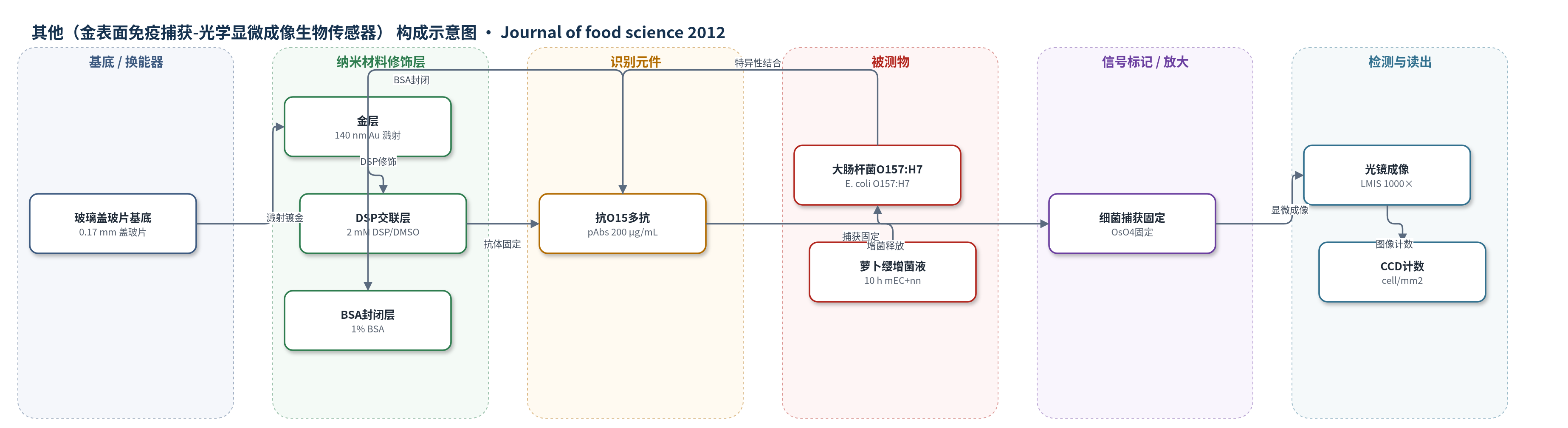
点击图片查看大图 · 依据论文自动绘制
传感器类型
其他(金表面免疫捕获-光学显微成像生物传感器)
检测对象
大肠杆菌O157:H7(Escherichia coli O157:H7);样品基质为萝卜缨(turnip greens)表面及mEC+nn增菌液,亦用PBS菌悬液验证
检测原理
该传感器以金表面为免疫捕获界面,DSP作为双功能交联剂将抗大肠杆菌O15多克隆抗体共价固定于金层上,BSA封闭非活性位点。样品中的E. coli O157:H7通过O15抗原与pAbs特异性结合而被捕获在金表面。随后用OsO4固定细菌,保持细胞形态。信号换能不依赖电化学或荧光标记,而是通过光镜和CCD对金表面捕获菌进行直接成像与计数;随机选取10个区域,以cell/mm2表示捕获量。随着目标菌浓度升高,表面捕获菌数量增加,图像计数信号相应增强。DSP修饰提高抗体固定密度和取向,LMIS可区分目标菌与非特异性吸附的食物颗粒,从而降低假阳性。
检测灵敏度
LOD: 10^3 CFU/25 mm2;适用浓度范围: 10^3–10^6 CFU/25 mm2
效应效果
Gold-DSP/LMIS对E. coli O157:H7 204P和301C灵敏度100%,特异性90%;与间接ELISA一致,pAbs对目标菌反应显著高于其他大肠杆菌、沙门氏菌和李斯特菌。LOD为10^3 CFU/25 mm2,作者认为与商业快速试纸(RapidCheck 10^4 CFU/mL、Singlepath 10^4–10^6 CFU/mL)可比,但低于SPR/QCM。萝卜缨加标中,初始10^1和10^2 CFU/25 g经10 h增菌后分别检测为2641±394和15383±3853 cell/mm2;10^2 CFU/25 g在8 h增菌时检测为1767±233 cell/mm2,阴性PBS未检出。实验以N=30报告标准差。食物颗粒非特异吸附存在,但LMIS可区分目标菌,减少假计数,适合新鲜农产品快速检测。
传感器的构成
- 基底:0.17 mm厚显微镜盖玻片,切割为5×5 mm2,经超声清洗,提供支撑与光学透明基底
- 金修饰层:140 nm厚金(Au)层,溅射沉积于玻璃表面,提供抗体固定界面和显微成像背景
- 化学交联修饰层:2 mM二硫双琥珀酰亚胺丙酸酯(DSP,溶于DMSO),与金表面及抗体共价结合,提高抗体固定效率
- 识别元件:抗大肠杆菌O15兔IgG多克隆抗体(pAbs),最佳浓度200 μg/mL,特异性捕获E. coli O157:H7
- 封闭层:1%牛血清白蛋白(BSA),22°C封闭1 h,减少非特异性结合
- 细菌固定处理:四氧化锇(OsO4)处理至少1 h,固定捕获的细菌并保护细胞结构
- 成像读出:光镜(Nikon Eclipse L150)连接冷却CCD相机,1000倍成像并随机10区域计数,输出cell/mm2
中文摘要
本研究旨在验证一种改性金生物传感器结合光学显微成像系统(LMIS)检测萝卜缨中大肠杆菌O157:H7的可行性。金生物传感器以玻璃盖玻片为基底,溅射140 nm金层,并用二硫双琥珀酰亚胺丙酸酯(DSP)和/或蛋白A/G进行表面修饰。其中Gold-DSP传感器与LMIS联用,用于固定抗大肠杆菌O15多克隆抗体(pAbs)并捕获目标菌。研究确定了pAbs的最佳固定浓度和特异性,并评估了Gold-DSP/LMIS的灵敏度、特异性和检出限。结果表明,DSP修饰可显著提高传感器对E. coli O157:H7的捕获量;pAbs对目标菌具有足够特异性,最佳浓度为200 μg/mL。Gold-DSP/LMIS的灵敏度、特异性和LOD分别为100%、90%和10^3 CFU/25 mm2。应用于萝卜缨时,经10 h增菌后,初始10^1和10^2 CFU/25 g样品分别检测到2641±394和15383±3853 cell/mm2。总体而言,该方法可用于萝卜缨中E. coli O157:H7的定性和定量快速检测。
英文摘要
This research aims to demonstrate the feasibility of a modified gold biosensor to detect E. coli O157:H7 in leafy turnip greens. The gold biosensor was modified with dithiobis-succinimidyl propionate (DSP) and/or protein A or G. The gold biosensor modified with DSP (Gold-DSP) was combined with a light microscopic imaging system (LMIS). The optimal concentration and specificity of anti-E. coli O15 polyclonal antibodies (pAbs) on the biosensor were determined. The reliability of Gold-DSP biosensor was investigated by determining the sensitivity, specificity, and limit of detection (LOD) of the Gold-DSP combined with LMIS. The Gold-DSP combined with LMIS was applied to turnip greens for E. coli O157:H7 detection. The modification of Gold biosensor with DSP significantly increased the detected number of E. coli O157:H7. The specificity of pAbs was sufficient to react with target E. coli O157:H7 among the tested bacterial culture. The optimum concentration of pAbs was determined as 200 μg/mL. The sensitivity, specificity, and LOD of Gold-DSP combined with LMIS were determined as 100%, 90%, and 10(3) CFU/25 mm(2) , respectively. When applied to turnip greens, the Gold-DSP combined with LMIS could detect 2641 ± 394 and 15383 ± 3853 cell/mm(2) with the initial concentrations of 10(1) and 10(2) CFU/25 g turnip greens, respectively, after 10 h-enrichment. Overall, this research suggested that the Gold-DSP combined with LMIS could be used to detect E. coli O157:H7 on turnip greens qualitatively and quantitatively.