组成图示
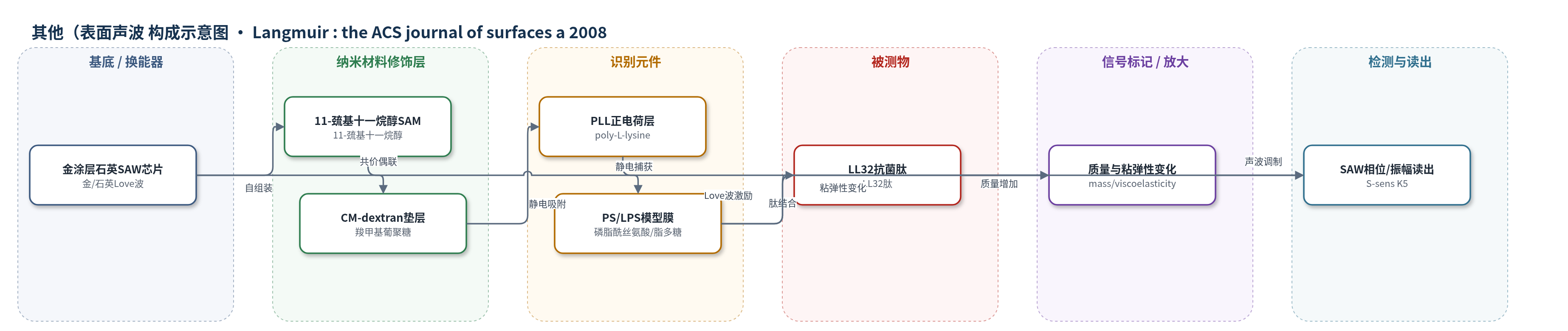
点击图片查看大图 · 依据论文自动绘制
传感器类型
其他(表面声波(SAW)生物传感器)
检测对象
抗菌肽LL32(human cathelicidin-derived peptide LL32);样品基质:5 mM Hepes、100 mM KCl、pH 7.0缓冲液中的肽溶液,作用于固定化磷脂酰丝氨酸(PS)或脂多糖(LPS)模型膜
检测原理
传感器基于Love表面声波在石英芯片表面传播,表面结合事件会改变声波相位和振幅。金表面经11-巯基十一烷醇SAM、羧甲基葡聚糖(CM-dextran)和聚-L-赖氨酸(PLL)修饰后,带负电或两性磷脂酰丝氨酸(PS)/脂多糖(LPS)脂质体被静电捕获并形成支撑双分子层。当缓冲液中的抗菌肽LL32注入时,LL32与带负电膜结合,使界面质量增加,导致相位正移;同时肽-膜相互作用改变双分子层粘弹性,使振幅增加。双频测量模式可减弱缓冲液盐浓度和粘度对相位的影响。随着LL32浓度升高,相位偏移近似线性增加;高浓度或快速流动下,LL32可破坏双分子层,剪切力使膜部分或完全脱离,信号回落。该方法无需酶或核酸放大,直接读出膜-肽相互作用。
检测灵敏度
原文未报告LOD、线性范围、灵敏度斜率或相关系数。
效应效果
作者报道脂质覆盖高度可重复且均匀,AFM显示PS膜厚度约5 nm,力谱回缩曲线出现约40 nm吸引区,提示形成柔性支撑双分子层。PS、LPS和LL32均以100 µM注入,PLL为60 µg/mL;吸附信号高度可重复,温度影响较低,E. coli LPS WBB01在36 °C相变温度上下吸附可比。对照实验表明LL32对CM-dextran/PLL基质结合可忽略。快速流动(150 µL/min初始脉冲)下相位从约130°降至10°,振幅恢复初始值,说明LL32可破坏双分子层。乙醇/甘氨酸/Triton X-100清洗后信号基本恢复,但二次装载相位略降。与Biacore 3000 SPR结果定性一致,作者认为该SAW平台可用于研究抗菌肽与细菌模型膜相互作用及耐药机制。
传感器的构成
- 基底/换能器:金涂层石英SAW芯片(S-sens K5 quartz chip, gold-coated quartz)作为Love波换能基底
- 自组装单分子层:11-巯基十一烷醇(11-mercapto-1-undecanol)在金表面形成SAM,提供羟基
- 交联缓冲层:环氧氯丙烷活化后共价偶联羧甲基葡聚糖(CM-dextran),溴乙酸羧基化形成带负电垫层
- 电荷识别层:聚-L-赖氨酸(PLL, poly-L-lysine)静电吸附形成正电荷层
- 模型膜识别元件:磷脂酰丝氨酸(PS)脂质体或脂多糖(LPS)聚集体形成支撑双分子层
- 信号读出:S-sens K5双频Love-wave系统输出相位与振幅
- 再生清洗:乙醇、0.1 M甘氨酸/0.3% Triton X-100(pH 12)、乙醇去除脂质与肽
中文摘要
表面声波(SAW)生物传感器是研究生物分子相互作用的有力工具。本文利用表面限制声波被表面结合事件调制来解析表面结合过程,其中声波相位和振幅分别大致对应表面质量负载和粘弹性变化。作者建立了一套在改性金传感器芯片表面重建磷脂和脂多糖双分子层的流程,用于研究膜活性肽的作用机制。该流程包括在金表面形成11-巯基十一烷醇自组装单分子层,共价偶联羧甲基葡聚糖,再覆盖聚-L-赖氨酸层。原子力显微镜显示脂质覆盖高度可重复且均匀;乙醇/吐温处理可完全去除脂质,为连续独立实验提供基础。该装置用于研究人cathelicidin来源抗菌肽LL32与固定化磷脂酰丝氨酸膜的结合。肽-膜相互作用引起正相位偏移和振幅增加,表明质量增加伴随粘度降低,提示LL32作用后双分子层变得更刚硬。
英文摘要
Surface acoustic wave biosensors are a powerful tool for the study of biomolecular interactions. The modulation of a surface-confined acoustic wave is utilized here for the analysis of surface binding. Phase and amplitude of the wave correspond roughly to mass loading and viscoelastic properties of the surface, respectively. We established a procedure to reconstitute phospholipid and lipopolysaccharide bilayers on the surface of a modified gold sensor chip to study the mode of action of membrane-active peptides. The procedure included the formation of a self-assembled monolayer of 11-mercaptoundecanol, covalent coupling of carboxymethyl-dextran, and subsequent coating with a poly- l-lysine layer. The lipid coverage of the surface is highly reproducible and homogeneous as demonstrated in atomic force micrographs. Ethanol/triton treatment removed the lipids completely, which provided the basis for continuous sequences of independent experiments. The setup was applied to investigate the binding of human cathelicidin-derived peptide LL32, as an example for antimicrobial peptides, to immobilized phosphatidylserine membranes. The peptide-membrane interaction results in a positive phase shift and an increase in amplitude, indicating a mass increase along with a loss in viscosity. This suggests that the bilayer becomes more rigid upon interaction with LL32.