组成图示
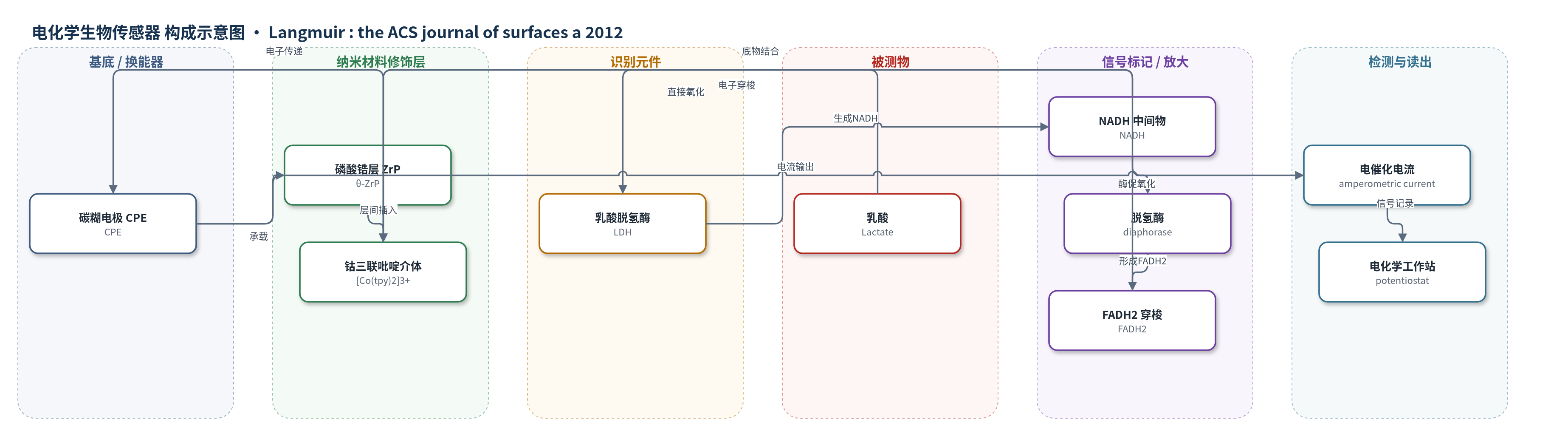
点击图片查看大图 · 依据论文自动绘制
传感器类型
电化学生物传感器
检测对象
乳酸(lactate);样品基质:0.1 M PBS(pH 7.0),文中提及血液/脑脊液等临床样品
检测原理
乳酸脱氢酶(LDH)催化乳酸氧化为丙酮酸,同时 NAD+ 还原为 NADH;NADH 在 [Co(tpy)2]3+:ZrP 修饰碳糊电极上被氧化,[Co(tpy)2]3+ 作为电子介质在 ZrP 层内保持电活性,E°′ 40.8 mV vs Ag/AgCl,不依赖 pH。加入 diaphorase 后,NADH 将电子传递给 FAD 形成 FADH2,FADH2 再与钴复合物/电极发生电子转移,使电催化电流增强约 10 倍。乳酸浓度升高使 NADH 生成量增加,电流呈 Michaelis–Menten 型响应,线性至 10 mM 后饱和,最终通过安培电流读出乳酸浓度。
检测灵敏度
线性范围: 至 10 mM;灵敏度: 0.003 μA/[lactate, mM]
效应效果
该传感器插入后保持化学与电化学稳定,UV–vis 显示无钴复合物溶出,E°′ 不随 pH 变化。加入 diaphorase 后 NADH 电催化电流增强约 10 倍。双酶乳酸传感器在 0.1 M PBS(pH 7.0)中对乳酸呈 Michaelis–Menten 型响应,线性至 10 mM 后饱和,灵敏度为 0.003 μA/[lactate, mM]。与无 ZrP 的 [Co(tpy)2]2+ 双酶体系相比,线性范围由 5 mM 扩展至 10 mM(对比灵敏度 0.48 μA/[lactate, mM])。作者认为可覆盖血液/脑脊液乳酸浓度(<4 mM),适用于临床检测。
传感器的构成
- 基底/换能器电极:碳糊电极(CPE)/碳糊旋转盘电极(RDE),提供导电基底并输出电流信号
- 纳米材料修饰层:θ 相层状磷酸锆(ZrP)直接插入 [Co(tpy)2]3+,形成 [Co(tpy)2]3+:ZrP 介体层,保持电活性并介导电子转移
- 识别/催化元件:乳酸脱氢酶(LDH),催化乳酸氧化为丙酮酸并生成 NADH
- 电子穿梭/放大元件:脱氢酶(diaphorase,NADH 脱氢酶),将 NADH 氧化为 NAD+ 并形成 FADH2,增强电子传递
- 辅因子/电子供体:NAD+(20 mM)作为 LDH 辅因子,NADH/FADH2 作为电子供体
中文摘要
本文报道将双(2,2′,2″,6-三联吡啶基)钴(II) [Co(tpy)2]2+ 直接插入高水合 θ 相层状磷酸锆(θ-ZrP)中,形成氧化态 [Co(tpy)2]3+ 嵌入的 ZrP 材料。X 射线粉末衍射显示,层间距由 θ-ZrP 的 10.3 Å 增大至干燥 [Co(tpy)2]3+:ZrP 的 14.9 Å,表明复合物进入层间。该钴复合物在 ZrP 层内仍保持电活性,修饰碳糊电极(CPE)的正式电位为 40.8 mV(vs Ag/AgCl,3.5 M NaCl),且不依赖 pH。然而,该修饰 CPE 对还原型烟酰胺腺嘌呤二核苷酸(NADH)电氧化的灵敏度低于此前报道的 [Ru(phend)2bpy]2+ 嵌入 ZrP 修饰 CPE。为改善 NADH 电氧化性能,作者在溶液中加入脱氢酶(diaphorase),使 NADH 氧化电催化电流增强,并构建了双酶乳酸生物传感器用于乳酸检测。
英文摘要
The direct intercalation reaction of [Co(tpy)(2)](2+) with the highly hydrated θ phase of layered zirconium phosphate (θ-ZrP) resulted in the formation of the oxidized [Co(tpy)(2)](3+) ion within the ZrP material. The X-ray powder diffraction patterns showed that the interlayer distance increases from 10.3 Å in θ-ZrP to 14.9 Å in the dry [Co(tpy)(2)](3+)-intercalated ZrP {[Co(tpy)(2)](3+):ZrP} phase. The complex remains electroactive within the layers of ZrP. The formal potential of a carbon paste electrode (CPE) modified with [Co(tpy)(2)](3+):ZrP (E°' = 40.8 mV versus Ag/AgCl, 3.5 M NaCl) is non-pH-dependent. However, the sensitivity of the [Co(tpy)(2)](3+):ZrP-modified CPE for the detection of reduced nicotinamide adenine dinucleotide (NADH) electrooxidation was lower than that of a previously reported CPE modified with [Ru(phend)(2)bpy](2+)-intercalated ZrP. (1) To improve the characteristics of NADH electrooxidation of the [Co(tpy)(2)](3+):ZrP-modified CPE, we included the enzyme diaphorase in solution, which increased the electrocatalytic current for NADH oxidation. A bienzymatic lactate biosensor was constructed and used for lactate sensing.