组成图示
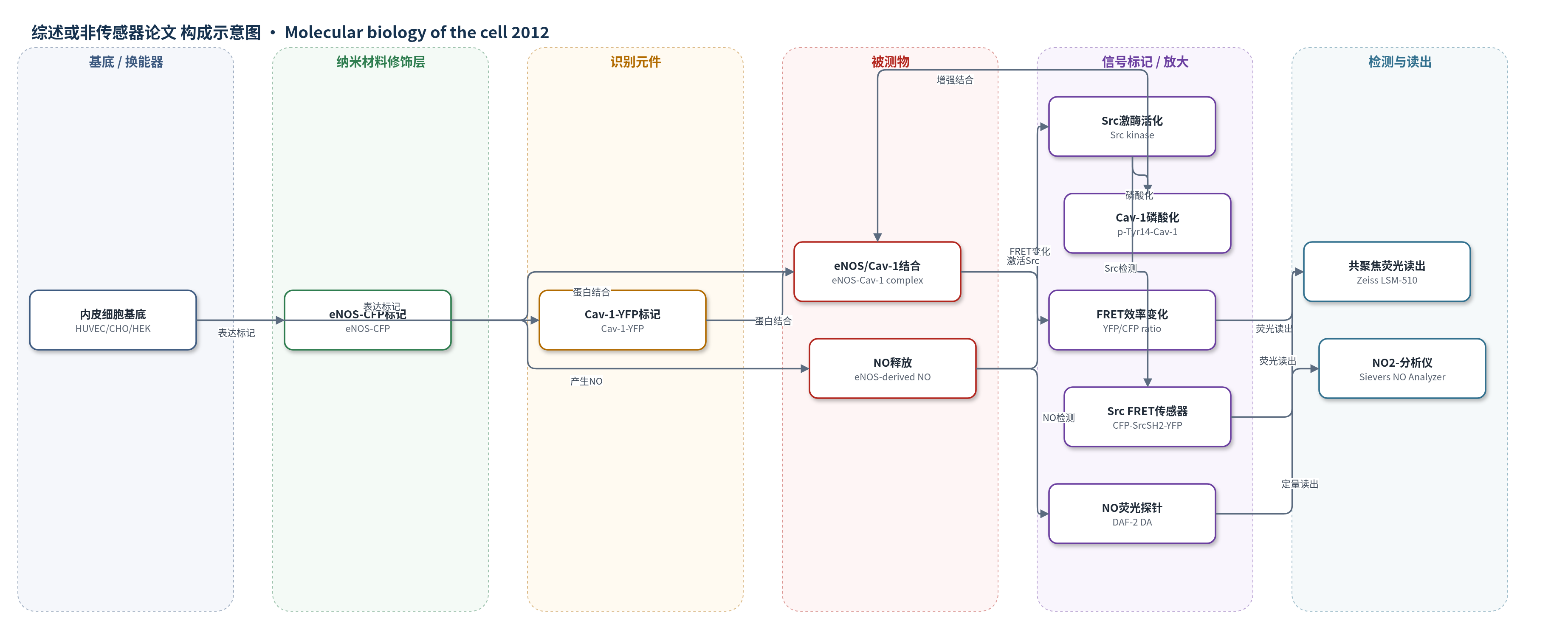
点击图片查看大图 · 依据论文自动绘制
传感器类型
综述或非传感器论文
检测对象
eNOS/caveolin-1 相互作用(eNOS/Cav-1 interaction)、一氧化氮(NO, nitric oxide)、Src激酶活性(Src kinase activity);样品基质:HUVEC/CHO/HEK细胞裂解液、细胞培养上清、离体小鼠肺匀浆
检测原理
本文并非传感器论文,但采用FRET检测蛋白相互作用。eNOS-CFP与Cav-1-YFP在细胞内表达,当eNOS与Cav-1结合距离接近时,CFP激发能量转移至YFP,使CFP荧光降低、YFP升高,YFP/CFP比值增加,反映结合增强。A23187、凝血酶或VEGF刺激使细胞内Ca2+升高,eNOS活化并产生NO;NO通过S-亚硝基化等机制激活Src,Src磷酸化Cav-1 Tyr-14,磷酸化Cav-1构象改变,增强与eNOS结合并抑制eNOS活性,形成负反馈。NO还可用DAF-2 DA荧光探针检测,NO使探针荧光增强;培养上清NO2-用Sievers分析仪定量。Src活性用Src FRET biosensor检测,Src活化使CFP远离YFP,FRET降低。
检测灵敏度
原文未报告LOD、线性范围、灵敏度斜率或相关系数。
效应效果
实验显示A23187刺激后eNOS/Cav-1 FRET在1.5 min达峰并维持5 min;coIP在1 min增加10倍(A23187)或5倍(凝血酶)。HUVEC中A23187处理5 min使eNOS/Cav-1结合增加5倍,30 min仍为2.5倍;离体小鼠肺3 min增加6倍。l-NAME和PP2显著阻断结合,提示NO/Src依赖。Y14D-Cav-1与eNOS结合较野生型高4.2倍,NO2-产生较WT-Cav-1低40%;NO供体使Cav-1-null MEF中Src活性增加80%,WT MEF增加50%。eNOS siRNA降低p-Src和p-Cav-1。数据以mean±SEM报告,n=3–13,p<0.05或更低。作者认为该机制对血管炎症和NO失调相关疾病具有重要意义。
传感器的构成
- 非传感器论文:无传感器构成,以下列出文中FRET检测工具组成
- 荧光供体:eNOS-CFP,标记eNOS并作为FRET供体
- 荧光受体:Cav-1-YFP,标记Cav-1并作为FRET受体
- 识别元件:eNOS与Cav-1 scaffold domain (CSD) 相互作用,介导结合
- 信号标记物:CFP/YFP荧光强度变化,反映FRET效率
- 检测仪器:Zeiss LSM-510 META confocal microscope,读取荧光
- 化学检测:DAF-2 DA荧光探针与Sievers NO Analyzer,检测NO/NO2-
中文摘要
内皮型一氧化氮合酶(eNOS)产生的一氧化氮(NO)对血管功能调节至关重要。caveolin-1(Cav-1)结合eNOS可使其失活,但Cav-1抑制已激活eNOS的机制不清。本研究探讨Src依赖的Cav-1磷酸化在eNOS负反馈中的作用。利用荧光共振能量转移(FRET)和共免疫沉淀(coIP),作者发现内皮细胞经凝血酶、血管内皮生长因子(VEGF)或钙离子载体A23187刺激后,eNOS与Cav-1相互作用增强,并在离体灌流小鼠肺中证实。eNOS抑制剂l-NAME和Src激酶抑制剂PP2可阻断该结合。在过表达eNOS的人胚胎肾细胞中,磷酸模拟突变体Y14D-Cav-1与eNOS结合增强,钙诱导NO产生低于磷酸缺陷突变体Y14F-Cav-1。Src FRET生物传感器、eNOS siRNA和NO供体实验证明,NO诱导Src活化并使Cav-1 Tyr-14磷酸化,从而增强eNOS/Cav-1结合并抑制eNOS活性。综上,eNOS激活促进Src依赖的Cav-1 Tyr-14磷酸化及eNOS/Cav-1结合,构成eNOS反馈抑制。
英文摘要
Endothelial nitric oxide synthase (eNOS)-mediated NO production plays a critical role in the regulation of vascular function and pathophysiology. Caveolin-1 (Cav-1) binding to eNOS holds eNOS in an inactive conformation; however, the mechanism of Cav-1-mediated inhibition of activated eNOS is unclear. Here the role of Src-dependent Cav-1 phosphorylation in eNOS negative feedback regulation is investigated. Using fluorescence resonance energy transfer (FRET) and coimmunoprecipitation analyses, we observed increased interaction between eNOS and Cav-1 following stimulation of endothelial cells with thrombin, vascular endothelial growth factor, and Ca(2+) ionophore A23187, which is corroborated in isolated perfused mouse lung. The eNOS/Cav-1 interaction is blocked by eNOS inhibitor L-N(G)-nitroarginine methyl ester (hydrochloride) and Src kinase inhibitor 4-amino-5-(4-chlorophenyl)-7-(t-butyl) pyrazolo [3, 4-d] pyrimidine. We also observe increased binding of phosphomimicking Y14D-Cav-1 mutant transduced in human embryonic kidney cells overexpressing eNOS and reduced Ca(2+)-induced NO production compared to cells expressing the phosphodefective Y14F-Cav-1 mutant. Finally, Src FRET biosensor, eNOS small interfering RNA, and NO donor studies demonstrate NO-induced Src activation and Cav-1 phosphorylation at Tyr-14, resulting in increased eNOS/Cav-1 interaction and inhibition of eNOS activity. Taken together, these data suggest that activation of eNOS promotes Src-dependent Cav-1-Tyr-14 phosphorylation and eNOS/Cav-1 binding, that is, eNOS feedback inhibition.