组成图示
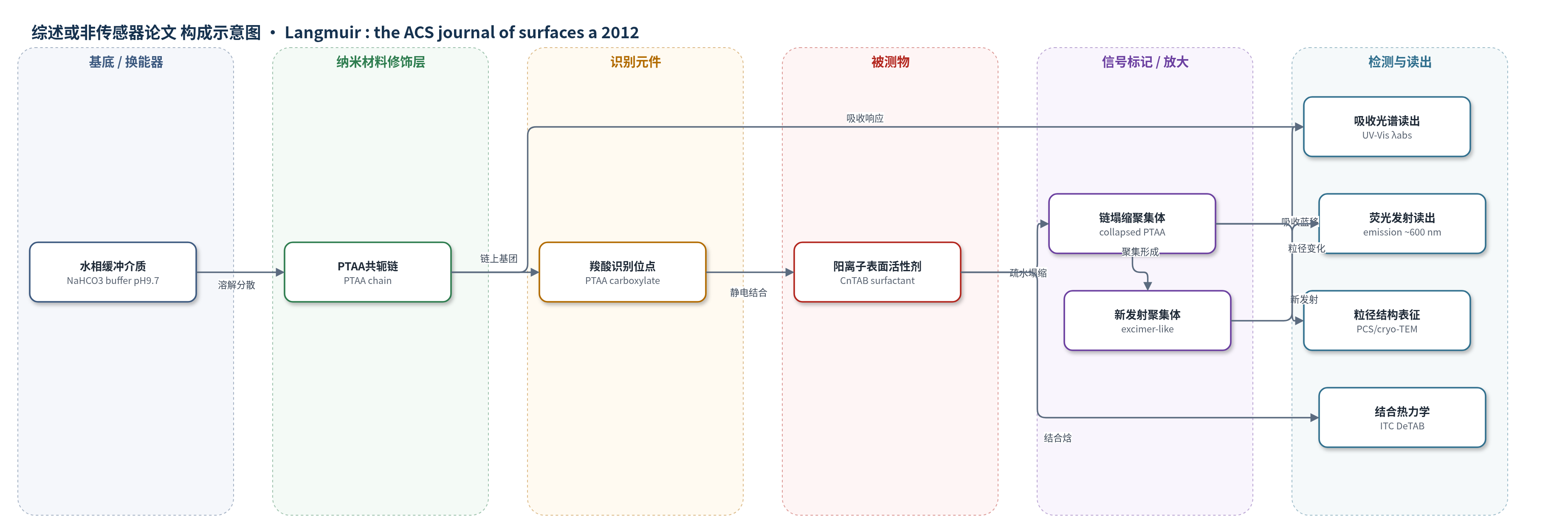
点击图片查看大图 · 依据论文自动绘制
传感器类型
综述或非传感器论文
检测对象
阳离子烷基三甲基溴化铵表面活性剂(alkyl trimethylammonium bromide surfactants, CnTAB,如 HTAB、OTAB、DeTAB、DoTAB、TTAB、CTAB);样品基质:碳酸氢钠缓冲水溶液(sodium bicarbonate buffer, pH 9.7, 36 mM)
检测原理
PTAA 在 pH 9.7 缓冲液中呈去质子化聚阴离子,其羧酸基团与阳离子 CnTAB 发生静电结合,表面活性剂烷基尾与强疏水共轭主链进一步相互作用。小组成比 R 下,结合使分子分散的 PTAA 链逐渐塌缩,构象无序增加,π 电子平均共轭长度降低,UV-Vis 吸收峰 λabs 蓝移 30–50 nm,而荧光发射基本不变。随 R 增大,混合聚集体富集表面活性剂并形成新结构/超聚集体,链间或链内低能态/激基复合物形成被促进,出现约 600 nm 的强发射带,较初始 472 nm 发射红移近 130 nm,初始发射逐渐减弱或消失。信号通过吸收峰位移和发射强度/波长读出,放大来自共轭链构象塌缩与聚集态诱导的低能发射。
检测灵敏度
原文未报告 LOD、线性范围、灵敏度斜率或相关系数。
效应效果
本文未做实际生物样品、选择性、稳定性、RSD、回收率或与 ELISA/HPLC/qPCR 对比。重复性方面,PCS 每样品测 30 次 ICF,N≈25 次平均,误差棒为标准差;λabs 拟合误差约 ±0.2 nm,初始值有 ±2 nm 波动。DoTAB 在 R=57 时第二发射带约为纯 PTAA 初始发射的 3 倍,初始 472 nm 发射消失;过滤后第二发射下降约 3 倍,说明红发射主要来自可滤除的纳米聚集体。ITC 显示 DeTAB 结合在 R<0.006 放热约 6 kJ/mol,R≈0.015 达约 8 kJ/mol,R≈0.1 转吸热。作者认为 PTAA 强疏水主链、大轮廓长/持久长比和水溶性适合小 R 比色传感与大 R 荧光标记。
传感器的构成
- 聚合物响应层:regiorandom poly(3-thiophene acetic acid) (PTAA),共轭聚电解质,提供吸收/发射光谱响应
- 结合配体层:alkyl trimethylammonium bromide surfactants (CnTAB,含 HTAB、OTAB、DeTAB、DoTAB、TTAB、CTAB),阳离子表面活性剂,与 PTAA 结合诱导塌缩与聚集
- 缓冲介质:sodium bicarbonate buffer (pH 9.7, 36 mM),维持 PTAA 去质子化与恒定离子强度
- 光谱读出层:UV-visible absorption and emission spectroscopy,通过 λabs 蓝移和 ~600 nm 新发射带读取结合信号
- 结构表征层:photon correlation spectroscopy (PCS) 与 cryogenic transmission electron microscopy (cryo-TEM),表征粒径、聚集体和超聚集体
- 热力学表征层:isothermal titration calorimetry (ITC),测定 PTAA 与 DeTAB 结合焓和 cac
中文摘要
本文在碳酸氢钠缓冲水溶液中,利用吸收与发射光谱、光子相关光谱、等温滴定量热和低温透射电镜,研究了不同烷基链长的阳离子表面活性剂与区域无规共轭聚阴离子聚(3-噻吩乙酸)(PTAA)的结合。在低聚合物浓度、低于临界胶束浓度且组成比 R(表面活性剂与单体摩尔浓度比)10^-6 到 10^2 的宽范围内考察混合溶液。表面活性剂结合后,分子分散的 PTAA 链先逐渐塌缩,随后随着混合聚集体中表面活性剂富集形成新结构。塌缩使共轭长度显著降低,吸收光谱蓝移 30–50 nm。新结构导致约 600 nm 处出现强发射带,较聚合物初始发射峰(约 472 nm)红移近 130 nm。表面活性剂尾链变短时,吸收蓝移和新发射增强延迟到更大组成比,且随表面活性剂浓度变化更平缓。这些特殊光谱性质源于 PTAA 强疏水主链、轮廓长/持久长比大以及良好水溶性的组合。结果表明,这些特性适合在小组成比设计比色生物传感器,在大组成比设计荧光生物标记。
英文摘要
The binding of cationic surfactants with varying alkyl chain length to a regiorandom conjugated polyanion, poly(3-thiophene acetic acid) (PTAA), is studied in an aqueous buffer by using absorption and emission spectroscopies, photon correlation spectroscopy, isothermal titration calorimetry, and cryogenic transmission electron microscopy. We study the mixed solutions as a function of composition ratio R of surfactant molecules to monomer units molar concentrations, at low polymer concentration and in a very wide composition range (10(-6) < R < 10(2)) below the critical micellar concentration. Upon surfactant binding, the molecularly dispersed chains first collapse progressively and then form new structures as the mixed aggregates get enriched in surfactant. The collapse leads to a strong decrease of the conjugation length and to a blue shift of the absorption spectra by 30 to 50 nm. The new structures are responsible for a new intense emission band at about 600 nm, red-shifted by nearly 130 nm from the initial emission maximum of the polymer (~472 nm). As the surfactant tail becomes shorter, the blue shift of the absorption spectra and the intensity raise of the new emission are delayed to larger composition ratios while their variations become smoother functions of the surfactant concentration. These particular spectroscopic properties of PTAA seem related to its unique combination of a strongly hydrophobic backbone, a large ratio of contour length to persistence length, and an overall good aqueous solubility. Our results show that such features are well suited to design a colorimetric biosensor at small composition ratio, and a fluorescent biomarker at large composition ratio.