组成图示
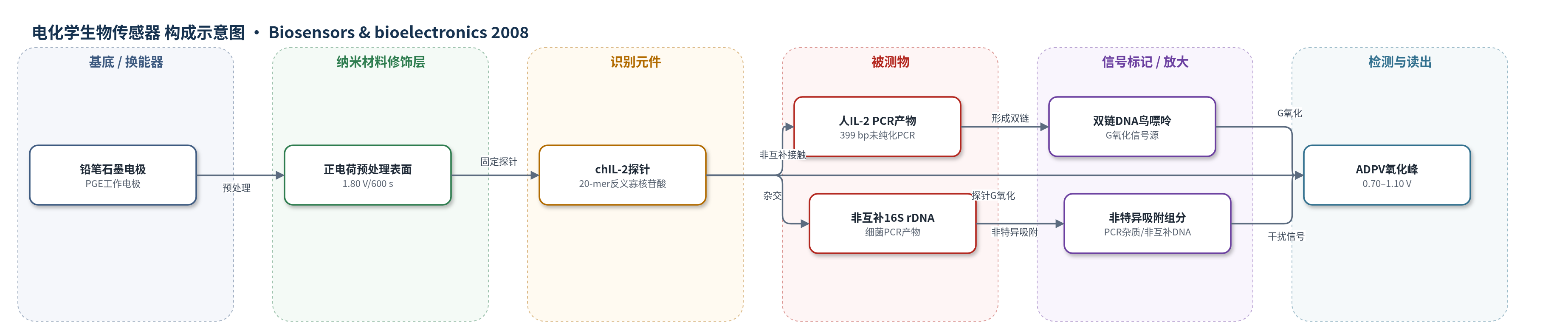
点击图片查看大图 · 依据论文自动绘制
传感器类型
电化学生物传感器
检测对象
人白细胞介素-2 DNA(human interleukin-2 DNA, hIL-2 DNA)PCR扩增产物;样品基质:未纯化PCR扩增真实样品(PCR反应液,稀释于Tris-HCl/NaCl杂交缓冲液)。
检测原理
该传感器采用无标记电化学DNA杂交检测。PGE经1.80 V/600 s预处理后表面形成较多正电荷位点,利于带负电的chIL-2探针固定。未纯化PCR样品中的人IL-2 DNA(399 bp)热变性后与探针杂交,形成双链DNA;由于目标片段含多个鸟嘌呤(G),电极表面可氧化G含量增加。ADPV在0.70–1.10 V扫描时,G阳极氧化峰电流随杂交量增加而增大,ΔI与目标浓度在100–2300 pM呈线性。洗涤步骤可去除PCR杂质和非互补DNA的非特异吸附,提高选择性。PCR扩增作为样品前放大,而非传感器信号放大。
检测灵敏度
LOD: 69 pM;线性范围: 100 pM–2300 pM;相关系数: 0.999
效应效果
选择性:互补IL-2 PCR产物使G氧化信号由81.21±4.47 nA升至274.4±10.27 nA;7种非互补16S rDNA PCR产物仅升至84.10±5.50 nA,PCR空白为86.31±4.72 nA。dNTPs和空白PCR的ΔIp分别为8.80±2.5 nA和9.0±5.53 nA,远低于互补样品124.76±4.0 nA。重现性RSD为5.3%(1500 pM,3个独立电极)。24 h储存及至少6 h暴露于20 mM Tris-HCl(pH 7.0)后响应无明显变化。凝胶电泳确认399 bp IL-2条带,验证可靠。作者认为可免纯化直接检测真实PCR样品。
传感器的构成
- 基底/换能器电极:铅笔石墨电极(PGE),工作电极,抛光后经1.80 V/600 s电化学预处理形成正电荷表面。
- 预处理/固定介质:0.50 M醋酸缓冲液(pH 4.80)含20 mM NaCl,用于PGE预处理和探针固定。
- 识别元件:20-mer寡核苷酸探针chIL-2(5′-CTA AAT TTA GCA CTT CCT CC-3′),人IL-2反义链,固定于PGE表面。
- 信号标记物:无外源标记,利用双链DNA中鸟嘌呤(G)的阳极氧化信号。
- 洗涤液:20 mM Tris-HCl(pH 7.0)含20 mM NaCl,300 s洗涤去除非特异吸附PCR组分。
- 检测介质:20 mM Tris-HCl(pH 7.00),用于ADPV测量。
- 电化学池:三电极体系,PGE工作电极、饱和甘汞电极(SCE)参比、铂丝辅助电极。
中文摘要
本文报道了一种无需纯化和预处理即可直接、快速电化学检测聚合酶链反应(PCR)扩增人白细胞介素-2(IL-2)编码DNA(399 bp)的方法。将20-mer寡核苷酸探针chIL-2固定于铅笔石墨电极(PGE)表面,该探针与人IL-2基因反义链互补。采用阳离子差分脉冲伏安法(ADPV)基于鸟嘌呤氧化信号检测杂交事件。通过优化电极预处理、杂交时间和样品滴加体积,并采用洗涤液去除未纯化PCR样品中非特异性吸附组分,有效抑制了PCR组分干扰。选择性评估显示,该传感器可区分互补IL-2 PCR产物与阴性对照及7种非互补细菌16S rDNA PCR产物。方法检出限为69 pM,并经凝胶电泳验证。
英文摘要
Electrochemical detection of polymerase chain reaction (PCR)-amplified human interleukin-2 (IL-2) coding DNA sample (399bp size) without any purification and pre-treatment is described. To achieve this goal, a sensor was made by immobilization of a 20-mer oligonucleotide (chIL-2) as the probe on the pencil graphite electrode (PGE). This probe is related to the antisense strand of human interleukin-2 gene. The results showed that the electrode could effectively sense the PCR product of human interleukin-2 DNA by anodic differential pulse voltammetry (ADPV) based on guanine oxidation signal. In order to inhibit PCR components interfering effects and improve biosensing performance, various factors were investigated. We found that the desorption of non-specifically adsorbed components of the unpurified PCR samples from PGE surface is easily achieved by washing of the electrode in washing solution for about 300s. The effectiveness of this procedure was confirmed using purified PCR samples. The selectivity of the sensor was assessed with negative control PCR sample and seven different non-complementary PCR products corresponding to 16S rDNA (bigger than 1500bp) of various bacterial genuses. Diagnostic performance of the biosensor is described and the detection limit is found to be 69pM. The reliability of the electrochemical biosensing results was verified by electrophoresis of the PCR products.