组成图示
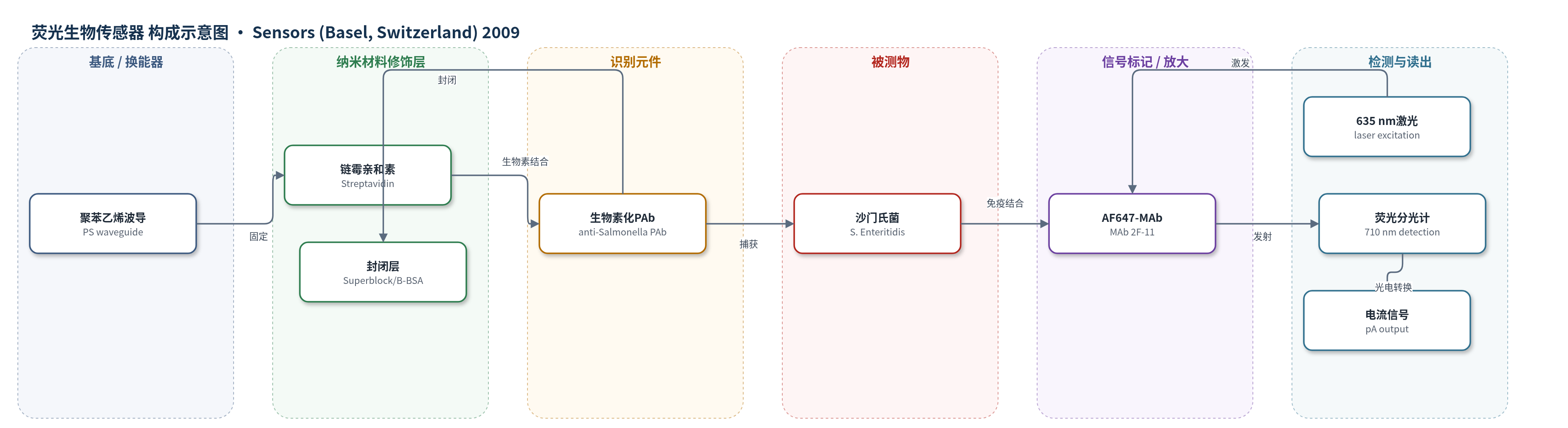
点击图片查看大图 · 依据论文自动绘制
传感器类型
荧光生物传感器
检测对象
沙门氏菌肠亚种 Enteritidis 血清型(Salmonella enterica serovar Enteritidis, S. Enteritidis);样品基质:无菌PBS纯培养、加标蛋壳蛋(shell egg)和鸡胸肉(chicken breast)TSB富集液
检测原理
传感器基于倏逝波荧光免疫识别。生物素化抗沙门氏菌多克隆抗体经链霉亲和素固定于聚苯乙烯波导表面,并用Superblock和生物素化BSA封闭。样品中的S. Enteritidis被捕获抗体结合,随后加入Alexa Fluor 647标记的MAb 2F-11形成夹心复合物。635 nm激光在波导芯中产生倏逝场,仅激发靠近波导表面的AF647,使其发射710 nm荧光。荧光经波导传回光电二极管,转换为pA电流。菌量越高,结合的二抗越多,荧光和电流越大。实际样品先经TSB富集以提高菌量,从而在8 h内完成检测。
检测灵敏度
LOD: 10^3 cfu/mL (pure culture);LOD: 10^4 cfu/mL (egg and chicken breast samples when spiked with 10^2 cfu/mL after 2–6 h of enrichment)
效应效果
传感器对S. Enteritidis和S. Typhimurium阳性,对E. coli O157:H7、E. faecalis、L. rhamnosus、L. monocytogenes阴性;S. aureus因Protein A假阳性。混合培养中10^5 cfu/mL S. Enteritidis与10^6 cfu/mL其他菌共存仍可检测(P=0.0105、0.0029)。加标10^2 cfu/mL样品经TSB富集后,鸡蛋4 h、鸡胸肉2 h阳性;鸡蛋2 h菌量9.45×10^4 cfu/mL,信号584.74 pA,对照459.9 pA(P=0.0226);鸡胸肉2 h菌量2×10^4 cfu/mL,信号539.68 pA(P=0.0011)。光纤法与IMB-TRF相当,富集后检测约1.5 h和2.5 h,总流程<8 h,可替代传统5–7天方法。未报告稳定性、RSD和回收率。
传感器的构成
- 基底/换能器:聚苯乙烯波导(polystyrene waveguides,4 cm、0.78 mm,Research International),传导倏逝波并提供抗体固定表面
- 亲和素修饰层:链霉亲和素(streptavidin,100 µg/mL),固定于波导表面并结合生物素化抗体
- 捕获识别元件:生物素化抗沙门氏菌兔多克隆抗体(biotinylated anti-Salmonella PAb,0.05 mg/mL,PBS含2 mg/mL BSA),捕获沙门氏菌
- 封闭层:Superblock(Pierce)和生物素化牛血清白蛋白(biotinylated BSA,B-BSA,1 mg/mL),封闭非特异结合位点
- 信号标记物:Alexa Fluor 647标记抗沙门氏菌单克隆抗体(AF-MAb 2F-11,2.2 mg/mL,染料:蛋白≈1:1),与捕获菌结合产生荧光
- 激发/读出:635 nm激光激发,710 nm荧光由激光荧光分光计/Analyte 2,000光电二极管读取(pA)
中文摘要
沙门氏菌肠亚种是全球关注的食源性病原,需要在零售前快速、敏感地评估产品安全。由于沙门氏菌常与禽肉相关,本研究开发了一种倏逝波光纤检测法,用于检测蛋壳蛋和鸡胸肉中的沙门氏菌,并与时间分辨荧光(TRF)法比较。抗沙门氏菌多克隆抗体通过生物素-亲和素相互作用固定于光纤表面以捕获沙门氏菌;Alexa Fluor 647偶联单克隆抗体(MAb 2F-11)作为报告物。检测时,635 nm激光在光纤中产生倏逝波并激发Alexa Fluor 647,710 nm荧光由激光荧光分光计测量。该传感器对沙门氏菌具有特异性,纯培养中检出限为10^3 cfu/mL,在鸡蛋和鸡胸肉样品中加标10^2 cfu/mL并经2–6 h富集后检出限为10^4 cfu/mL。结果表明,光纤传感器性能与TRF相当,可在8 h内完成,为现有检测方法提供了替代方案。
英文摘要
Salmonella enterica is a major food-borne pathogen of world-wide concern. Sensitive and rapid detection methods to assess product safety before retail distribution are highly desirable. Since Salmonella is most commonly associated with poultry products, an evanescent wave fiber-optic assay was developed to detect Salmonella in shell egg and chicken breast and data were compared with a time-resolved fluorescence (TRF) assay. Anti-Salmonella polyclonal antibody was immobilized onto the surface of an optical fiber using biotin-avidin interactions to capture Salmonella. Alexa Fluor 647-conjugated antibody (MAb 2F-11) was used as the reporter. Detection occurred when an evanescent wave from a laser (635 nm) excited the Alexa Fluor and the fluorescence was measured by a laser-spectrofluorometer at 710 nm. The biosensor was specific for Salmonella and the limit of detection was established to be 10(3) cfu/mL in pure culture and 10(4) cfu/mL with egg and chicken breast samples when spiked with 10(2) cfu/mL after 2-6 h of enrichment. The results indicate that the performance of the fiber-optic sensor is comparable to TRF, and can be completed in less than 8 h, providing an alternative to the current detection methods.