组成图示
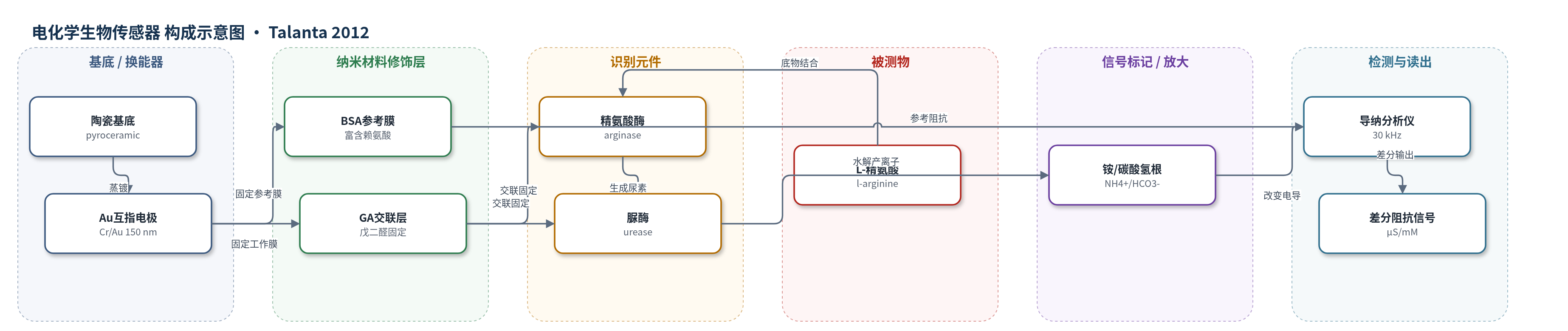
点击图片查看大图 · 依据论文自动绘制
传感器类型
电化学生物传感器
检测对象
L-精氨酸(l-arginine);样品基质:5 mM磷酸盐缓冲液(PB,pH 6.0)、可饮用溶液“Arginine Veyron”
检测原理
该传感器采用双酶级联识别与导纳换能。L-精氨酸进入工作电极生物膜后,被精氨酸酶催化水解为L-鸟氨酸和尿素;过量脲酶迅速将尿素水解为NH4+和HCO3-,并伴随局部H+消耗与pH变化。反应产生的离子改变电极/溶液界面电导,使工作电极阻抗下降。参考电极仅固定BSA膜,不产生相应离子变化。仪器施加30 kHz、10 mV正弦电位,避免法拉第反应和双电层充电,测量工作/参考电极阻抗差。稳态差分信号随L-精氨酸浓度增加而增大,过量脲酶保证尿素完全转化,从而放大离子信号。
检测灵敏度
LOD: 5.0 × 10⁻⁷ M;线性范围: 0.01–4 mM;灵敏度: 4.2 μS/mM
效应效果
传感器对L-精氨酸选择性良好:2 mM时L-精氨酸、L-刀豆氨酸、L-赖氨酸、L-组氨酸和γ-氨基丁酸响应分别为19.5、15.6、19.8、9.5和0.6 μS,其他氨基酸响应低;L-赖氨酸和L-组氨酸为竞争性可逆抑制,洗涤后可恢复。重现性CV为3.9%,操作稳定性10 h内RSD为3–5%,4℃干燥存储超过3个月,45天响应增加约90%后基本稳定。实际样品“Arginine Veyron”测定值为(964±9) mM,与厂家数据相对误差4.6%。与文献电位法相比,其LOD 5.0×10⁻⁷ M和响应时间120±5 s具有优势,作者认为可用于生物医学检测和药品质量控制。
传感器的构成
- 基底与换能器电极:非导电陶瓷(pyroceramic)基底上蒸镀50 nm Cr粘附层和150 nm Au互指薄膜电极,构成工作/参考导纳换能器
- 参考膜:参考电极上固定富含赖氨酸的牛血清白蛋白(BSA)膜,用于差分测量
- 工作识别膜:工作电极上固定精氨酸酶(arginase)和脲酶(urease)双酶膜,实现L-精氨酸识别与级联转化
- 交联固定层:戊二醛(GA)2%水溶液交联双酶,形成稳定生物膜(Variant 1)
- 包埋固定层:聚乙烯醇-苯乙烯基吡啶鎓(PVA-SbQ)20%膜经UV聚合包埋双酶(Variant 2)
- 辅助稳定组分:甘油(glycerol)15 wt.%、BSA 5 wt.%和40 mM磷酸盐缓冲液(PB,pH 7.15)用于酶膜制备与稳定
- 测量读出:便携式四通道分析仪施加30 kHz、10 mV正弦电位,读取工作/参考电极阻抗差
中文摘要
本研究开发了一种高灵敏度导纳双酶生物传感器,用于L-精氨酸(l-arginine)测定。该传感器利用尿素循环中精氨酸酶(arginase,E.C. 3.5.3.1)和脲酶(urease,E.C. 3.5.1.5)的识别能力,将两种酶共固定于工作传感器的单一生物选择性膜中;参考传感器固定富含赖氨酸的牛血清白蛋白(BSA)膜,实现差分测量。作者确定了精氨酸酶与脲酶在生物膜中的最佳质量比,使传感器对L-精氨酸和尿素的灵敏度最优。比较了戊二醛(GA)交联和聚合物膜包埋两种酶固定方式,GA交联型传感器性能最佳,灵敏度为4.2 μS/mM,线性范围为0.01–4 mM,检出限为5.0×10⁻⁷ M。对可饮用溶液“Arginine Veyron”中L-精氨酸的定量结果与厂家数据相比相对误差为4.6%。该传感器具有良好的操作稳定性和存储稳定性。
英文摘要
A highly sensitive conductometric biosensor for l-arginine determination was developed by exploiting the unique biorecognition capacities of two enzymes of urea cycle - arginase (E.C. 3.5.3.1) and urease (E.C. 3.5.1.5). The enzymes were co-immobilized in a single bioselective membrane on the working sensor, while a lysine rich bovine serum albumin (BSA) membrane was immobilized on the reference sensor, allowing differential measurements. The optimum percentage ratio of arginase and urease within the bioselective membrane was determined when the biosensor sensitivity to l-arginine and urea was optimum. Analytical characteristics of the conductometric biosensor for l-arginine determination were compared for two types of enzyme immobilization (cross-linking with glutaraldehyde (GA) and entrapment in the polymeric membrane). The optimum features in terms of the sensitivity, the linear range, and the detection limit (4.2 μS/mM, 0.01-4mM, and 5.0 × 10(-7)M, respectively) were found for l-arginine biosensor based on enzyme cross-linking with GA. A quantitative determination of l-arginine in the real sample (a drinkable solution "Arginine Veyron") gave a satisfactory result compared to the data provided by the producer (a relative error was 4.6%). The developed biosensor showed high operational and storage stability.