组成图示
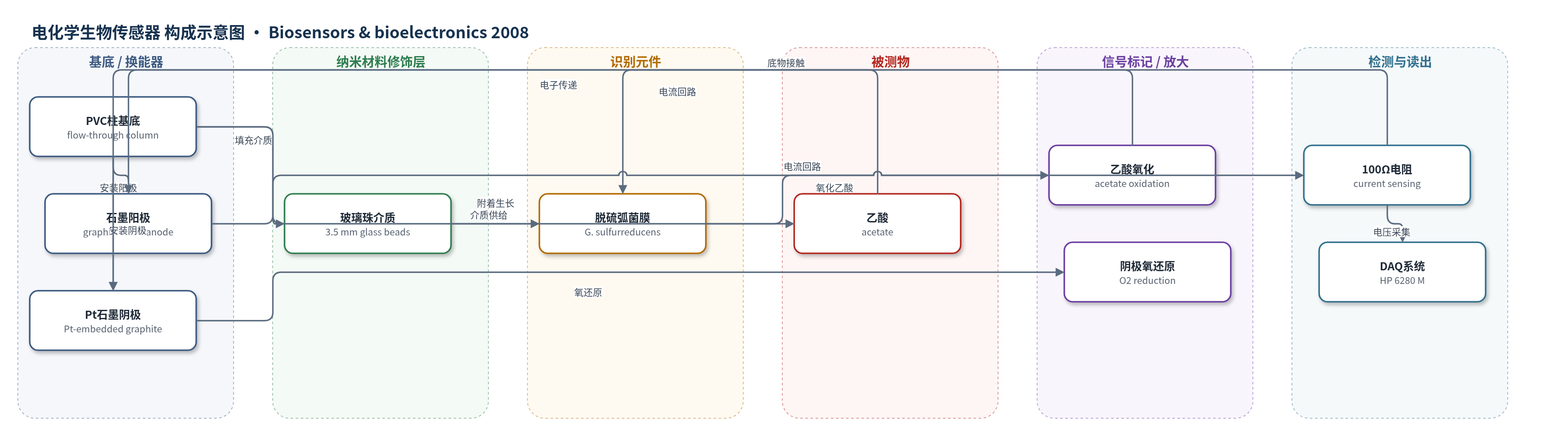
点击图片查看大图 · 依据论文自动绘制
传感器类型
电化学生物传感器
检测对象
乙酸(acetate)、微生物呼吸速率(microbial respiration rate),样品基质:流动柱状系统 DCB 培养基(模拟地下水/多孔介质水样)
检测原理
该传感器以微生物燃料电池为换能器。脱硫弧菌在石墨阳极表面形成生物膜,将乙酸氧化为电子供体,并通过细胞外电子传递(可能涉及纳米线或介体)把电子送至阳极;电子经外电路流向 Pt 阴极,阴极氧气被还原,形成闭合回路。外部 400 mV 偏压维持阳极还原电位,100 Ω 电阻上的压降被 DAQ 系统每秒采集并平均,从而得到电流。乙酸浓度升高时,微生物呼吸速率和电子供体氧化速率增加,电流随之增大;在 0–2.3 mM 乙酸范围内电流与浓度呈线性关系。氧气脉冲会抑制厌氧呼吸并使电流停止,恢复流动后电流恢复,因此还可指示毒性或不良生长条件。
检测灵敏度
线性范围: 0–2.3 mM acetate(对应电流 0–0.30 mA);灵敏度斜率: 0.132 mA/mM;线性方程: y = 0.001 + 0.132x(y=电流 mA,x=乙酸 mM);R^2 = 0.92
效应效果
未接种对照柱电流低于 0.01 mA,背景稳定。0–2.3 mM 乙酸范围内电流与浓度线性相关(R2=0.92);0.5 mM 乙酸在 500、575 和 725 h 均产生约 0.05 mA,显示可重复响应。乙酸变化后 1–4 h(0.13–0.52 PV)出现电流响应,接近柱内 2.3 h 平推流传输时间,表明阳极生物膜活性高。23 mM 乙酸降低后电流衰减延迟约 19 h(2.5 PV)并先短暂升高,可能与饥饿应激有关。氧气脉冲使电流立即停止,介质恢复后电流立即恢复,显示韧性并可指示毒性/不良条件。作者认为该 MFC 生物传感器可用于低成本、实时、原位监测地下水生物修复中的底物可用性和微生物呼吸速率。
传感器的构成
- 基底/换能器电极:石墨电极(graphite electrodes)与石墨布阳极(graphite cloth anode)、Pt 嵌入石墨布阴极(Pt-embedded-graphite cloth cathode,0.5 mg Pt/cm2,32 cm2),用于电子转移和氧气还原
- 多孔介质层:3.5 mm 玻璃珠(glass beads)紧密填充 PVC 柱,模拟多孔介质并提供生物膜附着表面
- 识别/生物催化元件:脱硫弧菌(Geobacter sulfurreducens, G. sulfurreducens)生物膜,氧化乙酸并向阳极传递电子;启动阶段可加入 Shewanella oneidensis MR1 建立还原条件
- 电子供体/被测物:乙酸(acetate)作为电子供体,其浓度决定微生物呼吸电流
- 电子受体:氧气(O2)在阴极被还原,完成 MFC 电路
- 流动介质:DCB 培养基(pH 7.1)含不同浓度钠乙酸,以 4.5 mL/h 流动,提供离子环境和底物
- 电路与偏压:400 mV 外部偏压和 100 Ω 串联电阻,维持阳极还原条件并量化电流
- 信号读出:Hewlett Packard 6280 M 多功能 DAQ 测量系统每秒采集电阻压降并平均 300 次,输出电流信号
中文摘要
本文探索基于微生物燃料电池(MFC)的传感方法,以获取原位监测底物浓度和微生物呼吸速率的有用信息。在柱状系统中,脱硫弧菌(Geobacter sulfurreducens)利用外部电子受体(电极)代谢乙酸,并监测电流产生。电流产生与主体相乙酸浓度呈镜像关系,建立了电流值(0–0.30 mA)与乙酸浓度(0–2.3 mM)之间的相关性(R2=0.92)。MFC 系统还经历冲击加载(氧气脉冲),在介质流动恢复后电力产生立即恢复,表明系统具有韧性并具备额外传感能力。因此,MFC 系统产生的电信号可为电子供体可用性和生物活性提供实时数据。这些结果对开发用于原位生物修复过程低成本实时监测的生物传感器具有实际意义,MFC 技术可提供有关生物降解过程速率和性质的信息。
英文摘要
Microbial fuel cell (MFC)-based sensing was explored to provide useful information for the development of an approach to in situ monitoring of substrate concentration and microbial respiration rate. The ability of a MFC to provide meaningful information about in situ microbial respiration and analyte concentration was examined in column systems, where Geobacter sulfurreducens used an external electron acceptor (an electrode) to metabolize acetate. Column systems inoculated with G. sulfurreducens were operated with influent media at varying concentrations of acetate and monitored for current generation. Current generation was mirrored by bulk phase acetate concentration, and a correlation (R(2)=0.92) was developed between current values (0-0.30 mA) and acetate concentrations (0-2.3 mM). The MFC-system was also exposed to shock loading (pulses of oxygen), after which electricity production resumed immediately after media flow recommenced, underlining the resilience of the system and allowing for additional sensing capacity. Thus, the electrical signal produced by the MFC-system provided real-time data for electron donor availability and biological activity. These results have practical implications for development of a biosensor for inexpensive real-time monitoring of in situ bioremediation processes, where MFC technology provides information on the rate and nature of biodegradation processes.