组成图示
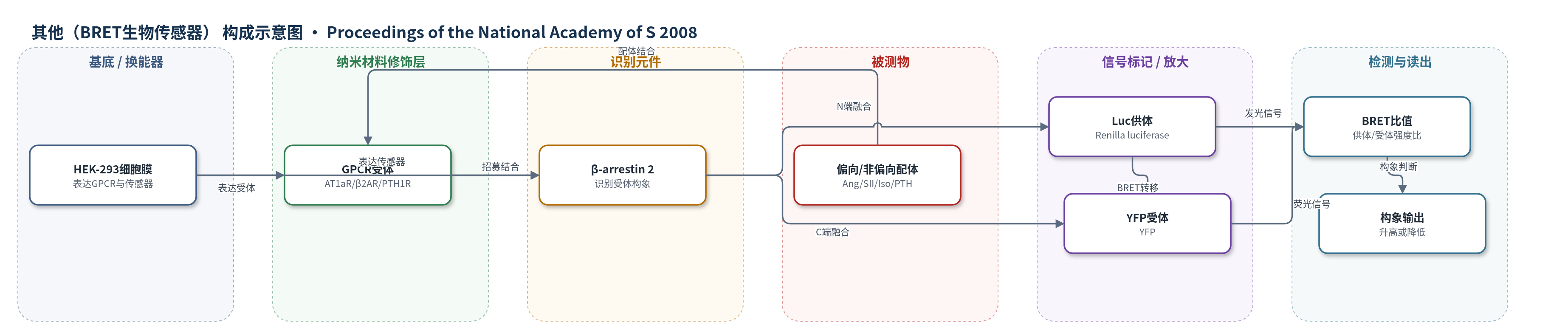
点击图片查看大图 · 依据论文自动绘制
传感器类型
其他(BRET生物传感器)
检测对象
β-arrestin 2 构象变化(β-arrestin 2 conformational change,反映 GPCR 偏向激动状态);样品基质:HEK-293 细胞、纯化 β2AR/脂质体
检测原理
配体与 GPCR 结合后,受体形成特定活性构象并招募胞质 β-arrestin 2。β-arrestin 2 与受体结合后发生构象重排,改变其 N 端 Luc 与 C 端 YFP 之间的距离和/或取向。Luc 的生物发光供体能量通过共振能量转移传递给 YFP,BRET 比值随供体-受体相对位置变化而升高或降低。非偏向配体通常使 BRET 比值升高,偏向配体或偏向受体突变使比值降低,方向相反反映不同 β-arrestin 构象。信号随配体浓度呈剂量依赖变化,EC50 与受体亲和力一致;无额外酶促或核酸放大,直接以 BRET 效率报告构象状态。
检测灵敏度
EC50: 2.9 ± 1.4 × 10^-9 M(Ang/AT1aR);EC50: 2.5 ± 1.9 × 10^-6 M(SII/AT1aR);EC50: 1 ± 1.8 × 10^-7 M(Iso/β2AR);EC50: 6.7 ± 5.0 × 10^-8 M(Iso/β2ARTYY);EC50: 1.0 ± 1.4 × 10^-8 M(PTH/PTH1R);EC50: 1.1 ± 1.9 × 10^-8 M(PTH-IA/PTH1R)
效应效果
BRET 变化可被 valsartan 或 propranolol 阻断,说明响应依赖 GPCR 激活。分子间 BRET 对照无显著变化,排除 β-arrestin 二聚或聚集。配体效能与 BRET 变化一致:部分激动剂响应较弱,反向激动剂 ICI 无检测变化。剂量依赖 EC50 与受体 Kd(Ang 约 1 nM、SII 约 300 nM)一致。纯化 β2AR/脂质体与传感器直接孵育也能诱导 BRET 升高,且可被 propranolol 阻断。磷酸化缺陷受体突变体仍产生类似构象变化。作者认为该传感器可解析 7TMR 偏向激动机制并支持 β-arrestin 偏向药物设计。
传感器的构成
- 表达基底:HEK-293 细胞膜,表达 AT1aR、β2AR 或 PTH1R 等 GPCR,提供受体-β-arrestin 相互作用界面
- 识别元件:β-arrestin 2(β-arr2),与激活或特定构象的 GPCR 结合并发生构象重排
- 供体标记:Renilla 荧光素酶(Luc),融合于 β-arr2 N 端,作为 BRET 生物发光供体
- 受体标记:黄色荧光蛋白(YFP),融合于 β-arr2 C 端,作为 BRET 荧光受体
- 信号读出:BRET 检测系统,测量 Luc 到 YFP 的能量转移效率(BRET ratio)
中文摘要
β-arrestin 通过抑制 G 蛋白信号并启动 β-arrestin 依赖信号,关键调控七次跨膜受体(GPCR/7TMR)。偏向性配体和受体突变使 G 蛋白介导与 β-arrestin 介导信号可药理学分离,但 β-arrestin 双重功能的分子机制仍不清楚。作者利用 β-arrestin 2 的分子内生物发光共振能量转移(BRET)生物传感器,将 Renilla 荧光素酶(Luc)和黄色荧光蛋白(YFP)分别融合于 β-arrestin 2 的 N 端和 C 端,结合三种 GPCR 的偏向配体或偏向突变体,证明 β-arrestin 可采取多种“活性”构象。出乎意料的是,受体磷酸化缺陷突变体也能诱导与野生型受体相似的 β-arrestin 构象变化,表明不同配体诱导或稳定的受体构象可在无受体磷酸化条件下促进功能特异的 β-arrestin 构象。结果说明功能特异的受体构象可传递至下游效应分子,从而决定其功能特异性。
英文摘要
Beta-arrestins critically regulate G protein-coupled receptors (GPCRs), also known as seven-transmembrane receptors (7TMRs), both by inhibiting classical G protein signaling and by initiating distinct beta-arrestin-mediated signaling. The recent discovery of beta-arrestin-biased ligands and receptor mutants has allowed characterization of these independent "G protein-mediated" and "beta-arrestin-mediated" signaling mechanisms of 7TMRs. However, the molecular mechanisms underlying the dual functions of beta-arrestins remain unclear. Here, using an intramolecular BRET (bioluminescence resonance energy transfer)-based biosensor of beta-arrestin 2 and a combination of biased ligands and/or biased mutants of three different 7TMRs, we provide evidence that beta-arrestin can adopt multiple "active" conformations. Surprisingly, phosphorylation-deficient mutants of the receptors are also capable of directing similar conformational changes in beta-arrestin as is the wild-type receptor. This indicates that distinct receptor conformations induced and/or stabilized by different ligands can promote distinct and functionally specific conformations in beta-arrestin even in the absence of receptor phosphorylation. Our data thus highlight another interesting aspect of 7TMR signaling--i.e., functionally specific receptor conformations can be translated to downstream effectors such as beta-arrestins, thereby governing their functional specificity.