组成图示
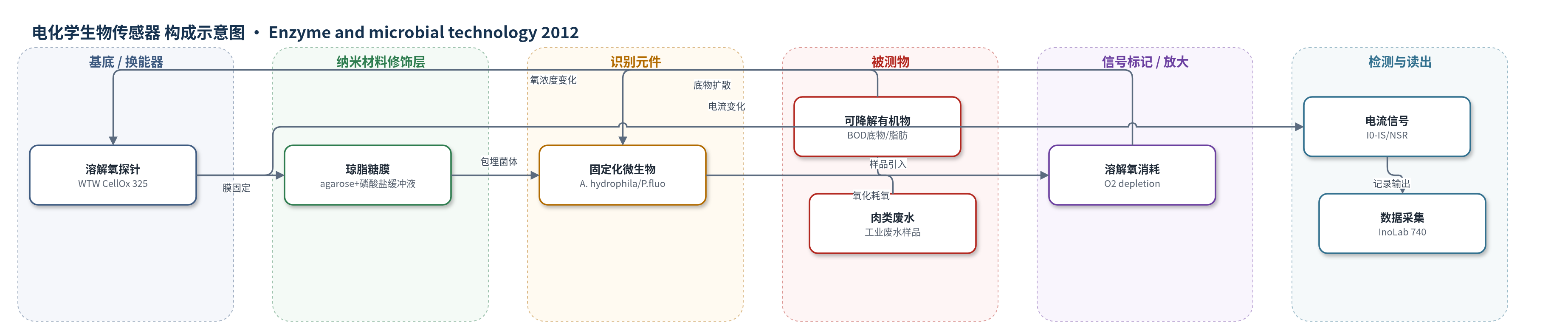
点击图片查看大图 · 依据论文自动绘制
传感器类型
电化学生物传感器
检测对象
生化需氧量(BOD/BOD7);样品基质:OECD合成废水、肉类工业废水、肉类浸出液及加标合成废水
检测原理
传感器以固定化活菌为识别元件,以Clark型溶解氧探针为电化学换能器。待测废水中的可生物降解有机物扩散进入琼脂糖膜,被A. hydrophila或P. fluorescens呼吸氧化;微生物代谢消耗膜内溶解氧,使探针处氧浓度下降。Clark型DO探针的电流与溶解氧浓度相关,加入底物前记录初始稳态电流I0,加入底物后记录终点稳态电流IS,响应为I0−IS或归一化信号NSR=(I0−IS)/I0,随BOD浓度增加而增大。A. hydrophila经含脂肪培养基诱导后产生脂肪转运和降解酶系,可氧化脂肪类底物,因此对高脂肉类废水的BOD响应更接近标准BOD7;P. fluorescens缺乏该途径,仅响应通用可降解组分。
检测灵敏度
LOD: 5 mg l−1 BOD7;线性范围: 至45 mg l−1 BOD7(A. hydrophila)、至40 mg l−1 BOD7(P. fluorescens);灵敏度: 0.019 1/(BOD7, mg l−1)(A. hydrophila)、0.023 1/(BOD7, mg l−1)(P. fluorescens)
效应效果
两种传感器寿命110天和115天,稳定期90天和80天,响应时间最长约20 min。校准RSD为2.0%–13.7%(A. hydrophila)和5.5%–13.5%(P. fluorescens),重现性±5.4%–±9.7%与±1.8%–±7.7%,再现性±3.2%–±6.9%与±2.9%–±7.7%,均在APHA 15.4%限内。与BOD7相比,肉类废水低估43%–71%,A更准:OECD加脂肪A 1231 mg L−1(0.99),P 962 mg L−1(0.77);肉类浸出液A 3116 mg L−1(0.29),P 3415 mg L−1(0.31)。A可反映脂肪比例,其他难降解物不可检出。
传感器的构成
- 换能器电极:Clark型溶解氧探针(WTW CellOx 325),电化学检测溶解氧消耗
- 固定支撑:聚丙烯网盘(Scrynel PP 500 HD)与插入环、支架(insertion ring, holder),承载并固定微生物膜
- 固定化基质:琼脂糖(agarose, type I-A Low EEO)与磷酸盐缓冲液(pH 6.86)混合,形成包埋菌体的膜
- 识别元件:Aeromonas hydrophila P69.1或Pseudomonas fluorescens P75活菌,氧化可生物降解有机物并耗氧
- 菌泥:离心洗涤后的细菌菌泥(900 μg),加入琼脂糖悬浮液中形成微生物膜
- 测量介质:磷酸盐缓冲液(pH 6.86)通氧饱和,作为底物扩散和微生物呼吸的介质
- 信号读出:测量模块(WTW InoLab 740)与MultiLab Pilot程序、计算机,记录电流信号
中文摘要
本文以具有半特异性脂肪降解能力的嗜水气单胞菌P69.1(Aeromonas hydrophila)构建BOD生物传感器,用于估算高油脂废水中的生化需氧量(BOD)。将菌体在含脂肪培养基中培养,以诱导脂肪转运和降解所需酶系;同时以非特异性荧光假单胞菌P75(Pseudomonas fluorescens)构建通用型BOD生物传感器作为对照。传感器采用OECD合成废水和稳态法校准,并对合成废水及工业废水进行检测。A. hydrophila传感器线性范围可达45 mg L−1 BOD7,P. fluorescens为40 mg L−1 BOD7,检出限为5 mg L−1 BOD7。两者使用寿命分别为110天和115天,响应时间随BOD7变化,分析不同废水时最长约20 min。两种传感器对肉类工业废水BOD均低估43%–71%,但A. hydrophila结果更准确;其可测定废水中脂肪比例,而其他难降解化合物对两种传感器均不可检出。
英文摘要
Aeromonas hydrophila P69.1 (A. hydrophila) was used to construct a semi-specific biosensor to estimate biochemical oxygen demand (BOD) in high fat and grease content wastewaters. A. hydrophila cells were grown in fat containing medium to induce necessary enzymes for transport and degradation of fatty substances. Universal biosensor based on non-specific Pseudomonas fluorescens P75 (P. fluorescens) was used to conduct comparison experiments. Biosensors were calibrated using OECD synthetic wastewater and steady-state method, subsequently several experiments with synthetic and industrial wastewaters were conducted. A linear range up to 45 mg l(-1) BOD(7) was gained using A. hydrophila biosensor, in comparison to 40 mg l(-1) BOD(7) obtained using P. fluorescens biosensors. The lower limit of detection was 5 mg l(-1) BOD(7). Service life of A. hydrophila and P. fluorescens biosensors were 110 and 115 days, respectively. The response time of the biosensors depended on the BOD(7) of measuring solution and was up to 20 min when analyzing different wastewaters. Both biosensors underestimated BOD in meat industry wastewater from 43% up to 71%, but more accurate results could be obtained with A. hydrophila biosensor. Semi-specific A. hydrophila biosensor was able to measure proportion of fat found in wastewater sample, while other refractory compounds remained undetectable to both biosensors.