组成图示
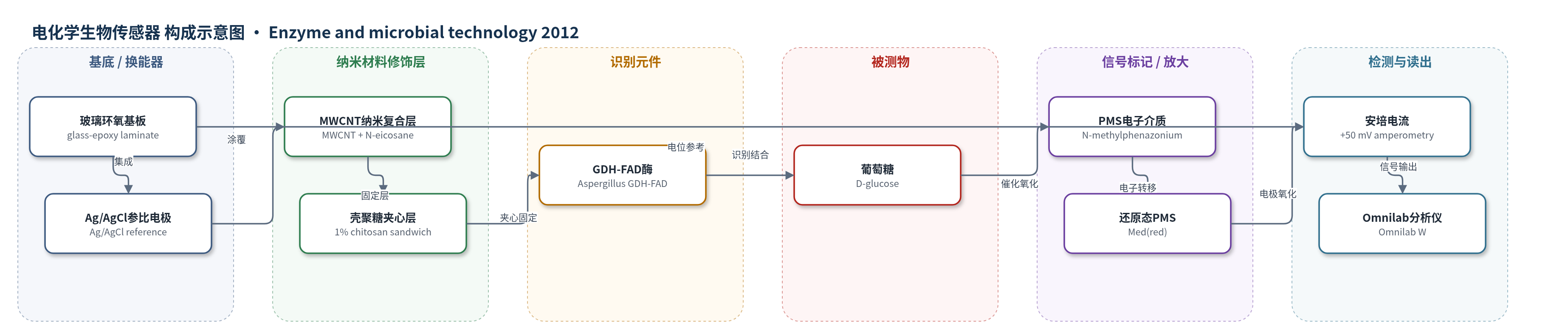
点击图片查看大图 · 依据论文自动绘制
传感器类型
电化学生物传感器
检测对象
葡萄糖(D-glucose / glucose),样品基质为果汁、饮料和葡萄酒(beverages, juices, wines)
检测原理
GDH-FAD 识别并催化 β-D-葡萄糖氧化为葡萄糖-1,5-内酯,同时 FAD 辅因子将电子传递给氧化态 PMS 介质,生成还原态 PMS(Med(red))。还原态 PMS 扩散至 MWCNT 纳米复合电极表面,在 +50 mV 工作电位下被电化学氧化,释放电子形成安培电流。电流大小与葡萄糖浓度成正比。MWCNT 提供高导电界面,PMS 作为可溶性电子介质实现酶催化位点与电极间的电子转移,避免依赖 O2 或 NAD+。壳聚糖夹心固定酶,保持活性并提高稳定性。响应时间约 60 s。
检测灵敏度
LOD: 4.15 μM(A. oryzae,signal/noise = 5);4.45 μM(Aspergillus sp.,signal/noise = 5);线性范围: 70–620 μM(A. oryzae);50–960 μM(Aspergillus sp.);灵敏度: 2.20 nA μM−1(A. oryzae);2.05 nA μM−1(Aspergillus sp.);R^2 = 0.998(A. oryzae, n = 10);R^2 = 0.999(Aspergillus sp., n = 15)
效应效果
传感器对乙醇(10%)、蔗糖、果糖、甘露糖、乳糖(各 18 g L−1)、乳酸、柠檬酸、酒石酸、乙酸(各 4 g L−1)及抗坏血酸(50 mg L−1)无超过检出限的干扰;多酚在 +50 mV 下亦无明显干扰。测量重现性 RSD 为 2.28%(n=12,10 mM 葡萄糖);批间重现性 RSD 为 18.34%(n=6,100 μM),可通过原位校准改善。操作稳定性良好:连续 100 次测量无灵敏度损失;4°C PBS 保存 4 周无变化,5 周保留约 82%;室温干燥保存至少 6 个月仍保持响应;50°C 至少 3 天稳定。对果汁和葡萄酒样品检测结果与 HPLC 及酶法比色法相关良好,作者认为可用于批量生产和商业分析。
传感器的构成
- 基底/换能器电极:玻璃环氧基板(glass-epoxy-laminate substrate)与平面导电工作电极层(d≈1.6 mm),并集成丝网印刷 Ag/AgCl 参比电极,提供电化学换能与电位参考。
- 纳米材料修饰层:80 mg N-二十烷(N-eicosane)与 8 mg 多壁碳纳米管(MWCNT, d=60–100 nm, L=5–15 μm, 95+%)混合形成纳米复合层,替代金电极并增强导电性。
- 识别元件:FAD 依赖性葡萄糖脱氢酶(GDH-FAD),来自 Aspergillus sp. 或 Aspergillus oryzae,催化葡萄糖氧化并将电子传递给介质。
- 固定层:1% w/w 壳聚糖(chitosan, 85% 脱乙酰)双层夹心固定酶,提供亲水微环境并提高操作与储存稳定性。
- 信号标记/电子介质:N-甲基吩嗪鎓甲基硫酸盐(PMS, N-methylphenazonium methyl sulfate),作为可溶性电子受体接受酶催化电子并在电极表面氧化。
- 工作介质:0.1 M 磷酸盐缓冲液(PBS, pH 5.5)含 1 g L−1 PMS,提供反应缓冲环境并支持介质氧化还原。
中文摘要
本文报道了利用两种曲霉来源 FAD 依赖性葡萄糖脱氢酶(GDH-FAD)构建的安培葡萄糖生物传感器。酶通过壳聚糖层夹心固定于由多壁碳纳米管(MWCNT)与 N-二十烷组成的纳米复合电极上。与常见葡萄糖氧化酶传感器不同,该传感器不依赖氧气。作者优化了酶用量、工作电位和工作介质 pH。基于 Aspergillus sp. 酶的传感器在 50–960 μM 呈线性,基于 A. oryzae 酶的传感器在 70–620 μM 呈线性;检出限分别为 4.45 μM 和 4.15 μM,响应时间 60 s。传感器具有优异操作稳定性:连续 100 次测量无灵敏度损失,4°C 磷酸盐缓冲液保存 4 周无变化;室温干燥保存至少 6 个月仍保持响应。对饮料和葡萄酒样品检测结果与酶法比色及 HPLC 标准方法比较,相关性良好,表明该概念可用于批量生产和商业应用。
英文摘要
Amperometric glucose biosensors utilizing commercially available FAD-dependent glucose dehydrogenases from two strains of Aspergillus species are described. Enzymes were immobilized on nanocomposite electrode consisting of multi-walled carbon nanotubes by entrapment between chitosan layers. Unlike the common glucose oxidase based biosensor, the presented biosensors appeared to be O(2)-independent. The optimal amount of enzymes, working potential and pH value of working media of the glucose biosensors were determined. The biosensor utilizing enzyme isolated from Aspergillus sp. showed linearity over the range from 50 to 960 μM and from 70 to 620 μM for enzyme from Aspergillus oryzae. The detection limits were 4.45 μM and 4.15 μM, respectively. The time of response was found to be 60 s. The biosensors showed excellent operational stability - no loss of sensitivity after 100 consecutive measurements and after the storage for 4 weeks at 4 °C in phosphate buffer solution. When biosensors were held in a dessicator at room temperature without use, they kept the same response ability at least after 6 months. Finally, the results obtained from measurements of beverages and wine samples were compared with those obtained with the enzymatic-spectrophotometric and standard HPLC methods, respectively. Good correlation between results in case of analysis of real samples and good analytical performance of presented glucose biosensor allows to use presented concept for mass production and commercial use.