组成图示
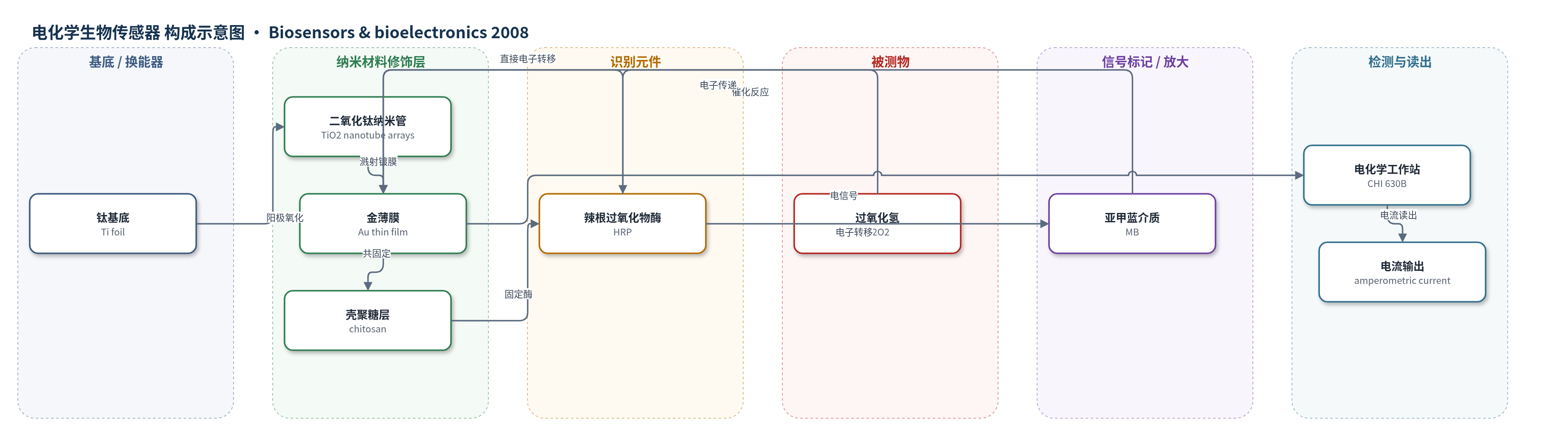
点击图片查看大图 · 依据论文自动绘制
传感器类型
电化学生物传感器
检测对象
过氧化氢(hydrogen peroxide, H2O2),样品基质为0.1 mol/L磷酸盐缓冲液(PBS)
检测原理
固定于金修饰二氧化钛纳米管阵列上的HRP作为识别与催化元件,H2O2与HRP(Fe3+)反应生成Compound I,随后Compound I从电极获得电子形成Compound II,并进一步还原再生为HRP(Fe3+),从而产生还原电流。金薄膜增强TiO2纳米管阵列的电导率,促进HRP与电极间的直接电子转移;亚甲蓝(MB)作为电子介质,通过HRP(ox)+MB(red)→HRP(red)+MB(ox)和MB(ox)+e−→MB(red)加速电子传递,放大电流。在−0.6 V恒电位下,H2O2浓度升高使稳态还原电流增大,实现电化学检测。
检测灵敏度
LOD: 2 × 10⁻⁶ mol l−1;线性范围: 5 × 10⁻⁶–4 × 10⁻⁴ mol l−1;R^2 = 0.996
效应效果
该传感器响应迅速,加入H2O2后5 s内可达到稳态电流的95%以上。在优化条件下,H2O2线性范围为5×10⁻⁶至4×10⁻⁴ mol/L,相关系数R^2=0.996,检出限为2×10−6 mol/L。传感器稳定性良好,4 ℃ PBS中保存21 d后仍保留95%初始电流响应;对3×10⁻⁵ mol/L H2O2连续测量10次的相对标准偏差为3.75%。与表中其他HRP或血红蛋白基H2O2生物传感器相比,该传感器在低检出限和长期稳定性方面表现优异。作者认为其制备简单、成本低、响应快、灵敏度高,适用于药物、临床和工业领域H2O2检测。
传感器的构成
- 基底电极:钛箔(Ti foil),经酸蚀与阳极氧化,提供导电基底并原位生长纳米管。
- 纳米管修饰层:二氧化钛纳米管阵列(TiO2 nanotube arrays),由DMSO/2% HF阳极氧化形成,提供大比表面积固定基质。
- 导电增强层:金薄膜(Au thin film),氩等离子体溅射沉积,提高电导率与电子转移。
- 固定基质:壳聚糖(chitosan),与HRP共固定,辅助固定酶并维持生物活性。
- 识别催化元件:辣根过氧化物酶(HRP),催化H2O2还原并传递电子。
- 电子介质:亚甲蓝(MB),在电解液中介导电子转移,放大电流信号。
- 缓冲电解液:0.1 mol/L磷酸盐缓冲液(PBS),提供pH 6.0酶反应环境。
中文摘要
本研究报道了一种基于辣根过氧化物酶(HRP)与壳聚糖共固定于金修饰二氧化钛纳米管阵列的过氧化氢(H2O2)生物传感器。首先通过阳极氧化法在钛基底上直接生长二氧化钛纳米管阵列,随后采用氩等离子体溅射技术在纳米管阵列表面均匀沉积金薄膜。扫描电镜(SEM)和能量色散X射线光谱(EDS)用于表征所制备金修饰二氧化钛纳米管阵列的形貌与组成。循环伏安法和计时电流法用于研究并优化电化学生物传感器性能,并系统考察了pH、施加电极电位、电子介质亚甲蓝(MB)以及钛基底阳极氧化时间对传感器的影响。电化学测量表明,金修饰二氧化钛纳米管阵列为HRP固定提供了优良基质;优化后的传感器在H2O2检测中表现出宽线性、低检出限、高稳定性和良好重现性。在优化条件下,H2O2检测线性范围为5×10⁻⁶至4×10⁻⁴ mol/L,检出限为2×10−6 mol/L(S/N=3)。
英文摘要
In this study, we report on a promising H(2)O(2) biosensor based on the co-immobilization of horseradish peroxidase (HRP) and chitosan onto Au-modified TiO(2) nanotube arrays. The titania nanotube arrays were directly grown on a Ti substrate using anodic oxidation first; a gold thin film was then uniformly coated onto the TiO(2) nanotube arrays by an argon plasma technique. The morphology and composition of the fabricated Au-modified TiO(2) nanotube arrays were characterized by scanning electron microscopy (SEM) and energy-dispersive X-ray spectroscopy (EDS). Cyclic voltammetry and chronoamperometry were used to study and to optimize the performance of the resulting electrochemical biosensor. The effect of pH, applied electrode potential, the presence of the electron-mediator methylene blue, and the anodic oxidation time of the Ti substrate on the electrochemical biosensor has been systemically studied. Our electrochemical measurements show that the Au-modified TiO(2) nanotube arrays provide excellent matrices for the immobilization of HRP and that the optimized electrochemical biosensor exhibits long linearity, a low detection limit, high stability and very good reproducibility for the detection of H(2)O(2). Under the optimized conditions the linearity of the developed biosensor for the detection of H(2)O(2) is observed from 5 x 10(-6) to 4 x 10(-4) moll(-1) with a detection limit of 2 x 10(-6) moll(-1) (based on the S/N=3).