组成图示
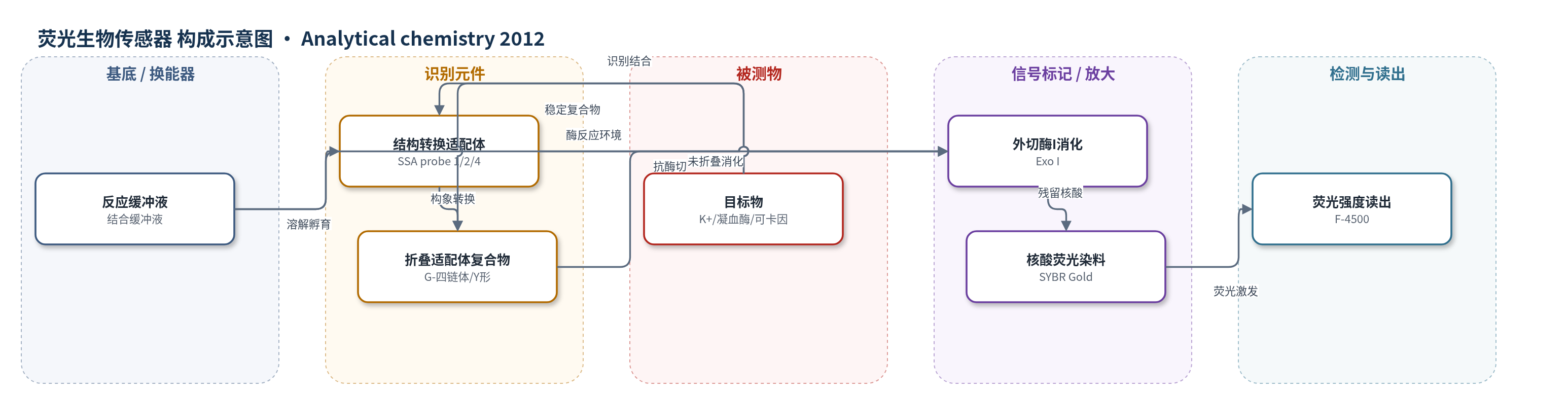
点击图片查看大图 · 依据论文自动绘制
传感器类型
荧光生物传感器
检测对象
钾离子(K+)、凝血酶(thrombin)、可卡因(cocaine);样品基质为尿液、血清及掺假物(糖、面粉、小苏打、胡椒)。
检测原理
目标物与结构转换适配体(SSA)特异性结合后,诱导适配体由随机卷曲单链折叠为 G-四链体或 Y 形等稳定二级结构。随后加入外切酶 I(Exo I),该酶优先从末端消化未折叠单链适配体,而目标-适配体复合物因结构致密、抗酶切,得以保留。残留完整适配体的量随目标浓度增加而增加。SYBR Gold 作为核酸荧光染料插入残留双链/折叠核酸中产生强荧光,但不能结合被消化成核苷酸单磷酸(dNMPs)的片段,因此荧光强度与目标浓度成正比。该策略以核酸酶选择性消化作为信号门控和放大机制,无需标记适配体,即可实现离子、蛋白和小分子的无标记荧光检测。
检测灵敏度
K+: LOD: 20 μM;动态范围: more than 3 orders of magnitude;R^2 = 0.979(whole detection range);R^2 = 0.998(low micromolar concentrations);缩短条件 LOD: 20 μM;R^2 = 0.954。凝血酶: 线性范围: nanomolar concentrations;R^2 = 0.96。可卡因: LOD: 5 μM (S/N = 3)。
效应效果
选择性良好:500 倍过量 Na+ 下仍可检测 20 μM K+;Li+、NH4+、Mg2+ 基本无干扰,Ca2+ 仅约 20% 荧光增加,1 mM K+ 约 150%。凝血酶检测中 BSA 和随机 ssDNA 无响应;可卡因检测中 BE、EME 及随机 ssDNA 无响应。实际样品中,500 μM 可卡因在尿液和血清的 (F−F0)/F0 分别为 1.6 和 1.5,与标准一致,并耐受糖、面粉、小苏打、胡椒掺假;680 nM 凝血酶加标血清荧光比缓冲液标准低 7% 以内。真实尿液和血清 K+ 结果平均为 ICPMS 值的 84 ± 8%。最短检测时间 25 min,作者认为其通用、低成本、适合高通量平行分析。
传感器的构成
- 识别元件:结构转换适配体(SSAs,probe 1/2/4),与K+、凝血酶或可卡因结合后折叠为G-四链体或Y形结构,抵抗核酸酶消化
- 核酸酶门控元件:外切酶I(Exo I),选择性消化未折叠单链适配体,保留目标结合态适配体,实现信号门控
- 信号标记物:SYBR Gold核酸荧光染料,插入残留完整核酸产生强荧光,不结合消化产物dNMPs
- 反应介质:结合缓冲液(K+缓冲液:50 mM Tris-HCl、2 mM MgCl2、pH 8.3;凝血酶缓冲液:100 mM Tris、140 mM NaCl、20 mM MgCl2、20 mM KCl;可卡因缓冲液:25 mM Tris-HCl、0.15 M NaCl、2 mM MgCl2、pH 8.0)
- 样品基质:尿液、血清或掺假物(糖、面粉、小苏打、胡椒)中的目标物,经稀释、过滤或萃取后参与反应
- 读出装置:F-4500荧光分光光度计,测量SYBR Gold荧光强度
中文摘要
本文提出一种基于结构转换适配体(SSAs)、SYBR Gold 和外切酶 I 的无标记荧光传感策略,用于检测无机离子、蛋白质和小分子等广泛目标。该方法利用目标结合后 SSAs 折叠形成 G-四链体或 Y 形等二级结构,使其比未折叠单链状态更耐核酸酶消化这一现象。核酸酶反应后残留适配体的量与目标浓度成正比,而 SYBR Gold 只能结合完整核酸、不能结合其消化产物核苷酸单磷酸(dNMPs),因此荧光强度与目标浓度成正比。以钾离子(K+)为例,该荧光检测具有灵敏、选择性好和操作简便的特点,在 500 倍过量 Na+ 存在下仍可检测 20 μM K+。作者进一步将该策略推广至凝血酶和可卡因的特异性检测,并在尿液、血清及掺假样品中验证,结果与真实值吻合良好。与多局限于 G-四链体结构的方法相比,该方法对适配体及其目标复合物的结构要求更低,因而适用于更多目标,并可进一步扩展至其他检测平台或用于多目标高通量平行分析。
英文摘要
We have demonstrated a label-free sensing strategy employing structure-switching aptamers (SSAs), SYBR Gold, and exonuclease I to detect a broad range of targets including inorganic ions, proteins, and small molecules. This nearly universal biosensor approach is based on the observation that SSAs at binding state with their targets, which fold into secondary structures such as quadruplex structure or Y shape structure, show more resistance to nuclease digestion than SSAs at unfolded states. The amount of aptamer left after nuclease reaction is proportional to the concentrations of the targets and in turn is proportional to the fluorescence intensities from SYBR Gold that can only stain nucleic acids but not their digestion products, nucleoside monophosphates (dNMPs). Fluorescent assays employing this mechanism for the detection of potassium ion (K(+)) are sensitive, selective, and convenient. Twenty μM K(+) is readily detected even at the presence of a 500-fold excess of Na(+). Likewise, we have generalized the approach to the specific and convenient detection of proteins (thrombin) and small molecules (cocaine). The assays were then validated by detecting K(+), cocaine, and thrombin in urine and serum or cutting and masking adulterants with good agreements with the true values. Compared to other reported approaches, most limited to G-quadruplex structures, the demonstrated method has less structure requirements of both the SSAs and their complexes with targets, therefore rending its wilder applications for various targets. The detection scheme could be easily modified and extended to detection platforms to further improve the detection sensitivity or for other applications as well as being useful in high-throughput and paralleled analysis of multiple targets.