组成图示
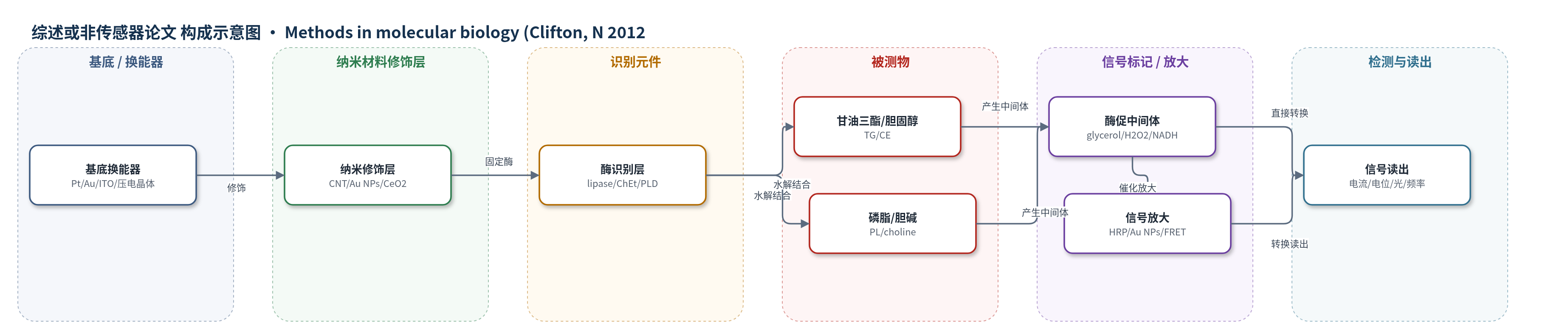
点击图片查看大图 · 依据论文自动绘制
传感器类型
综述或非传感器论文
检测对象
甘油三酯(triglycerides, TG)、胆固醇/胆固醇酯(cholesterol/cholesterol esters)、磷脂(phospholipids)、胆碱(choline)、磷脂酶D/A2活性(phospholipase D/A2 activity)、有机磷农药(dimethoate);样品基质包括血清、血液、牛奶、食品(蛋、肉)、鱼体、缓冲液、菜籽等。
检测原理
脂肪酶/磷脂酶生物传感器通常以酶为识别元件:lipase水解甘油三酯生成甘油和脂肪酸,ChEt水解胆固醇酯生成胆固醇,PLD水解磷脂生成胆碱。随后甘油经glycerol dehydrogenase/glycerol kinase/glycerol-3-phosphate oxidase级联产生NADH或H2O2;ChOx氧化胆固醇产生H2O2;choline oxidase氧化胆碱产生H2O2。H2O2可在电极上电化学氧化/还原,或被HRP催化显色;脂肪酸引起pH变化可被ISFET/电容检测;质量或界面变化可被压电/电容/液晶/FRET/Au NPs聚集读出。多酶级联、纳米材料电子传递和FRET/纳米颗粒聚集提供信号放大,信号随被测物浓度增加而增强。
检测灵敏度
LOD: 81 ng/mL dimethoate;线性范围: 0.167–1.34 μg/mL dimethoate;LOD: 0.28 mM triglycerides;线性范围: 0.56–2.25 mM triglycerides;sensitivity: 4.28 × 10⁻⁴ mA/(mg·dL) triglycerides;LOD: 19.4 mg/dL cholesterol;线性范围: 100–400 mg/cholesterol;LOD: 1.0 × 10⁻⁷ M choline;线性范围: 5.0 × 10⁻⁷–7.0 × 10⁻⁵ M choline;LOD: 0.5 ng/mL phospholipase A2;线性范围: 0–150 U/mL lipoprotein-associated phospholipase A2;sensitivity: 1.45 nA/U
效应效果
综述报道的传感器多具快速响应与可重复使用:TG酶电极10 s响应、70 d内200次;PANI/SWCNT 12 s、13周;nano-CeO2 20 s、3个月;胆固醇传感器30 s、玻璃珠300次、PVC反应池>100 d/200次;无线鱼体监测>40 h;PLD传感器18个月600次;液晶毒素<5 pg、AuNP-脂体700 pM。选择性来自酶/抗体/脂体识别;作者认为相比HPLC/FIA,生物传感器更小型、便携、可在线/体内,适合临床与食品环境。
传感器的构成
- 基底/换能器:Pt、Au、ITO、碳糊电极、丝网印刷电极、LiNbO3压电晶体、石英晶体、ISFET、光纤、液晶界面,用于承载识别层并转换电、声、光或电容信号。
- 纳米材料修饰层:CNT、SWCNT、Au NPs、Fe3O4、nano-CeO2、纳米铱、普鲁士蓝、聚苯胺、溶胶-凝胶,用于增强电子传递、固定酶或放大信号。
- 识别元件:lipase、phospholipase D、phospholipase A2、ChEt、ChOx、glycerol dehydrogenase、glycerol kinase、glycerol-3-phosphate oxidase、choline oxidase、HRP、抗体、脂体或磷脂单层,用于特异性水解或结合目标物。
- 酶促中间体:glycerol、fatty acids、H2O2、NADH、O2、choline、pH变化,作为识别事件到电信号/光信号的转换介质。
- 固定/交联剂:glutaraldehyde、BSA、EDC/NHS、重氮化、吸附、包埋、交联,用于将酶或生物元件固定在基底上。
- 信号读出:电流、电位、电导、频率、电容、荧光/FRET、液晶取向信号,由电化学工作站、ISFET、压电仪或光学系统读取。
中文摘要
生物学、电子学与纳米技术的进展推动了生物传感器的发展。生物传感器由生物识别元件和传感换能元件组成,在生物技术、药学、食品和环境等领域日益重要。脂肪酶和磷脂酶可催化脂肪、油脂和磷脂的水解,广泛用于食品、油脂化工、可降解聚合物、洗涤剂等行业;在医学中,它们可作为诊断工具检测血液样本中甘油三酯、胆固醇和磷脂水平。因此,开发脂肪酶和磷脂酶生物传感器对临床诊断具有重要意义。本章介绍生物传感器的基本概念,并综述脂肪酶和磷脂酶生物传感器的最新进展,重点涵盖酶固定化、纳米材料修饰、电化学/光学/压电换能机制,以及甘油三酯、胆固醇、磷脂和磷脂酶活性的检测应用。
英文摘要
Recent advances in the field of biology, electronics, and nanotechnology have improved the development of biosensors. A biosensor is a device composed of a biological recognition element and a sensor element. Biosensor applications are becoming increasingly important in areas such as biotechnology, pharmaceutics, food, and environment. Lipases and phospholipases are enzymes which have been used widely in food industry, oleochemical industry, biodegradable polymers, detergents, and other applications. In the medical industry, lipases and phospholipases are used as diagnostic tools to detect triglycerides, cholesterol, and phospholipids levels in blood samples. Therefore, the development of lipase and phospholipase biosensors is of paramount importance in the clinical area. This chapter introduces the reader into the preliminaries of biosensor and reviews recent developments of lipase and phospholipase biosensors.