组成图示
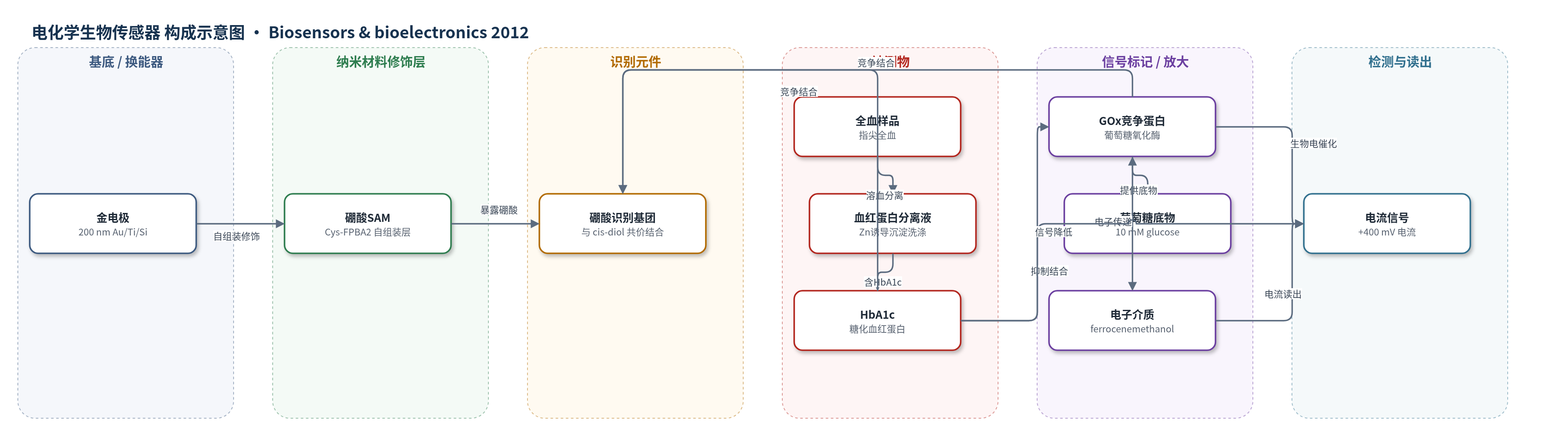
点击图片查看大图 · 依据论文自动绘制
传感器类型
电化学生物传感器
检测对象
糖化血红蛋白(HbA1c,glycated hemoglobin A1c);样品基质:全人血(指尖血,溶血后 Zn 诱导分离血红蛋白)
检测原理
Cys-FPBA2 在金表面形成含硼酸基团的自组装单分子层。硼酸基团可与糖化蛋白糖基的顺式二羟基形成共价结合,从而识别 HbA1c。全血先经溶血,再用 ZnCl2 诱导血红蛋白沉淀,并通过硝酸纤维素膜离心洗涤去除葡萄糖和血清糖蛋白等干扰物。分离后的血红蛋白样品中,HbA1c 与固定浓度的 GOx 竞争结合硼酸表面。HbA1c 浓度越高,占据硼酸位点越多,GOx 结合越少。GOx 催化葡萄糖,经 ferrocenemethanol 介导电子传递,在电极上产生生物电催化电流。循环伏安在 +400 mV 记录电流,电流随 %HbA1c 升高而降低,在 4.5–15% 范围内线性。信号放大来自 GOx 酶催化。
检测灵敏度
线性范围: 4.5–15%(HbA1c/total hemoglobin,分离血红蛋白样品);灵敏度: 0.14 μA/%HbA1c(R^2 = 0.99);灵敏度: 0.1 μA/%HbA1c(R^2 = 0.96)
效应效果
该传感器通过 Zn 诱导血红蛋白沉淀和离心洗涤去除全血中葡萄糖及血清糖蛋白干扰;三次洗涤后葡萄糖由 2.9 μg/ml 降至 0.7 μg/ml,较 40 倍稀释溶血液对照 19.3 μg/ml 降低约 96.4%。Bradford 显示分离血红蛋白总蛋白较溶血液低 16 μg/ml,接近纯化 HbA1c 试剂(仅高约 4 μg/ml)。在分离血红蛋白样品中线性范围 4.5–15%,灵敏度 0.14 μA/%HbA1c,R^2=0.99;HbA1c 参考样品灵敏度 0.1 μA/%HbA1c,R^2=0.96。未处理溶血液无浓度依赖信号,说明前处理必要。HbA1c 参考试剂盒与分离血红蛋白样品变异系数分别约 4% 和 6%。方法无需抗体、染料或荧光标记,可应用于全血 %HbA1c 及其他糖蛋白检测。
传感器的构成
- 基底/工作电极:Ti 打底 20 nm 的 Si 晶圆上蒸镀 200 nm Au,作为电化学换能器电极
- 修饰层:Cys-FPBA2 自组装单分子层(SAM),由 cystamine 与 3-formylphenylboronic acid(FPBA)经席夫碱偶联,提供硼酸基团
- 识别元件:硼酸基团,通过顺式二羟基(cis-diol)与糖化蛋白糖基形成共价结合,识别 HbA1c
- 竞争信号蛋白:葡萄糖氧化酶(GOx),作为糖蛋白与 HbA1c 竞争结合硼酸表面,并催化产生电流
- 酶底物:葡萄糖(glucose),GOx 催化底物,驱动生物电催化反应
- 电子转移介质:ferrocenemethanol,介导 GOx 催化电子传递至电极
- 缓冲/洗涤:PBS(pH 7.2),用于洗涤非特异结合并维持反应环境
中文摘要
我们开发了一种用于全人血糖尿病诊断的电化学糖化血红蛋白(HbA1c)生物传感器,其基于糖化蛋白之间的竞争性结合反应。迄今为止,尚无研究报道一种简单且准确的电化学生物传感器用于全血中 HbA1c 的定量,因为在全血中很难将 HbA1c 与大量血红蛋白及其他成分正确区分。为检测糖化血红蛋白,我们使用硼酸修饰电极,其硼酸基团可与糖化蛋白糖基部分的顺式二羟基形成共价键。为实现准确的 HbA1c 生物传感,我们首先去除血红蛋白以外的血液成分,如糖化蛋白和血糖,因为它们会通过顺式二羟基相互作用与硼酸修饰表面反应,从而干扰基于硼酸的 HbA1c 竞争分析。血红蛋白分离后,目标 HbA1c 与预定浓度的葡萄糖氧化酶(GOx)在硼酸修饰电极上进行竞争反应,使 HbA1c 在分离血红蛋白样品中 4.5–15%(HbA1c/总血红蛋白)范围内线性检测。该范围覆盖了糖尿病所需的临床参考范围。因此,所提方法可用于测量全人血中 %HbA1c,也可应用于测量含有外周糖基的各种糖化蛋白浓度。
英文摘要
We developed an electrochemical glycated hemoglobin (HbA(1c)) biosensor for diagnosing diabetes in whole human blood based on the competitive binding reaction of glycated proteins. Until now, no studies have reported a simple and accurate electrochemical biosensor for the quantification of HbA(1c) in whole blood. This is because it is very difficult to correctly distinguish HbA(1c) from large amounts of hemoglobin and other components in whole blood. To detect glycated hemoglobin, we used electrodes modified with boronic acid, which forms a covalent bond between its diol group and the cis-diol group of the carbohydrate moiety of glycated proteins. For accurate HbA(1c) biosensing, we first removed blood components (except for hemoglobin) such as glycated proteins and blood glucose as they interfere with the boronate-based HbA(1c) competition analysis by reacting with the boronate-modified surface via a cis-diol interaction. After hemoglobin separation, target HbA(1c) and GOx at a predetermined concentration were reacted through a competition onto the boronate-modified electrode, allowing HbA(1c) to be detected linearly within a range of 4.5-15% of the separated hemoglobin sample (HbA(1c)/total hemoglobin). This range covers the required clinical reference range of diabetes mellitus. Hence, the proposed method can be used for measuring %HbA(1c) in whole human blood, and can also be applied to measuring the concentration of various glycated proteins that contain peripheral sugar groups.